Joining cable when fitting a new log paddlewheel unit

MJWB

Well-Known Member
Joined
24 May 2019
Messages
309
Location
Yorkshire coast
Visit site
I have a NASA paddlewheel log unit in situ when I bought the boat a couple of years ago. The paddle wheel axle mounting points failed whilst I was removing the old axle to replace the paddlewheel.
The boat came with a new paddlewheel unit as a spare with cable attached.
Can I join the cable on the new unit to the existing cable already in situ? That is behind glued headlining.
If I can join the cables, how do I do so please?
From a non-electrical type of person.
Many thanks.
 
Yes, you can certainly join the cables. I would probably use crimp butt connectors and, as it may be in the bilge, I'd also use adhesive lined shrink wrap over the top.
Get a reasonable ratchet crimper and you can usually buy small quantities of crimp connectors on ebay.
Otherwise find someone with the right equipment and they'll do it for a pint, it's a 5 minute job.
 
If you are using small crimps to make the connections, the neat way to do it is offset the join for each wire so you don't have one big lump for the heatshrink to go over. Or use a little junction box with Wago 221 connectors as the wires are quite fine and even the red crimps are too big really.
 
I would solder the joints, staggered, as above. Heat shrink on each joint, then another shrink over the whole lot.

The unit works with pulses, so cable length is less important than say a depth sounder, where, I understand, length is more important.
 
Last edited:
I would solder the joints, staggered, as above. Heat shrink on each joint, then another shrink over the whole lot.

The unit works with pulses, so cable length is less important than say a depth sounder, where, I understand, length is more important.

Quick question. Never done soldering before but have bought a cheap kit. Question. What type of flux should I use please?
 
There is flux cored solder, which, if the wire is not corroded, usually works for electrics. If in doubt, I use some paste stuff from the local B&Q..
 
Hang on, aren’t the nasa paddle wheel units connected with a coax cable? Surely that would be better joined using suitable coax connectors? The nasa ‘instrument pod’ comes with two coax extension leads that only have a connector at one end to allow you to pass the lead thru a gland but include coax connectors to complete the join to the sensor cables.
 
Hang on, aren’t the nasa paddle wheel units connected with a coax cable? Surely that would be better joined using suitable coax connectors? The nasa ‘instrument pod’ comes with two coax extension leads that only have a connector at one end to allow you to pass the lead thru a gland but include coax connectors to complete the join to the sensor cables.
Tried that last weekend with F connectors. The cable is coax but the signal wire is not one solid wire such as in tv coax. It's just a small collection of very fine strands which are not robust enough to enter the centre piece of an F connector set. So I'm going to try solder and heat shrink. If that fails I'll look at adhesive crimp on butt connectors. Problem is the wire is so fine so how well these will work in crimp remains to be seen. So try solder first.
Thanks all for comments.
 
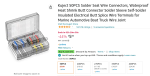
The solder heat shrink connectors (post 5) join and shrink seal the individual wires.

Before making these pass a larger section of adhesive filled heat shrink over everything, then wrap some silver foil over the ends of the cable braids, pass the larger piece heatshrink over and shrink wrap the lot.
 
Top