Jaw Jaw toggle assembly

I must be missing something here. How can I put a 10mm wire rope and thimble through a motor-cycle chain link? I'm utterly confused!

Maybe the answer lies in your statement "if you have the space for the parts." If I understand you correctly then I don't have the space.

]View attachment 81439 View attachment 81438

You don't put the rope and thimble through the chain, but link the two with a pair of steel strips and nuts & bolts.
 
Norman

I do appreciate you going to the effort you have. I've gone through this exercise before but a long time ago.

Just now I have been doing some calculations of elastic stretch of 7 X 19 cable and also forces on a rudder. the forces on the rudder can be found here:

https://www.phoenixmarinesolutions.co.uk/themes/phoenixmarine/calc.html

My rudder is 1.4M height
Average width .4M
Speed 8 (max)
My rudder post is not vertical (let's ignore that)

As far as elasticity of wire rope is concerned I've used the formula here

View attachment 81432

I'll go over my figure again but working on 8 ft (6mm wire rope) I found the stretch was .21384 of an inch. As there are two cables there would be .42748 inch at the sprocket and therefore with a 32 in wheel and 4 inch sprocket 3.42 inches slack at the fingertips.

Now where have I gone wrong?

(I'll go over your calculations too to see if they give similar results)

I better do some work but I'll be back.:encouragement:

You have gone wrong by doubling the stretch. Only one cable is in tension at any time and you are never going to have forces on the rudder rudder trying to turn it both ways at once. Another point is that if you are sailing in conditions where there is a constant sideways force on the rudder a bit of cable stretch does not matter at all, its all one way. In such circumstances you should adjust your sail trim. In a quartering sea where the boat has alternate port and starboard forces on the rudder stretch does come into play, but you will not notice it if you are hand steering as you will anticipate the wave action and steer to keep the boat going as straight as possible. What looks like a big issue on paper is not really of any great importance in practice.

A bit of free movement at the wheel rim is not a problem. On my boat with twin wheels, long 6mm cables and convoluted wire rope runs over three pulleys each side there is an inch or so free play at the wheel rims without moving the rudder. I could probably adjust that out by tightening the fittings at the quadrant but Its not a problem and may even be helping the autopilot by allowing it to start moving the quadrant before having to overcome the inertia of the two wheels.
 
Last edited:
You have gone wrong by doubling the stretch. Only one cable is in tension at any time.

In a rough sea I might have it hard to starboard stretching the cable then immediately switch hard to port and stretch the other cable. Of course the yacht would have to be steered by turning the wheel one way then the other.

Right now I'm trying to work out the stretch wit (say) a 1000lb force on the rudder.
 
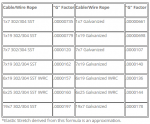
Elastic Stretch

Elastic Stretch is the actual physical elongation of the individual wires under load. The elastic stretch can be calculated by using the following formula*:

E = (W x G) / D2

Where:
E = Elastic Stretch, as a % of Length**
W = Weight of Load, in pounds
D = Diameter of cable, in inches (I am going to use ¼ inch)
G = See Chart Below

Screenshot_2019-11-04 How to Calculate Wire Rope and Cable Stretch(1).png

Calculated by using the following formula*:

E = (W x G) / D2

% stretch = 1000 X .0000162/.25²
= 1000 X .0000162/.0625
=.2592%

If the cable is 8ft then it will stretch 8 X 12 X .2592%
= 1/4 inch

that would translate to about 2 inch at the fingertips. If I want to now correct direction by turning the wheel the other way the other cable will stretch 2 inches. Total 4 inches.
 
Last edited:
The issue here is whether 10mm cable is justified given the difficulty connecting it to the chain. Quite clearly the weakest link in the system using 10mm cable would be the chain and its relativly small link cross section. The Phoenix Marine calculator is intended to be used to size the power steering ram so that it is capable of holding the rudder at full lock, at maximum speed. You are not going to be doing that whilst sailing. Even if your rudder is a completely unbalanced one I don't see any need to use 10mm cables, which will be a positive disadvantage if they have to turn corners over a pulley system.
 
The issue here is whether 10mm cable is justified given the difficulty connecting it to the chain. Quite clearly the weakest link in the system using 10mm cable would be the chain and its relativly small link cross section. The Phoenix Marine calculator is intended to be used to size the power steering ram so that it is capable of holding the rudder at full lock, at maximum speed. You are not going to be doing that whilst sailing. Even if your rudder is a completely unbalanced one I don't see any need to use 10mm cables, which will be a positive disadvantage if they have to turn corners over a pulley system.

The chain most certainly wouldn't be the weakest link (One KN = 100kg) I am using competition motorcycle chain which is an overkill.

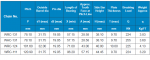
Screenshot_2019-11-04 GBChainTC_03 pdf.png

I am using 8 inch pulleys so there is no problem with the cable turning corners.
 
Last edited:
Very low tension? Really!! (You can't be serious?) :eek:

Why don't you google something like rudder torque calculation

I'm very serious, because the whole of your calculations are flawed.

You've used the Phoenix Marine Solutions calculator, which tells you to "Use the Rudder Torque in Kgm ....", but you seem to have ignored this and used the load instead. Using your suggested figures (in post 17), the rudder torque is 43.5kgm.

Let's look at some of your assumptions...

I'll go over my figure again but working on 8 ft (6mm wire rope) I found the stretch was .21384 of an inch. As there are two cables there would be .42748 inch at the sprocket and therefore with a 32 in wheel and 4 inch sprocket 3.42 inches slack at the fingertips.

Now where have I gone wrong?

To start with, only one cable is in tension at any one time. So there's no need to double whatever stretch you think there might be.

Suppose I'm in a gale and start surfing at 12 knots the load on the rudder would be 650kg. The mechanical advantage of the quadrant would be about 8:1 and the mechanical advantage of the pedestal gear/wheel would be about 10 so total 18 Therefore load on the wheel would 650/18 = 36kg

That sounds about right to me but I'm rushing

This is also wrong. You don't add mechanical advantages, you multiply them. So if your quadrant has 8:1 and your wheel has 10:1, the total mechanical advantage is 80:1 and in your calculation the load on the wheel rim would be about 8kg.

Calculated by using the following formula*:

E = (W x G) / D2

% stretch = 1000 X .0000162/.25²
= 1000 X .0000162/.0625
=.2592%

If the cable is 8ft then it will stretch 8 X 12 X .2592%
= 1/4 inch

that would translate to about 2 inch at the fingertips. If I want to now correct direction by turning the wheel the other way the other cable will stretch 2 inches. Total 4 inches.

You seem to have switched back to Imperial units, and assume that the wire has a load of 1000lbs on it. It doesn't.

The rudder torque is 43.5kgm, based on your figures, as I mentioned earlier. You haven't said how big your quadrant is, but let's assume the wire attaches at 300mm from the rudder post. To resist the 43.5kgm torque, you'd need to apply 145kg force on the wire to resist the rudder torque. That's about 320lbs in your money. So your % stretch would be 320 X .0000162/.25² = 0.0829%. On an 8ft cable this gives 0.08" stretch, which is negligible. And, as mentioned before, you don't need to double it just because you have two cables.

The chain most certainly wouldn't be the weakest link (One KN = 100kg) I am using competition motorcycle chain which is an overkill.

View attachment 81446

The chain strength table you've included isn't for "competition motorcycle chain", it's for "straight sidebar welded steel chain" which is absolutely giant! Are you really using chain with a 19mm pin diameter??

I'm afraid you need to sit down in a quiet room for a while and get your act together.
 
Last edited:
coopec;6961301 [I said:
Suppose I'm in a gale and start surfing at 12 knots the load on the rudder would be 650kg. The mechanical advantage of the quadrant would be about 8:1 and the mechanical advantage of the pedestal gear/wheel would be about 10 so total 18 Therefore load on the wheel would 650/18 = 36kg[/I]

I made a mistake here. Instead of adding the mechanical advantage of the quadrant to the mechanical advantage of the wheel I should have multiplied them.
So if the load on the rudder is 650kg the weight on the wheel will be 650 /80 = 8.125 kg

Here is an interesting article which explains yacht steering loads.

https://www.cruisingworld.com/how/rudder-loads-modern-cruiser/
 
When you compare the stretch of a 6mm wire rope with at of a 10mm wire rope (as recommended by the experts) the amount of stretch is quite significant.

Screenshot_2019-11-05 Cable Wire Rope Stretch - Loos Co , Inc .png

Screenshot_2019-11-05 Cable Wire Rope Stretch - Loos Co , Inc (1).png

With 6mm cable I will have 5.2 inch wheel slack at the fingertips but with 10 mm wire rope only 2.02 inches.
 
Last edited:
When you compare the stretch of a 6mm wire rope with at of a 10mm wire rope (as recommended by the experts) the amount of stretch is quite significant.


With 6mm cable I will have 5.2 inch wheel slack at the fingertips but with 10 mm wire rope only 2.02 inches.

Utterly wrong!
 
Top