Itchenor.....nostalgia

Wansworth

Well-Known Member
Joined
8 May 2003
Messages
38,529
Location
SPAIN,Galicia
Visit site
Anybody remember the name of the harbour master at itchenor back in 1964 Hand or Hard?

Hused to have a flaoting office on the hard at Itchenor.His launch is still in service.I recall in Itchenor reach there was one boat an Excalibour class built in Grp almost all the other boats were wood.
 
hmasterhand.jpg


Lt.Commander Freddie Hard, the first Conservancy Harbourmaster 1971-4.

From the excellent 'Chichester Harbour - A History'

by John Reger,

published by Phillimore & Co Ltd,

Shopwyke Manor Barn
Chichester
West Sussex
England
PO20 6BG
 
As above - Freddie Hard - I used to work for him and a very good boss he was too.
That goes for the Assistant Harbour Master at the time, Gerald something or other as well - two good and very able chaps.....
 
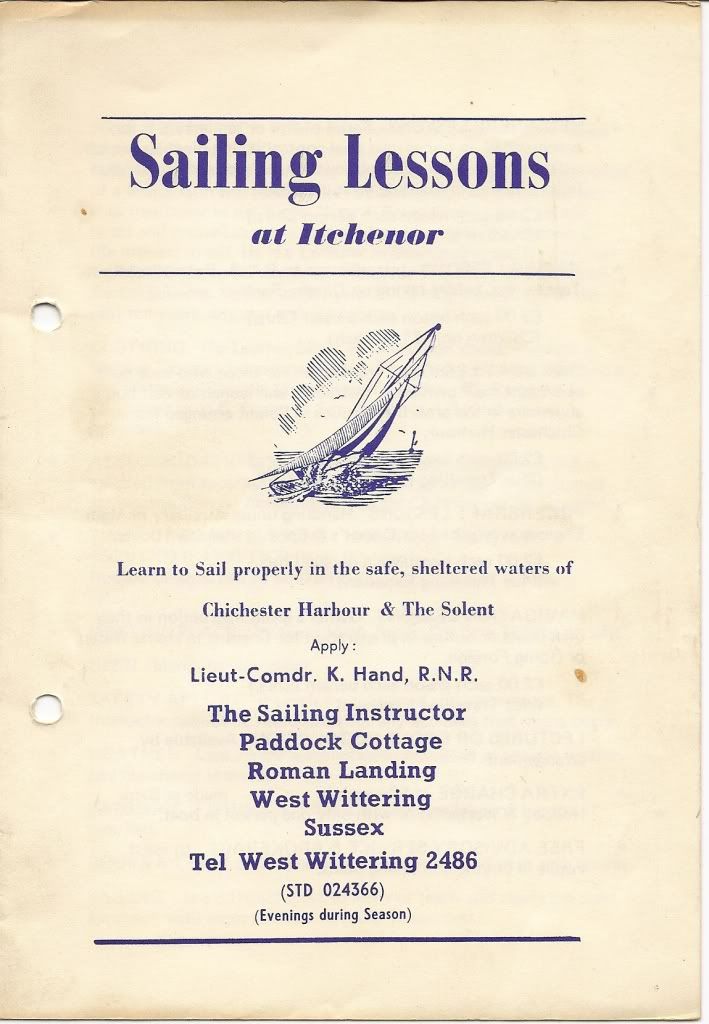
Lt. Cmdr Hand was the "mad sailing instructor" at Itchenor. .... "Without fear of capsize"


I didnt know he gave sailing lessons.....there was on old chap who gave classess;I heard him shouting at his students..."YOU WOULDNT STAND ON THE BONNET OF A CAR,WOULD YOU".many of his students were French:
 
Same vicinity, similar era, different query...

Here's an extraordinarily obscure question for anyone who knew the upper reaches of Chichester Harbour thirty years ago:

Up at the top of the Bosham Channel, where the water was (and doubtless still is) too shallow for even a bilge keeler to float for longer than about ninety minutes either side of high tide, there was usually a funny little vessel called 'Ugly Duckling', moored.

I'd heard she was a 'chain-layer'. My family lived on the Chidham peninsular and most days, Ugly Duckling was the only boat I could see from there. I never saw 'chain-laying' in action, so I never knew what the craft did. It sometimes haunts my memory though.

For a year or two there was a Westerly moored up there too, not a particularly small one either, so heaven knows why the owner chose that spot; she was high and dry for most of every day, and miles from the nearest dinghy slip.

I wonder what happened to that sturdy old chain-layer? I once deliberately punted into it in my dinghy, purely from delinquent adolescent instinct. It didn't budge an inch, though I don't think my mast was ever quite the same again. :o
 
Dancrane,

I was in playing around in the harbour and Solent then, and went on 3 courses roughly around 1972-5 at Cobnor, but I don't remember those craft; I do remember a very nice Folkboat called Aurora, and of course the barge Pride of Sheppey which we had our meals on.

I looked up Ugly Duckling / chain layer in 'Chichester Harbour - a History' but no joy.

I did find an entry re. the floating Harbour Office, a converted ships' lifeboat:

" At this time ( 1963 ) the Harbour Master, his staff & workshop were cramped into a converted ships' lifeboat on the Hard. The Harbour Masters' secretary, Ann Fox, remembers how sea-sick she felt at her desk during high tides & stormy weather and on more than one occasion she had to abandon ship !"

" The harbour authority, Chichester City Council,decided to solve the problem by buildng brand new accomodation right on the hard - see photo below. There was uproar in the village- and beyond - at the insensitivity of the City Council in interfering with the free use of the hard and ruining the view across the water to bosham and the Downs. They were forced to back down and demolish the building. Eventually 'Ferryside' was purchased for the City Councils' Harbour Office which was soon transferred to the new Harbour Conservancy in 1971.
chiharbouroffice.jpg
 
Last edited:
Thanks SJ, that's funny. The thought of the harbourmaster's staff crammed into a pitching little launch, reminds me of the Alec Guiness film, Barnacle Bill (A.K.A. All at Sea).

The Ugly Duckling was a catamaran in form - a couple of square-ended steel tanks perhaps fifteen feet long, held together with a hefty winch on the deck. I bet it's still in use somewhere in the harbour - it looked indestructible!

I remember sailing past the semi-permanently moored Gerald Daniel every time I sailed. For some reason I was petrified of being swept out to sea (or perhaps my mother was) - hence I was always delivered to the dinghy park several hours before high water, so that as soon as I wanted to return to Bosham Quay, I wouldn't have to fight the ebb.

That meant all my adventures to the south involved lots of very slow flat tacks against the flood, just to get to Cobnor! :mad:

Note to self...make sure next dinghy has oars...
 
Last edited:
Dancrane,

that sounds rather like the thing used by Langstone SC ( which of course has access to Chichester harbour too ) - also the sort of kit which seems to end up at Emsworth Marina.

I used to wonder how a lot of aircraft kit like drop tanks, their trolleys and crash recovery tracked supports, ended up there and had assumed they must be from Thorney Island's days as an RAF base - and that's probably the case.

However I didn't know about Admiral Percy Gick then, I sometimes saw a parked Rolls Royce at the marina office in a spot marked 'The Admiral' and thought 'another stuffed shirt'.

I only discovered via his obituary in the Telegraph ( written by hs assistant Jenny Duxbury, quite a character in her own right ) that he was pilot of one of the Swordfish biplanes which attacked the Bismark, was the only RN officer to get a speeding ticket in his destroyer 'Daring' on the Suez canal, and later commanded HMS Bulwark including using the carrier to tow & salvage a blazing oil tanker, sharing the salvage prize money around the crew.

He became top of the Fleet Air Arm, with a personal Hunter jet fighter...

Admiral Percy Gick then built Emsworth Yacht Haven, literally with his own hands; I have ordered a secondhand copy of his book about that, which I'm looking forward to reading...
 
Fantastic! What a character. There ought to be a movie based on a life like that.

I used to take the train from Havant to Petersfield, to go to school. I was driven from our home at Chidham, past Southbourne and Emsworth along the old two-lane A27 to Havant station. The views over the water made going to school more bearable.

I hope to visit the harbours again this summer. It's been twenty years! :eek:
 
He had a fine sense of humour.I worked for him for a few months.One day he comes in saying anybody know anything about landscape gardening.Ah I thought that could be interesting so said yes.His landscape gardening involved digging holes and planting trees....those that line the entrance to the marina.He had very able second in command then back in the 60s...Major jefferies who was known as Major Mistake another interesting character
 
QUOTE=Seajet ...that sounds rather like the thing used by Langstone SC ( which of course has access to Chichester harbour too ) - also the sort of kit which seems to end up at Emsworth Marina.

I used to wonder how a lot of aircraft kit like drop tanks, their trolleys and crash recovery tracked supports, ended up there and had assumed they must be from Thorney Island's days as an RAF base - and that's probably the case.
QUOTE

A quick 'balloon flight' over Emsworth, courtesy of Google Earth, reminds me that distinctive individual vessels are easily recognisable from about 250' elevation. I'll find the Ugly Duckling if she's still afloat!

I drove round Thorney Island with my dad, just once, in about 1981. Very bleak and breezy it seemed, so we never returned. Is it still? I'd imagine its location could make such a spot extremely valuable to developers, if the RAF don't cling to the area.
 
Last edited:
Dancrane,

I expect Mogy knows this, but another tale about Admiral Percy Gick; he was put on 'anti-piracy' patrol in Chinese waters ( the original order from the Admiralty omitted the word 'anti' so he just had 'piracy orders' ! ), " The basic idea was, if anyone answered a query signal with gunfire, they got back 10 times as much", when asked by a gunnery type what to do, " Bu**er their Lordships, do what we always do !" - which earned a reprimand, " Not much when I add it to the others I've earned ! "

He was also first on scene and took command of relief operations when the earthquake hit Cephalonia, as ( the earthquake ) portrayed in the book & film 'Captain Correli's Mandolin'.
 
Last edited:
This Percy Gick sounds like another Horatio Hornblower, but with an outrageous streak of "never mind the rowlocks" in his personality.

I'll have to read his biography - it really sounds like the stuff of comically charismatic cinematic adaptation.
 
Dancrane,

I suspect a bit more of a Jack Aubrey than a Horatio Hornblower !

I don't know of a full biography, but Admiral Gick certainly deserves one and I'd love to see it; try a google of his name & 'the making of Emsworth Yacht Haven', you should at least come across his obituary by Jenny Duxbury - if no luck please let me know, meanwhile I hope to get his book soon, will let you know.

Andy
 
Mogy,

please stand by and I'll send details; From The Telegraph ( written by his assistant Jenny Duxberry ) -

----------------

Rear Admiral Philip Gick

12:01AM GMT 19 Jan 2002

REAR ADMIRAL PHILIP "PERCY" GICK, who has died aged 88, flew Swordfish aircraft in the early years of the Second World War; he served in a total of eight aircraft carriers, and was awarded the DSC and Bar and twice mentioned in dispatches.

Less than a month after joining 825 Squadron, flying Swordfish biplanes from the carrier Victorious, Lieutenant Gick was involved in the hunt for the German battleship Bismarck in May 1941. During an initial attack at night, he was the only pilot out of nine to score a torpedo hit, though no significant damage was inflicted.

Bismarck was sunk two days later following a more successful air strike from Ark Royal. Gick subsequently received the DSC for his part in the action. Two weeks later 825 Squadron transferred to Ark Royal, and for the next five months was employed in the Mediterranean supporting convoys from Gibraltar to Malta.

The ship also flew off several fighters to the island. On the night of July 31 Gick's squadron attacked the port of Alghero in Sardinia. On November 13, while returning from another reinforcement of Malta, Ark Royal was torpedoed by U-81. The ship sank the following day, only 25 miles from the safety of Gibraltar.

Gick was mentioned in dispatches for his part in these actions. In December 1941 Gick took command of 815 Squadron operating in the Western Desert in support of the 8th Army. During the next nine months the squadron attacked enemy airfields and armoured formations, and conducted anti-submarine patrols off the coast.

Gick subsequently received a Bar to his DSC for his part in the destruction of U-652 in June 1942. During his time in the Western Desert Gick was compelled to make the best use of resources as and when he found them.

A group of Italian prisoners of war was conscripted to do the cooking for Gick's men, while some of their comrades - who had worked for Alfa Romeo - were put to work repairing the various aircraft. Gick then spent a year in staff appointments in Britain. Following promotion to acting lieutenant commander he joined the escort carrier Vindex as Lt Cdr (Flying).

After work on the Atlantic convoy routes, Vindex was part of the covering force for the Normandy invasion in June 1944. In August the ship was part of the escort for a convoy to Russia and its return in September.

By the time Gick left the ship in October, his aircraft had taken part in the sinking of no fewer than five U-boats, for which he was again mentioned in dispatches. He had also come close to being court-martialled, after telling a gunnery officer to "bugger their Lordships' orders and do as we have always done".

Gick got away with a reprimand, of which he later commented coolly: "Added to those I had already got, [it] made very little difference." After a short spell in command of a training squadron, Gick joined the carrier Venerable, part of the British Pacific Fleet, in command of the ship's air group.

Venerable was part of Rear Admiral Harcourt's force sent to liberate Hong Kong after the Japanese surrender. One of the problems Gick had to deal with in Hong Kong was piracy; junks carrying the vital rice supplies were being hijacked, and their crews murdered.

Gick was accordingly appointed Staff Officer Anti-Piracy (although when the signal from the Admiralty arrived, it had omitted the word "anti"). With the aid of a well-armed team (including a professor of classics) Gick intercepted the pirates at sea.

"The drill was quite simply that, when a strange craft came close to us and answered a challenge with a burst of fire, they received about 10 times the amount they could possibly muster," he recorded later.

"By the time we got on board most of them were dead or dying; we took the junk back with one or two still alive and saw fit to get them to their homes to spread the rumour that there was not much future in piracy." In time, the pirates gave up.

Philip David Gick (he acquired the name "Percy" courtesy of an admiral on board the battleship Nelson) was born at Weymouth on February 22 1913, the son of Sir William Gick, who had been in charge of naval supplies during the First World War. ]

Educated at St Lawrence College, Ramsgate, he joined the Royal Navy in 1931 as a public school entrant aged 18 (most officers in those days joined as cadets at 13). After Dartmouth he did his sea training in Nelson and then completed professional courses ashore at Greenwich and Portsmouth.

He spent much of 1936 at sea in the fishery protection sloops Godetia and Lupin. Having been selected for the Fleet Air Arm, he commenced flying training at Leuchars, Fife, in September that year. Twelve months later, Lt Gick joined his first squadron, No 822, flying Swordfish aircraft from the carrier Furious.

The following year he transferred to 810 Squadron in Courageous, and on the outbreak of war his squadron moved to the new carrier Ark Royal, engaged in anti-submarine operations with the Home Fleet. Ark Royal survived submarine and air attacks before joining Force `K' in early 1940, searching for German commerce raiders in the South Atlantic.

The ship and her aircraft then played an active part throughout the Norway Campaign. Afterwards, Gick served ashore for a few months as a flying instructor before joining 825 Squadron in Victorious. Following the liberation of Hong Kong at the end of the War, Gick moved ashore on the staff of the Commander-in-Chief.

On his return to Britain as a Commander, he served on the staff of the RN Tactical School and went to sea in the carrier Vengeance as Executive Officer. Promoted captain in 1952, Gick took command of the new destroyer Daring.

She had lost her commander, who had collapsed and died on board, and also two crewmen in a gun accident; morale was low, and it was decided that she needed a young, progressive captain to get her back on course.

Gick swiftly won the confidence and respect of the crew. Among his first acts was to persuade Gracie Fields to come on board and sing for them. They were also suitably impressed when he became the only naval officer to be fined for speeding in the Suez Canal.

The following year, while on exercise in the Mediterranean, Daring was among the ships which provided disaster relief following the devastating earthquake on the Greek island of Cephalonia. Gick sped to Malta to load up emergency supplies.

Daring was the first ship on the scene to deliver aid and Percy Gick supervised the whole operation until further help arrived. The episode is commemorated by a plaque in HMS Daring Street, Argostoli, on Cephalonia, where he is remembered going ashore to functions sporting top hat, tails, cape, cane and a monocle.

In 1954 Captain Gick came ashore as the Captain of the Royal Naval Air Station Lossiemouth in Scotland. In January 1957 he took command of the aircraft carrier Bulwark for her final commission as a fixed-wing carrier before her conversion to helicopter carrier.

Initially part of the Home Fleet, Bulwark took part in Nato exercises in the North Atlantic and the Caribbean before transferring to the Far East Fleet in May 1958. Later that summer, in response to events in Lebanon and Cyprus, the ship transported troops of the Army's Strategic Reserve from Mombasa to Aden.

Soon after, Bulwark intercepted a distress signal saying that two tankers had collided 150 miles away off the Arabian coast. Gick sped to the scene, where Bulwark's helicopters rescued a number of crewmen from one of the tankers; the second tanker - the 56,000-ton Melika - was ablaze, and Gick resolved to take her in tow.

This was a difficult and dangerous operation, yet Bulwark succeeded in towing her into Muscat, a feat that was rewarded with what was then the highest salvage value recorded (it stood for six years in the Guinness Book of Records); the money was distributed equally among Bulwark's crew.

It was while on Bulwark that Gick had occasion to discipline an unpleasant bully from the lower deck. The miscreant was told that he could suffer a conventional punishment, or go two rounds in an improvised boxing ring with Gick himself, who was welterweight champion of the Navy.

The hapless sailor opted for the latter, and was soundly beaten. After Bulwark paid off in Portsmouth at the end of the year, Gick became president of an Admiralty interview board and then, following promotion to rear admiral in 1961, was appointed Flag Officer Naval Flying Training at Yeovilton.

Here he was accustomed to drop in unannounced - piloting his bright blue Hunter - at Fleet Air Arm bases to carry out his inspections. He retired in 1964. Gick decided to commute his pension, and threw himself into a demanding new project, turning the former logging ponds at Emsworth, near Chichester, into a yacht harbour.

Making use of local plant hire companies, he did much of the physical work himself, losing a finger in the process. Within five years he created the Emsworth Yacht Harbour, one of the first such enterprises in the country. He sold the business in 1990.

A keen yachtsman, he was a member of the Royal Yacht Squadron and the Royal Ocean Racing Club. He was appointed OBE in 1946, and CB in 1963. Gick married, in 1938, Aylmer Rowntree, whom he had met at Emsworth Sailing Club; she died in 1993.

He is survived by a son and three daughters.
 
Top