
Is this diesel engine direct or indirect cooling?

davidpbo

Well-Known Member
Joined
14 Aug 2005
Messages
4,886
Location
Boatless in Cheshire. Formerly 23ft Jeanneau Tonic
myweb.tiscali.co.uk
Is this diesel engine direct or indirect cooling?

By that I mean does the raw water circulate through the engine directly or is it likely there is a heat exchanger with a separate cooling circuit for the engine. ?
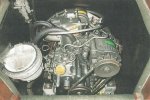
It is a Yanmar 10HP, sorry for the image quality it is scanned off an ad. Is it an expansion bottle on the left of the picture?

If it is indirect could the engine be run on dry land very briefly?
scan0002.jpg
 
It is raw water cooled. The object on the left is a Vetus strainer. Best way to run it ashore is using a hose pipe with a pistol grip nozzle. Fire water into the strainer, keeping it full while the engine is running. If no hose pipe you can use a decent sized water container. My 11 litre container is enough to run my bigger engine at fast tickover for 30 seconds or so.
 
Yanmar engines can be either seawater cooled (direct) or freshwater cooled (indirect) - I would be concerned at using a picture from a catalogue to identify which you have! As Vyv says, you can run it by feeding water into the strainer, alternatively the hose may be disconnected from the seacock and put into a bucket of water so it sucks it up as required (use a hose to replenish). Both types use a rubber impeller to pump seawater either through the engine or the heat exchanger and this is then fed into the exhaust to prevent the exhaust hose and water trap from burning! If you do not supply water, the pump impeller may well disintegrate stopping it from pumping in the future and the severed blades may block a water passage causing local overheating or total failure of the flow. As above, the exhaust componnets will also fail after a very short time!

Rob.
 
Yanmar engines can be either seawater cooled (direct) or freshwater cooled (indirect) - I would be concerned at using a picture from a catalogue to identify which you have!

But that's a 1GM(10), which also matches his idea that it's a 10HP, and as far as I know there has never been a freshwater version of it. If it were freshwater cooled, we would also be able to see the heat exchanger in the picture, and we can't.

Pete
 
Yes, clearly a seawater cooled 1GM. The (rare) freshwater cooled ones used an electric pumped system with a remote heat exchanger. That photo gave me happy memories - could have been the 1GM installation I had in my boat, even down to the positioning of the strainer and antisyphon valve.
 
Are they generally reliable and easy to service in situ?

Yes. Just about as simple as you can get. Known less-than-good bits are easy to improve. Check exhaust bend and water injection point every year by removing and cleaning. Replace water pump cover with a Speedseal - first time you try to change the impeller you will see why. Make sure the external oil pipes are not corroding from leaking water pipes, clear out the water pipes regularly and change the anode frequently depending on the wear rate. Make sure electrical connections are good. Sounds a lot, but once you get to know what to do very little to go wrong.
 
Yes. Just about as simple as you can get. Known less-than-good bits are easy to improve ...

All good stuff to which I'd add that the one downside with the 1GM is that it is a wholly Yanmar engine (their bigger ones are marinised Kubotas) and that they therefore have you over a barrel for spares, which are ludicrously expensive. They are much much cheaper in the US, but dealers there aren't allowed to sell to us. However, if you know anyone coming across ... my new head was £300 two years ago from Connecticut and would have been £450 here ...

The one bright side is that we don't do as badly as continental Europeans ... the head would have cost me £600 in euros.
 
Yes, all small Yanmars are Yanmar made. Some large (200hp+ ) are Toyota based. No Kubotas used.

1GM head is now £600 in UK. Encourages one to make sure the exhaust is good and an antisyphon valve fitted - main causes of head failure due to water getting back through the exhaust.
 
Yes, all small Yanmars are Yanmar made. Some large (200hp+ ) are Toyota based. No Kubotas used.

1GM head is now £600 in UK. Encourages one to make sure the exhaust is good and an antisyphon valve fitted - main causes of head failure due to water getting back through the exhaust.

I stand corrected on the engines ... though in my own defence I was assured here a couple of years ago that only the 1GM10 was wholly Yanmar. I wonder how they justify a 33% increase in the price of a head over two years. Of course that's not quite as big a question as how they justified charging £450 for a single cylinder diesel engine head two year ago.

The biggest price discrepancy I found then was in exhaust valves: as I recall they were £24 here and $6 there.

Incidentally, I bought one of the stainless exhaust elbows available, on the grounds that even if it wasn't the best possible stainless it should be better than mild steel, and costs half as much. Still seems OK, but I will be taking it off this winter for a Good Hard Stare.
 
Incidentally, I bought one of the stainless exhaust elbows available, on the grounds that even if it wasn't the best possible stainless it should be better than mild steel, and costs half as much. Still seems OK, but I will be taking it off this winter for a Good Hard Stare.

I checked the original manifold on my 3GM30F with a magnet this year. It was not attracted, and I assume the manifold to be a 300 series stainless steel.
 
I checked the original manifold on my 3GM30F with a magnet this year. It was not attracted, and I assume the manifold to be a 300 series stainless steel.

Alas the elbow for the 1GM10 (a snip at £180, guv) is nice, rustable mild steel. I don;t know how long the stainless one will last - I remember you expressed some worries here about the "316 and 304L" used - but at half the price then and much less now it seemed worth a gamble ...
 
Top