
Poignard
Well-Known Member
If, last time the flywheel was fitted, a thread lock compound was used on the bolt threads, is there any reason to think any more force will be needed to undo them than if they were fitted yesterday?


Not at all.Threadlock comes in different grades
Low purple
Med blue
High red
Hope I’m not teaching anyone how to suck eggs
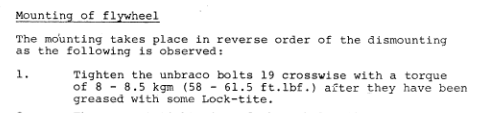

Failure to follow these instructions on reassembly may result in the flywheel coming free when running. This happened on a boat at our marina but fortunately the flywheel came to rest sitting on the engine bearers.the flywheel should have been torqued on; 4-4.5kgm (28.9-32.5 ft.lbf) and thread lock used. Those figures are lifted from the manual.
It may be that a serious thread lock has been used in which case you may need to heat the head of the bolt gently before undoing.
You can purchase a hex key fitting for a torque wrench, looks just like a normal socket fitting but with a hex key tip
Failure to follow these instructions on reassembly may result in the flywheel coming free when running. This happened on a boat at our marina but fortunately the flywheel came to rest sitting on the engine bearers.
Not at all.
There is no reason for the flywheel bolts to have been fitted using an uneccessarily strong grade of threadlock. When I took the flywheel off my BUKH engine for the first time in its life after 15 years. The bolts unscrewed without needing anything other than a hand tool. When reassembling I used Loctite Blue - medium grade.
Here, by the way, is an extract from my copy of the BUKH Workshop manual:
View attachment 206332

I think I will be using loctite 262 or 263My mental hypothesis was that maybe someone else had used a stronger grade
Damn him if he did!My mental hypothesis was that maybe someone else had used a stronger grade

....Here, by the way, is an extract from my copy of the BUKH Workshop manual:
View attachment 206332
They are Danish the write the manuals so I would guess it is just a spelling error. Hopefully no critical errors.And they can't spell "Loctite" or specify the actual product. Doesn't fill you with confidence does it? What else have they got wrong in that manual?
I bought some new bolts from T norris along with a new crank case seal. I have an oil leak and think it is a good idea to change it as I do not want to remove it twice. I have a feeling the flywheel needs to be on for alignment which is a pain as I have limited space.Unbrako socket bolts (Allen type) are marked 12.9 (1200 MPa, YS 90% of UTS). I believe that most Allen bolts are the same grade, although I have come across black painted ones that are almost certainly not. Unbrako claim that theirs are the best but I suspect that any from a reliable source would be as good. Socket Head Cap Screws | Unbrako Socket Head Cap Screws | Unbrako
When I had a Bukh I removed the flywheel several times and used the existing bolts each time, after an inspection for cracks or deformation.
Aunty Intelligence says:And they can't spell "Loctite" or specify the actual product. Doesn't fill you with confidence does it? What else have they got wrong in that manual?

It is a remarkably thorough manual but I have come across the occasional omission and error. It's the annoying little things that cause most time loss, one that springs to mind is in the regulator, where a cylindrically wound spring has legs of differing length. It is crucial that these be in the correct positions but the manual says nothing. I wasted hours on this one.They are Danish the write the manuals so I would guess it is just a spelling error. Hopefully no critical errors.
When the Bukh was invented the use of re useable bolts was hardly mainstream! So I doubt they need to be renewedI too had thought I'd read that the flywheel bolts should not be re-used, but later came across something (on this forum?) saying otherwise. I also recall reading that they are not standard bolts, but Unbrako ones (branded, extra strong ones). I now don't know what the true situation is.
You definitely do not want your flywheel coming off when the engine is running - likely to make a catastrophic mess of hull and/or bodies.
Replacement bolts from Bukh spares stockists are less than a fiver each, and I would have thought that £30 for the set is probably worth it for peace of mind.
