
Is Harwich to Amsterdam for beginners too much?

parito

New Member
Joined
12 Jul 2013
Messages
20
Visit site
Hello cruisers,

Need some sincere advice here.

We are a crew of 2 (2 lads in their 30's)
We have a small 21 foot bilge keeler Vivacity 650 based in Mersea Island region (Tollesbury). Perfect for sitting in the east coast mud


Our Experience
So far our experience was only short trips on the East Coast, in river Blackwater/river Crouch region between marinas and anchoring in the creeks. Sometimes some short daysails a bit further from the coast (10-15miles).

None of us have any real ocean/seas experience. One of us (me) did get a day skipper sertificate + ICC (theory and practice), which to be honest I don't value that much as it was quite easy to obtain imo.

We are reasonably fit and determined.

Our boat

21 foot bilge keeler Vivacity 650. Did lot's of upgrades to it (new rudder, autopilot, hull-through fittings, sails, standing/running rigging, new outboard). It is quite slow because it's so short, so we always have to work with tides, otherwise you might end up stationary. It's quite beamy boat for it's length so it slams a bit especially with wind against tide, which slows her down even more.
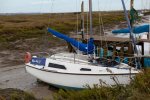
20120930_IMG_4497.jpg

Plan
We both took 2 weeks off from work, and are considering a longer trip. So basically we have ~17 days.

2 options on the table are
- hopping to europe (holland, france?) via Ramsgate->Ostende, and then maybe north to Amsterdam? Would love doing that..
- doing extensive coastal cruising southwards (isle of wight area), or northwards.


Questions

- Is Europe side much more demanding than East Coast?
- Is documentation required to sail in Europe a lot of hassle? We do have radio license and ICC, but no registration documents as the boat is quite old, and it's not required in UK to have those.
- Do we have enough time (17 days) for that sort of trip, there and back(Europe, Amsterdam)
- are we asking too much from that sort of a boat?
- Do you _FEEL_ we would be better of with getting more experience along the coasts of UK?
- Any additional comments would be highly appreciated
 
Welcome to the forum, you'll get lots of good advice and meet lots of friendly people hereabouts ... and me!!! :D

You might find the account of our recent trip along the South Coast of interest and also our failed attempt to sail from Lowestoft to Blakeney overnight last year (both accounts and much other blather and waffle to be found in the blog, link in my sig!)

Brigantia is slightly bigger than your boat but very similar being from the same manufacturer and our major trips are generally two handed (or three this year although the third hand, my youngest, spent more time in his bunk than anywhere else! Lazy beggar!) We're currently based in the Crouch not far from you and started off three years ago from pretty much the same basis so our experience translates pretty directly I think

We have yet to venture over to the coast of Europe but it is on our medium/long term radar and no, I see no reason why a Vivacity 650 shouldn't venture across the channel or even the Southern North Sea provided due regard is paid to conditions and what have you. It is a challenge in a small boat to make passages that in a 30 odd footer would be relatively easy but it's all the more satisfying for that.

I would suggest, as we are in the process of doing, building up to the really big trips in stages. Last year we experimented with our first night sail and although it didn't entirely go to plan thanks to adverse weather we learnt a great deal about ourselves and the boat. We'll be better prepared next time

This year, we set out to find out how we'd cope with longer passages of several days duration with overnight stops and it went very well but with some provisos. That was a trip which might appeal to you in essence as a first longer haul cruise: Crouch - Ramsgate - Dover - Eastbourne - Hayling Island. Apart from the Ramsgate to Dover leg, a shorter hop of about 5 or 6 hours, each leg was 10 to 12 hours but could easily have been longer. We then spent two days in Chichester before heading back East again adding an extra overnight stop at Brighton (a dump) to break the long Hayling Island to Eastbourne leg in to two days and also stopping for two days in Dover to spend a day at the castle (well worth it).

A reliable engine capable of pushing the boat through in an adverse sea at a useful speed and sufficient fuel for at least 8 hours under motor is a must IMO - we have a very economical 6hp 4 stroke which sips petrol like it's going out of fashion but I wouldn't set out from, say, Dover heading for Eastbourne without at least 30 litres of petrol - that would be enough to motor there AND back ... and motoring there AND back is something that in extremis you could conceivably end up doing. Consider, for example, the possibility of getting almost all the way to Eastbourne only to be faced with a growing foul wind and building sea and then find you can't get into Sovereign Harbour for some reason. Conditions are such that rounding Beachy Head and heading for Newhaven (the next available safe haven heading Westwards) is simply not an option and Rye, back to the East, is very tidally restricted. So you have to contemplate having to head all the way back to Dover in potentially worsening conditions

This same consideration also means that whilst the passage from Dover to Eastbourne (about 44 miles) is achievable in daylight in summer provided you get your tidal streams right and can sail or motor at well over 3 knots you have to plan for the possibility of being out for two days including an overnight and that means if the weather outlook is dodgy it could be a no go - even though today is a perfect sailing day if tomorrow is forecast to be beyond your safe limits it is, in my book at any rate, an unnecessary risk to set out into a situation where I cannot make a safe haven within the available weather window in any conceivable circumstances (a bigger boat might reasonably weather almost anything thrown at them in the Southern North Sea or English Channel in summer but I wouldn't want to try it in a small tub like ours! She's a fantastic little boat but there are limits)

One of the biggest problems with pushing the boundaries on such a small boat is fatigue. It is, and there's no getting away from it, more tiring due to the lack of space, lack of standing headroom, the motion of the boat and so on. Even a simple act such as putting the kettle on and making a brew is a wearing exercise when the boat is rolling around in a Channel swell or leaping about in a Thames Estuary chop. And going to the loo is even less fun! It doesn't seem bad to us, or I venture to suggest yourselves, when day-sailing around the local area but on the third or fourth day out of a major cruise when you're spending 10 to 15 hours at sea everybody starts to get more than a bit physically and mentally weary of the constant effort involved doing even the simplest of tasks. It's not a show stopper but you do have to take it into consideration and find ways to mitigate it plus allow enough recovery time (which we didn't really this year)

Another challenge is stowage. Carrying enough food, water and clothing for a two week trip on a 20 odd footer takes a bit of planning! In fact, last year we grossly overloaded the boat as a result of taking too much of everything so this year we were fairly strict and also planned a mid-trip major replenishment (Eastbourne and Brighton do have one thing to be said for them - both have an Asda within easy walking distance. Last years plan involved spending some time in and around Blakeney where replenishment wasn't available). Overloading had some unintended consequences - too much weight in the ends of the boat (water up forward, petrol down aft) made her motion in a chop much worse than normal and the amount of stuff on board meant the cockpit drains weren't doing their job when heeled - quite the opposite 'cos water was coming IN through the downhill drain! That puddle of cold seawater in the front corner of the cockpit was just where I wedged my foot encased in it's (as it turned out) leaky boot in the middle of the night off the North Norfolk coast which resulted in my having a cold wet foot to add to my other woes!

Anyway, I could waffle on for pages and pages but in a nutshell my advice would be to go for it! And have fun!!

PS. I see you're on the Saltings at Tollesbury - we may be neighbours next year 'cos if there's a mooring available Brigantia may be heading that way for 2014
 
What Brigantia says makes lots of sense.

With coast hopping from Ramsgate/Dover you could get across to France/Belgium/Holland in manageable chunks.

2 up, for 50 mile plus passages the question would be can you both sail singlehanded to allow the other to get some kip, nothing worse than both being absolutely knackered when entering a strange port or sorting out a problem.

Going to Europe or south coast, Europe going west gives smaller steps, Calais, Boulogne, St Valery, Etaples, St Valery sur Somme, Le Tréport...

I would get across the other side as quick as I could.
 
Last edited:
Is Harwich to Amsterdam for beginners too much?

Anything is possible, however...

- You yourself said your boat is quite slow. Don't underestimaste the ground you need to cover. I am guestimating an average SOG of about 4kts. From where you are to Ramsgate is a bit over 40NM. Should you run into foul wind and tide, will you still manage 4kts with your outboard? How will you feel after a 12hr passage in 'not great' weather?
- Heading for the IoW - that's another 100+NM, etc... Are you looking to just push along every day? Fatigue?
- Personally, after Ramsgate I would head for Calais/Gravellines/Nieuwpoort before heading back. And I would also take at least a day in each to explore.

I don't want to appear discouraging and you know your own boat/abilities best, but if I were in your situation I would stick to bit-size chunks (how far can I get on one tide?). And at the back of my mind there would always be the consideration whether or not I could back from where I am in the time available to me.

Going foreign: you will NEED some kind of registration to satisfy foreign offials. I know it's not required in the UK, but £25 for SSR registration will save you a lot of potential hassle.
 
Agree with all of the above, though I doubt you will average as much as 4 knots.

I'd say beware of overestimating how far you can get. (I know I always do!) Unless you allow some time for just mooching about and relaxing, in a small boat especially it will be a gruelling endurance test. It's easy to look at the map and think 'once we're in Ostend we may aswell just nip up to Amsterdam', but you'll enjoy it more spending some of the time exploring local harbours and sights around, say, Ostend/Gravelines than two whole weeks passage making and worrying about whether you'll make it there and back in time.

In a small boat you (and we) are always much more affected by the weather, and being held up for some days waiting for the wind to abate or change direction is commonplace. Don't forget to allow more time to get home from wherever than it took you to get there.

the cockpit drains weren't doing their job when heeled - quite the opposite 'cos water was coming IN through the downhill drain!
Try crossing your cockpit drain pipes (i.e. downhill drain from cockpit exits through uphill skin fitting).
 
Agree with all of the above, though I doubt you will average as much as 4 knots.

They've got new sails and a new engine so I wouldn't be surprised - we do! :D

OK, only just and when "passage" making we perhaps resort to the engine more than we'd ideally like in order to keep our ETA the right side of the clock

The one time you can find yourself in a bit of bother as a small fish in the big sea is fighting into the teeth of an F5 plus with a choppy head sea as well. As you know I'm sure that can clobber your speed dramatically to the point where you cannot continue to press on. OK so all boats will have their limit beyond which they cannot go in any direction and the choice of course starts to become constrained by the conditions but in a little 20 odd footer that point is reached, in my limited experience, in wind speeds as low as upper end of F5 to the bottom end of F6 or to put it another way anything much over 20 knots sustained. In reality, I really don't want to be out there in much above an F4 although sea state is the biggest issue - slight can vary from "hey it's not too bad out here" to "freakin' hell it's a bit rough" and moderate is definitely "what time does the bar open?" territory!

I'd say beware of overestimating how far you can get. (I know I always do!) Unless you allow some time for just mooching about and relaxing, in a small boat especially it will be a gruelling endurance test. It's easy to look at the map and think 'once we're in Ostend we may aswell just nip up to Amsterdam', but you'll enjoy it more spending some of the time exploring local harbours and sights around, say, Ostend/Gravelines than two whole weeks passage making and worrying about whether you'll make it there and back in time.

That's a very important point. We arguably overdid it a bit this summer - I'd have ideally liked a couple more days relaxing in port as I mentioned earlier. Each to their own however as some may be perfectly happy to be on the go every day for the whole of a two week trip however ...

In a small boat you (and we) are always much more affected by the weather, and being held up for some days waiting for the wind to abate or change direction is commonplace. Don't forget to allow more time to get home from wherever than it took you to get there.

... that's another very important point! One third of the available time out, two thirds back and leave a bit in hand is my rule of thumb - if you've got 17 days for the whole holiday, 5 days out, 10 days back and a couple of days in hand to cater for holdups would be a good plan. You can just about make the Solent in five days (we made Chi in four) but then you've got to come straight back!

You've also got to have a plan for getting weatherbound and not getting back at all. I've got a fallback fund I can call on to cover the cost of either leaving the boat somewhere until we can weekend her back or in extremis getting her picked up on a trailer and moved back to base by road - one advantage of a small boat is, of course, that getting her moved by road isn't quite as big a financial hit as it would be with a 30 or 40 footer! But you do, IMO, need to be prepared to take the financial hit of not completing the trip because otherwise you could be tempted to go in weather where you ought to stay because of the cost of not doing so

Try crossing your cockpit drain pipes (i.e. downhill drain from cockpit exits through uphill skin fitting).

It's on the to-do list :D

It's not usually a problem (which is why it's still on the to-do list) provided we're not overloaded
 
The boat is capable - the question is are you?

If you were to go to Ostend then the sensible thing would be to go to Flushing (29 nm) and enjoy the delightful inland waters of Zeeland. We pootled as far as Amsterdam this year (and then went on to the Ilslemeer) but to be honest the journeying was better than the arrival. If I went to Amsterdam again it would be by Easyjet from Southend! Bashing up the coast of Holland would be no fun.

So is Ostend do-able? Well it's a long way at a slow speed and using the engine to keep up passage time has been the case more often than not. You need to push the boundaries of your passages bit by bit. Going from 15 nm to 80 nm is a big jump requiring a different level of preparation and mindset. A good weather window is also essential. My advice would be to push yourselves this year on a trip that has safe havens and get used to it.

Confidence grows with experience but experience is often gained by bad experiences! There's no point in us saying "It'll be fine" - it will be fine when you think it is.

I have never been asked for papers in Holland but in Ostend they have asked for passports, insurance certificate and SSR certificate.

Enjoy a couple of weeks and push the envelope a bit.
 
Questions

- Is Europe side much more demanding than East Coast?
- Is documentation required to sail in Europe a lot of hassle? We do have radio license and ICC, but no registration documents as the boat is quite old, and it's not required in UK to have those.
- Do we have enough time (17 days) for that sort of trip, there and back(Europe, Amsterdam)
- are we asking too much from that sort of a boat?
- Do you _FEEL_ we would be better of with getting more experience along the coasts of UK?
- Any additional comments would be highly appreciated

When I was in the first couple of years of boat owning I took a Sonata (lift keel - keel stuck up!) across from Shotley to Ijmuiden, with the tail end of a fresh wind and north sea chop. These were just pre gps days and navigation was all deadreckoning plus the occasional buoy spot. This meant a lot more time down below doing chartwork than now which was not easy for sea sickness. We managed to get to Borkum (partly through the canals) and back in 4 weeks, taking it reasonably easy coming back. I don't regret going through the learning experience, and with improvements in electronics some of the stresses are now virtually gone.

17 days is fine for a trip over to Holland. Don't worry too much about experience - you will gain it on the way, and that is the only way of getting experience anyhow. If you post a bit what you have done so far I am sure you will get some feedback as to whether you are sufferering from nerves or whether you really should not go (eg how much night sailing have you done, what are the worst conditions you have been out in, do either of you get seasick, longest trip and conditions). Think a bit about options for if things go differently from what you imagined (eg going to Scheveningen if Ijmuiden is on the nose). Sleep on the way. So long as the boat is sound and you don't go with an 8 in the forecast it should be fine (I went with a 7 decreasing). Take the paperwork the RYA recommend and you will be fine - it is not a hassle (I believe you will need SSR though). Go for it - it is different and fun.
 
I have not (yet??) crossed the channel, but I can vouch for the boat as I own one.

I have sailed Gitane, a Vivacity650, in and around the Thames estuary for six years. I was a very nervous sailor to start off with, but over the years, I have got more and more confident in my v650.

Last year I crossed from Bradwell to Sheppey in what ended being a good F5, knocking on F6, on the beam, but Gitane took it easily in her stride. A very dry boat despite an angry sea, except for one rogue wave which soaked one of us, but didn't touch the other.

I have motored into a F5 on the nose up the Blackwater with wind against a spring tide. Horrible short steep waves typical for the Blackwater in those conditions. Gitane slammed a few times, but otherwise looked after me very well. I end up going into shallow water just to get a smoother ride. The other tactic is to position the boat to take the waves at a slight angle.

I even got caught in a brief F7 as a squall came through, other than having to shorten sail, Gitane was fine.


With a ballast to displacement ratio of 44%, a V650 has a lot of inherent stability which pays off when the conditions get a little rough.

Fuel consumption wise, I have a 6 HP 4 stroke outboard. Last month I ended motoring at about 4 knots more or less all the way from Gillingham to Bradwell, eight hours, on a two gallon tank, and still had a quarter tank left when I arrived. I carry four gallons of fuel, so that should give a maximum theoretical endurance of around 80 miles ignoring tides.


Finally, there was an article a while back on the, now defunct, v650 website about a v650 crossing from Ramsgate to Gravelines and back with no problems encountered.

In short, I believe the boat can do it.

Gitane
 
Last edited:
Lots of good advice.

My first boat was a 21' cox with 4hp outboard. With a not very experienced friend we did Orwell to Ramsgate to Calais to Boulogne to Ramsgate to Orwell. Just pick your weather and be ready to change your plan if the weather you want doesn't arrive!

I always make a flask and sandwiches up before setting off and have lots of Jaffa cakes, mars bars etc available to keep spirits up. Nothing worse than being hungry and not feeling like going below to make a hot drink or get some food.

Most important though - HAVE FUN!!
 
Im just sitting here reading all of the good advice and voices of reason and wondered if I had anything to add and one thing I thought was why the rush to go foreign ? , I've had 3 sailing cruisers , 23 ft , 26 ft and now 28 ft and the only one I took to holland was the Etap26 , I think there are quite a few passages you could undertake to gain experience / confidence without going across the channel/north sea , why not go up to Lowestoft through Mitford lock and into the broads or if that doesn't appeal do what Brigantia did and visit the south coast ? .

If you really want to go across why not see if you can crew on a boat with a skipper who's done it before and you can get a feel for its like but without the responsibility of it being yr boat and yr crew if a problem should arise .

As the others have said , it is meant to be fun ...
 
We've just returned from a trip that started with a motor from Harwich to Amsterdam and a cruise down the Dutch coast going inland at Stellendam, followed by a spectacular sail back to Harwich from Zeebrugge. It took 17 days but it was in a Rustler 31 which is a good passage maker. I have sailed smaller boats and did a similar cruise in a 26' some years ago. All the points made by Briganta and others I would endorse. Everything takes longer than you think it will especially in Holand when you are waiting for locks and bridges to open. If it was me, I'd start with the Ramsgate-Calais -Graveilines-Neuport option. Good luck..
 
Thank you everyone for your replies,

we decided to head south down the coast applying all the suggestions from you guys - push south 5-6 days following weather. I suppose we will find out about the comfort levels on the way.. Although I am pretty sure now, it will be quite tiring bouncing in the waves in such a small boat and on the knees inside the cabin.

The worst we have seen so far was around Clacton wind farms area, ~20 kt wind against spring tide, beating upwind - boat hammering in to those short steep waves, barely doing any forward progress, everything flying all over the place inside the boat - were really glad to reach land that day.. so this is the stuff I am hoping not to encounter :) Also after that trip we made some interior changes - new lockers, as to keep stuff in place when things get rough.

The engine we have is 6hp honda outboard which we are planning to use a lot on this trip..

Because of the size of the boat we are both capable of single handing it, so we are now considering enforcing "one in the cockpit, one in the bunk", as to reduce fatigue levels as much as possible.

But hey, it is an adventure and we are looking forwards to it - expecting ups and downs, highs and lows.. that's what it is sailing about, isn't it ?
 
The smallest boat we went abroad in was a Mystere 26 - 25.5 ft with a petrol engine, no radio etc. We did eventually do Blackwater to Ijmuiden but that would be much too far for inexperienced crew. Although Amsterdam is achievable and well worth doing, 17 days is cutting it very fine as you can easily spend a week in Ostend waiting to get home with endless NW5s.

I would also recommend a simpler cruise, such as the Belgian coast and see how far you get, or better, the Normandy coast that others have said. The scenery is lovely, the cheese is better and you learn to get the feel of Channel seas and tides. Most importantly, you have every chance of a favourable wind for getting home. The longest haul is Boulogne-Dieppe, about 50 miles. We did Blackwater to Honfleur and back several times in two weeks.

There is nothing hard about foreign cruising, though there are a few tricks to learn. There is an old saying that if you can sail the Thames Estuary you can sail anywhere, which is very true.
 
Thank you everyone for your replies,

we decided to head south down the coast applying all the suggestions from you guys - push south 5-6 days following weather.

...

The engine we have is 6hp honda outboard which we are planning to use a lot on this trip..

Yup, you surely will use it a lot - it's all very well pontificating about sailing as much as possible, which I'm as guilty of as anyone, but when it comes down to it on a trip like this your constantly chasing your ETA at destination

I would though recommend not reaching for the starter cord TOO soon. I now, as part of my passage plan, calculate the latest acceptable ETA at our destination. I then calculate the latest time we can arrive at intermediate points along the way - say a headland or off a particular coastal feature - and still make the ETA under motor at 4 knots (our comfortable and economic cruising speed)

As we're sailing, our ETA at our destination might fall behind the line but provided we're still above the "we can do it at 4 knots" line we keep sailing. It's a bit complicated but it does give me something to do!

Because of the size of the boat we are both capable of single handing it, so we are now considering enforcing "one in the cockpit, one in the bunk", as to reduce fatigue levels as much as possible.

Forget it, won't work! Not unless you're VERY disciplined. Unless you're deliberately planning an overnight, in which case ideally you both get an off watch period in the late afternoon / early evening to rest up for the night, it's not necessary anyway. We operate a casual system of people taking breaks when they feel inclined to - although it has to be said in our case I'm a bit of a Duracell Bunny 'cos I just keep going and going and going whilst everyone around me is falling asleep on their feet!

I rarely go below decks to my bunk when taking a break anyway, preferring to snooze in a corner of the cockpit (partly because I feel keenly responsible for the boat and her crew and unhappy to be fully "off watch" and partly because I'm prone to coming over queasy in any sort of seaway if I go below for more than five minutes). Rik, Mark and my dearly beloved (my regular crews) all happily hit their bunks for varying periods of time which is (mostly) fine by me. With George the Tiller Pilot on hand I'm generally quite happy left to my own devices anyway

Rik, my mate, is very good at making sure we eat at regular intervals which I find essential for maintaining energy levels but tend to forget to do. As others have said hereabouts and on dozens of other threads about sailing long legs and overnights, snacks and nibbles are hugely important especially for a watch keeper left to single hand for a couple of hours or more. Biscuits, chocolate, sweeties etc. easily reached from the helm. A flask or two too if popping below to brew up is not an option - we've not had a lot of success with flasks so far as the first ones we bought turned out to be too big to stow in the space available (the DLW told me they were and I didn't listen as she has been reminding me at every single bleedin' opportunity ever since!) and the smaller stainless steel ones we bought for this year don't keep stuff hot beyond an hour or two. We've not found ourselves in a situation where putting the kettle on was totally impossible two handed but there have been times when it's been tricky and/or it wouldn't have been possible for the helmsman to leave the helm on autopilot to brew up for himself

But hey, it is an adventure and we are looking forwards to it - expecting ups and downs, highs and lows.. that's what it is sailing about, isn't it ?

That's the spirit that man!

Oh, just a thought - I presume you've got a decent VHF on the boat anyway but if you haven't already got one I'd recommend a hand held to supplement it. One of these days I'll replace it with a better one but for now I've just got the cheapest of the cheap Cobras which cost me less than £50. I can clip it to my lifejacket which means I can clearly hear it over the engine noise and (at the risk of people telling me it isn't, which is technically true but bascially cobblers never the less) VHF comms is absolutely vital when entering Dover, useful when entering Ramsgate and helpful elsewhere and unless you've got a remote mic the main VHF set down below isn't the most convenient thing to use whilst your messing about on final approach to the entrance of a harbour!

I fire up the hand held and switch it to the port control channel anything up to an hour before we get there (leaving the main set on 16) which means I can build up a pretty good picture of what's going on. This is especially helpful around harbours heavily used by wind farm support boats such as Ramsgate and Lowestoft. It's handy to know that three windcats are about to exit Ramsgate and head for the London Array when you're on the reverse course to the one they'll be taking - means you don't get a nasty last minute surprise! And entering Dover without contacting Port Control is not even to be considered - actually, it's hard to see how you could legally since the default setting for the traffic signals is three reds. Ramsgate OTOH was showing green, white, green when we entered heading South but three greens when we entered heading back home again (given the level of traffic and the relatively blind nature of the entrance, I still called Port Control to advise them of our approach anyway)

Look forward to hearing about the adventure
 
Top