Inverter installation

We have a large (ish) Sterling inverter on board which was installed before we got the boat. I only really use for the telly.

A thought occurred to me (not got around to checking!) that when it is in switched on, it is powering the 240v battery charger, which is turn is charging the batteries, which in turn is powering the inverter. If I am correct, I am not really sure what the the result of that loop is, although nothings blown up so far!
 
That made me think. In fact Sidepower recommend it for some cable runs.

However you are right because if one goes open circuit you’d never know. Never considered it before.

An appropriate fuse in each cable would make it safe If you had to do it?

In the OPs case, a 300/350a fuse would still protect a single 50mm cable if one broke loose (he's using two cables to counter voltage drop, not for the current capabilities). But, if the cables were in parallel to carry the current (2x50mm = 690a) and one cable broke loose the remaining cable wouldn't be properly protected, so in that case, yes, separate fuses in each cable.
 
We have a large (ish) Sterling inverter on board which was installed before we got the boat. I only really use for the telly.

A thought occurred to me (not got around to checking!) that when it is in switched on, it is powering the 240v battery charger, which is turn is charging the batteries, which in turn is powering the inverter. If I am correct, I am not really sure what the the result of that loop is, although nothings blown up so far!

Won't blow anything up, but will flatten your batteries without having anything turned on. Firstly, the inverter has an overhead, that is, it uses power in standby, albeit a small amount. Secondly, it isn't 100% efficient, so if, for instance, the battery charger is drawing 10 amps from the inverter, it would be taking about 11 amps from the batteries.

Varies ways of overcoming the battery charger issues. Bigger inverter installations usually have split mains units, one set of high consumption items, water heaters etc and the battery charger, the other one for low current circuits, such as lights, TV sockets and my one ow two galley outlets. Both sets of circuits are on when on shore power, but only the low current circuits when using the inverter.

Another way of doing it is to fit a 240v normally open relay into the mains consumer unit. Connect it inline with the mains charger connection, so with no 240v supply the main charger has no connection. Run a wire from the shore power side of the changeover switch (shore power-off-inverter) to the relay coil. When you turn the shore power on, the relay will close and the battery charger will work, turn the switch to the inverter setting and the charger goes off.
 
If the inverter manufacturer specifies a certain size of fuse, it may be a bad idea to fit larger. It may be 'protecting' more than the cable.
Unless you know all about the internal protection of the inverter (if any).
Fuses rated at hundreds of amps are actually pretty useless at protecting cables, you have to make a very good job of shorting the cable otherwise you're likely to just get an arc of up to a couple of hundred amps....
That's the problem with scary high power at 12V. At 230V, the arc is much less likely to limit the current to within the fuse rating.
 
There is no electrical workshop around and it would be way too costly to arrange. Plus considering a bit complicated installation I'd like to do this on a spot.

I have been puzzled about inverter power for a while. First 1500W, then 2000W and finally ended up with 2500W with AC transfer switch. Do we need 2500W? Definitely not at the moment. We are very light power users and just recently got 1350W espresso machine and 950W toaster. Apart from upgrading battery bank and switching to induction cooktop someday (maybe), I doubt we will ever use it anywhere close to cont. 2500W.
 
My Samsung TV and soundbar are both 14v, so run nicely from a pair of DC-DC converters.

Ditto, with a variety of voltages:

2 x Samsung TVs. 1 x Yamaha digital piano. 1 x Sony Soundbar. A variety of laptops, old and newer. Three/Huawei Homefi Router.

There are many electrical items that are actually fundamentally DC, with AC transformers to enable them to be run in our homes.
 
My telefunken TV/computer monitor runs on unregulated 12VDC OK even when the solar has te battery over 14 VDC.

I did originally fit a DC/DC converter to limit the voltage to 12VDC but then the display had a beat frequency interference on the screen so I removed the DC/CD converter.
 
My telefunken TV/computer monitor runs on unregulated 12VDC OK even when the solar has te battery over 14 VDC.

I did originally fit a DC/DC converter to limit the voltage to 12VDC but then the display had a beat frequency interference on the screen so I removed the DC/CD converter.

I ran one of my 14V Samsung TVs on the unregulated DC supply for a year or so before managing to find an adapter with the correct connector. It was fine although, maybe it ran a bit hot due to drawing extra amps? Even now it runs on a 15V regulated supply because I couldn’t find a 14v one.
 
We have a large (ish) Sterling inverter on board which was installed before we got the boat. I only really use for the telly.

A thought occurred to me (not got around to checking!) that when it is in switched on, it is powering the 240v battery charger, which is turn is charging the batteries, which in turn is powering the inverter. If I am correct, I am not really sure what the the result of that loop is, although nothings blown up so far!

I do not have my inverter mains output connected to anything on a permanent basis, but I can plug the mains fridge into it. If you have a an inverter connected to your boat's mains wiring you should do so via a double pole changeover switch with a centre off position, so that mains and inverter 220 volts cannot be connected together. I would always unplug or turn off a battery charger whilst the inverter was connected. Most inverters should be switched on without any high voltage load connected.
 
50mm cable is rated at 345a, so a pair of cables would be rated at 690a and either of the 350a, 400a or 500a fuses would protect the cables. However, if one of the cables became detached or broken you are left with a single 345a cable carrying the full inverter load, but, more importantly, each cable would singularly be protected by the fuse. A 500a fuse is clearly overrated for 345a cable, as is a 400a fuse, so, fit the 350a fuse.

How about Mastershunt? Main fuse 500A (300 A cont. at 40 °C) /// Current 300A cont. / 500A for 5 minutes

Should I go down to 350A or fine to keep 500A?
 
How about Mastershunt? Main fuse 500A (300 A cont. at 40 °C) /// Current 300A cont. / 500A for 5 minutes

Should I go down to 350A or fine to keep 500A?

If you use 95 mm² cables as originally advised no change of fuse or additional fuse is needed. The 500A fuse in the Mastershunt does it all.

If you reduce the cable size to 50mm² you have two choices ... change the fuse in the Master shunt to 350 amp or keep the 500 amp fuse and connect the inverter with a separate 350 amp fuse.

Unless there is some other reason to keep the 500 A fuse, changing it to 350A would seem to be the most sensible way forward. Job done and no other fuse for the inverter is required.
 
If you use 95 mm² cables as originally advised no change of fuse or additional fuse is needed. The 500A fuse in the Mastershunt does it all.

If you reduce the cable size to 50mm² you have two choices ... change the fuse in the Master shunt to 350 amp or keep the 500 amp fuse and connect the inverter with a separate 350 amp fuse.

Unless there is some other reason to keep the 500 A fuse, changing it to 350A would seem to be the most sensible way forward. Job done and no other fuse for the inverter is required.

I agree with Vic here.

My only other thought would be, where is the shunt fitted, in relation to the batteries ? The internal fuse only protects the cabling after the shunt itself, it provides no protection for the cables between the batteries and the shunt.
 
My only other thought would be, where is the shunt fitted, in relation to the batteries ? The internal fuse only protects the cabling after the shunt itself, it provides no protection for the cables between the batteries and the shunt.
I think Kemp said the battery to Mastershunt wiring was/would be 1 - 1.5 m. The solutions to having no protection of theses cables is presumably to make them as short and direct as possible and installed so that the risk is reduced to practically zero They are pretty robust !
 
I think Kemp said the battery to Mastershunt wiring was/would be 1 - 1.5 m. The solutions to having no protection of theses cables is presumably to make them as short and direct as possible and installed so that the risk is reduced to practically zero They are pretty robust !

You're correct he did say that. If the cable to the shunt absolutely cannot be sorted, it's acceptable to omit a fuse at the battery, otherwise a 300/350a one should be fitted, in which case toe 500a shunt fuse would be fine. If no battery fuse were to be fitted, you are correct that the shunt fuse should be downrated to a max 350a one.
 
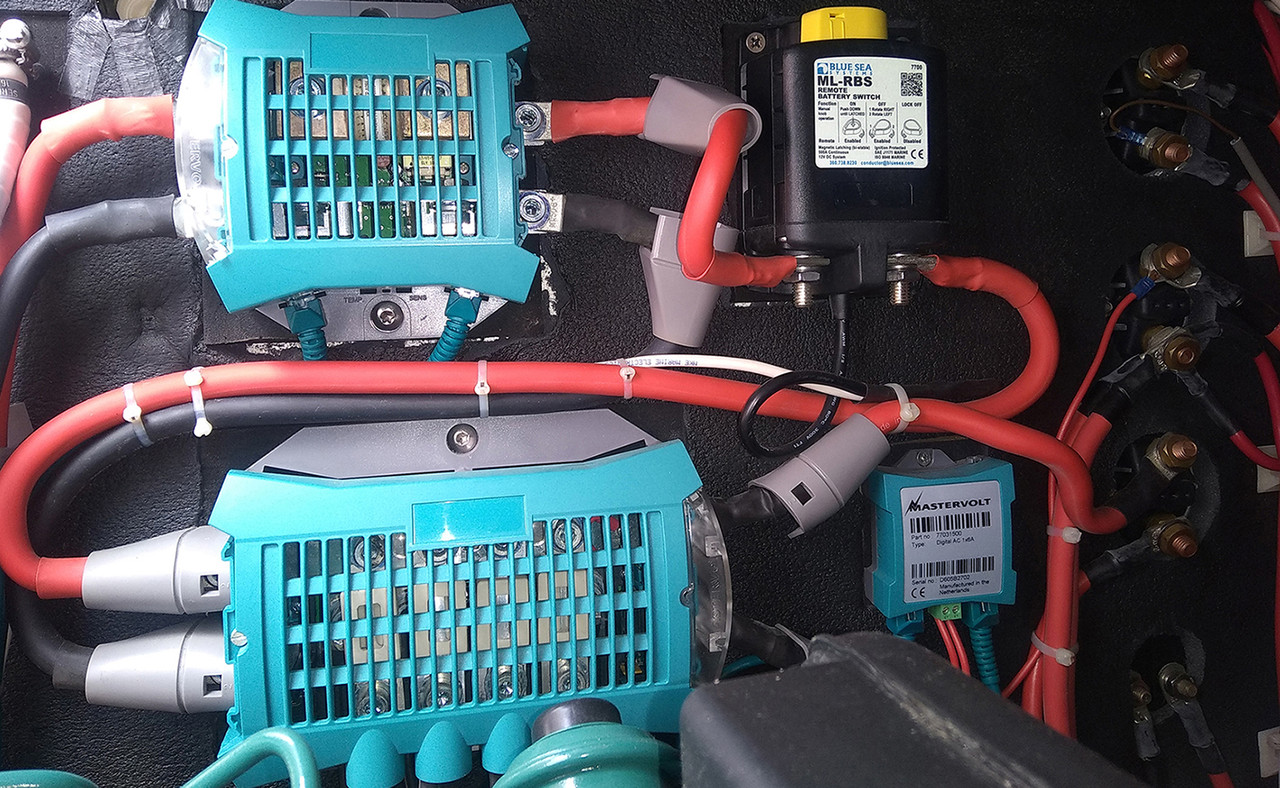
I do not have wiring schematics, so here is a picture of current setup. The battery to shunt cable is 1-1.5 m. Maybe I could connect shunt directly to DC distribution, but then battery switch will have to be moved before the shunt and will not be protected. I'm not sure if current setup is very good, but I do not want to over complicate and make it ideal. Or I should?

Correct me if I'm wrong, my plan is to 1) install 2x50mm² cables from the battery to the shunt 2) change shunt fuse to 350A 3) install 2x50mm² cables from the shunt to the inverter 4) install 350A fuse at the inverter end.

IMG-20200121-134154.jpg
 
Last edited:
I do not have wiring schematics, so here is a picture of current setup. The battery to shunt cable is 1-1.5 m. Maybe I could connect shunt directly to DC distribution, but then battery switch will have to be moved before the shunt and will not be protected. I'm not sure if current setup is very good, but I do not want to over complicate and make it ideal. Or I should?

Correct me if I'm wrong, my plan is to 1) install 2x50mm² cables from the battery to the shunt 2) change shunt fuse to 350A 3) install 2x50mm² cables from the shunt to the inverter 4) install 350A fuse at the inverter end.

IMG-20200121-134154.jpg


Too much equipment and bare connections right next to the engine to not have a battery fuse.

Fit a 350a fuse at the batteries, 2x50mm cables to the shunt, leave the 500a fuse in the shunt, 2x50mm cables to the inverter, no need for a fuse at the inverter.

Get the covers on the cables properly fitted and cover all of those isolator switch terminals too. Also, the 1.5mm and 2.5mm cables that connect to the switches appear to be unfused.
 
Too much equipment and bare connections right next to the engine to not have a battery fuse.

Fit a 350a fuse at the batteries, 2x50mm cables to the shunt, leave the 500a fuse in the shunt, 2x50mm cables to the inverter, no need for a fuse at the inverter.

Get the covers on the cables properly fitted and cover all of those isolator switch terminals too. Also, the 1.5mm and 2.5mm cables that connect to the switches appear to be unfused.
Thanks, but a bit confused. Why changing shunt fuse to 350A would not be a way to go? Isn't a shunt fuse = battery fuse? Or non fused 1-1.5m cable from battery to shunt is potencially problematic?

Any picture of cable covers and how to properly cover terminals would be great.

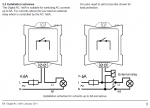
Regarding 1.5mm² and 2.5mm² cables that connect to the switches. The red one is for Digital AC 1x6A and it seems does not need to be fused (check picture). Grey/brown is for switch panel voltage indicator.
Digital AC 1x6A.png
 
Top