Internation Woodskin - one year on feedback

Following the positive reports on Woodskin I applied this to the woodwork on my boat last July. Here is some feedback on performance after 1 year. The wood I treated was copings, rubbing strakes, cockpit seats, handrails and gunwhales - all teak. For the mast and spars I used Le Tonkinois. The wood was all sanded back to new wood washed, dried and then wiped down with white spirit. I then applied 3 coats over 3 or 4 days, which is the minimum required. My plan was to apply an initial 3 coats and then top up this summer with some more. The effect when completed was very pleasing. Now one year on there are patches that need treatment. Even the cockpit which was under a cover from October until April has bare patches. Maybe the specified minimum 3 coats are insufficient. I have to say I am disappointed and expected better

I have used the Sikkins stuff a lot and found it good. It tended to last up to five years, with yearly attention, before it needed to be redone.

I am finding woodskin a touch less durable and you do need at least the three coats but again I have no complaints.

For cockpit seating I use exterior wood stain and, under cover, it seems to last indefinitely. Maybe woodskin can't hack the wear in this application.
 
Last edited:
Have used Sikkens Cetol on previous boat to good effect. Used Woodskin this year on new boat (to me) and already its showing signs of been less durable. Scuffs easily.
International seems to have changed it and thats a pity.
 
Tried Woodskin on teak rubbing strakes last year. New wood, applied six coats. Still like new.

Tried it on cabin doors and a compass surround that had a touch of varnish still in the grain - not very successful.

It appears to be good on new clean wood, but think 3 coats is not sufficient.

Found it very easy to use. Planning to clean down with white spirit and apply one maybe two coats this year.

Bob
 
Just done my teak with 7 coats of Woodskin so time will tell.
 

Attachments

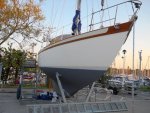
  • mtrax 573.jpg
    mtrax 573.jpg
    97.2 KB · Views: 10
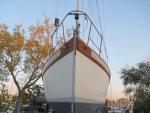
  • mtrax 572.jpg
    mtrax 572.jpg
    97 KB · Views: 11
The variable results with the same wood treatment suggests that the type of wood is critical to the performance of the treatment. I use Deks Olje D1 just the soaker coat on my cockpit rails and grab rails each year (only because it dulls), no peeling or flaking at all. It soaks in well and looks good. I know other people have said that DO is no good but that is not my experience-any problems and it has to be the wood type or previous treatments!
 
International have ruined Cetol Marine, which was a great product. If pressed they will admit to having changed the formulation.
 
I bought a tin of Dulux Trade Exterior Weathershield Ultimate Woodstain last year to do the exterior trim on my Nelson and it has been brilliant (much to my surprise). It still looks good after more than a year (varnish never lasts more than a season). It is slightly pigmented and glossy, and is a reasonable substitute appearance-wise for varnish.
I have only had problems with oil being sticky a few times - the only time it will happen is if you use old stale stuff that has lost all the volatile components. Decent fresh oil will dry completely because it oxidises. I agree it doesn't last more than a few months but then again it is really an interior finish in my view (except for Deks Olje, which I have had success with as a long term finish, better than varnish).
 
I was the original poster and it is now 4 years on. So I thought I would provide another update. My boat has a lot of teak. I have given up on the Woodskin and I am in the process of stripping it all off. After thorough preparation and following the instructions to the letter and goodness knows how many coats it now looks awful. It has gone a matt dark brown laced with black patches where water has penetrated. The sad thing for me is the teak looks nothing like teak. It looks more like the sort of colour on dark brown Edwardian furniture. It lasted slightly better on vertical surfaces, but the horizontal ones are prone to water ingress and blackening. When I came to strip it was apparent that it had not penetrated the teak - it just sits on top. I used some heat and a scraper, then chemical teak cleaner followed by sanding. It is a lot of work. After a recommendation from a boat builder friend I am now trying Semco. It is expensive (but so was the Woodskin and I have 2 unopened tins) It is easy to apply - like brushing khaki coloured water onto the teak. Just two coats the second immediately following the first. Yet to be proven but they say a wash followed by a top-up coat each season. So far I am pleased with the results. The teak looks like untreated teak. Water beads on the teak and apparently when this stops it is time to recoat. I'll provide an update next year.
 
I was the original poster and it is now 4 years on. So I thought I would provide another update. My boat has a lot of teak. I have given up on the Woodskin and I am in the process of stripping it all off. After thorough preparation and following the instructions to the letter and goodness knows how many coats it now looks awful. It has gone a matt dark brown laced with black patches where water has penetrated. The sad thing for me is the teak looks nothing like teak. It looks more like the sort of colour on dark brown Edwardian furniture. It lasted slightly better on vertical surfaces, but the horizontal ones are prone to water ingress and blackening. When I came to strip it was apparent that it had not penetrated the teak - it just sits on top. I used some heat and a scraper, then chemical teak cleaner followed by sanding. It is a lot of work. After a recommendation from a boat builder friend I am now trying Semco. It is expensive (but so was the Woodskin and I have 2 unopened tins) It is easy to apply - like brushing khaki coloured water onto the teak. Just two coats the second immediately following the first. Yet to be proven but they say a wash followed by a top-up coat each season. So far I am pleased with the results. The teak looks like untreated teak. Water beads on the teak and apparently when this stops it is time to recoat. I'll provide an update next year.

I absolutely agreed with you. I've tried it twice and both time Woodskin has been rubbish. I'm likely to go back to good old varnish. The original owner put Coelan on and in 2001 and in parts it is still there! I would try that but apparently it's hard to apply, very expensive and I can testify to how hard itnis to remove should you ever need to.
 
I think International should have a technical inspector go round and see why some people have such poor performance from Woodskin, whilst others like me, put it on and have it work year after year after year.

But I do wonder when I read " . . . following the instructions to the letter and goodness knows how many coats . . . "
Well, it's a semi porous coating that is totally impaired if you put too much on. They say 2-3 coats and if you want to touch it up in subsequent years, then you need to sand one off before replacing it.

More than that and it doesn't work, it will look muddy brown and certainly not 'teak like' and will be a disappointment all round.
 
I think International should have a technical inspector go round and see why some people have such poor performance from Woodskin, whilst others like me, put it on and have it work year after year after year.

But I do wonder when I read " . . . following the instructions to the letter and goodness knows how many coats . . . "
Well, it's a semi porous coating that is totally impaired if you put too much on. They say 2-3 coats and if you want to touch it up in subsequent years, then you need to sand one off before replacing it.

More than that and it doesn't work, it will look muddy brown and certainly not 'teak like' and will be a disappointment all round.

I agree. You need to understand how it works. It is not intended to "soak in" - don't know why people get so fixated with this as most of the treatments that claim to sink in almost by definition leech out unless covered with a second impermeable coating, or an encapsulating porous one like Woodskin.

I have bits of my wooden boat which have porous woodstain, either Sikkens or Woodskin that has been on for over 10 years with initially 3 coats and some have had a refresher after rubbing down of up to two coats. Mixture of timbers - mahogany, sapele, iroko, teak and douglas fir for spars.
 
I think International should have a technical inspector go round and see why some people have such poor performance from Woodskin, whilst others like me, put it on and have it work year after year after year.

But I do wonder when I read " . . . following the instructions to the letter and goodness knows how many coats . . . "
Well, it's a semi porous coating that is totally impaired if you put too much on. They say 2-3 coats and if you want to touch it up in subsequent years, then you need to sand one off before replacing it.

More than that and it doesn't work, it will look muddy brown and certainly not 'teak like' and will be a disappointment all round.

Their instructions say a minimum of 3 coats. I only gave it 3. Their information also says Low viscosity penetrating formulation does not require thinning for application
 
Their instructions say a minimum of 3 coats. I only gave it 3. Their information also says Low viscosity penetrating formulation does not require thinning for application

I tried 3 and then 5. In the vertical surfaces no problem but horizontal surfaces it cracks and water penetrates. Certainly didn't breath. I also had very different colours from different tins. I asked them about this and they sent me 3 new tins.

I have found it to work reasonably well inside though but then most product fair well inside out of UV and rain.
 
Please could someone tell me why epoxy with anti uv varnish coat would not work?

I think the usual reason given is that a cured epoxy coat is brittle but wood moves under several influences. The result can be cracks in the epoxy. No experience myself but that's what I have read. These days I would have thought that more flexible epoxies existed.
 
Top