Interior restoration tips please

Didn't do it myself but a friend employed a proffesional furnature restorer and it was amazing.Without a doubt worth the money and it didn't actually cost that much.I can't remember how much but it was in the hundreds for a 48 footer interior like yours.Think how much paint etc costs (and time)
 
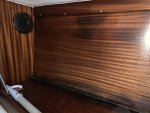
That is pretty standard teak faced ply but difficult to tell what the finish is. Different builders use different finishes, sometimes traditional varnish or polyurethane or a lacquer, probably sprayed on if it was from one of the bigger producers.

Many ways of freshening it up, depending on how bad it is and the amount of time and effort you want to put in. At one extreme you could strip it all back and start again, but a mammoth job, and often the top veneer is thin so you run the risk of damaging it. Probably the best way to start is to try in an inconspicuous place - clean the existing surface with white spirit and put on a coat of your chosen final finish and see whether it works. Personally I prefer a satin finish and use Ronseal polyurethane - blends perfectly with the original finish on my boat, but a dedicated satin finish such as Epifanes or International will also give a good finish. The worst bits are if you have water damage or abrasion removing the finish, then you have to go back to the bare wood bring back the colour and blend your new finish into the old.

You could also go radical and paint much of the panelling with white or off white and bright finish the trim which is solid wood. Upside is that it will brighten the interior and be easier to keep looking good. Downside is that it is effectively irreversible and could affect the resale of the boat in the future.
 
I like the idea of professional restoration from a furniture restorer, from what I've read there's little variation on this technique in the marine environment and the process is pretty much outlined by Tranona's post.

I found a really useful document on the process in the public domain by Colin Shead and have posted it here as I'm sure others will find it useful too

Many thanks ... Fizz

Colin Shead -http://leisureowners.memberlodge.org/Resources/Documents/teakwoodwork.pdf said:
Restoring Internal Teak Woodwork

Sometimes the teak interior woodwork, bulkheads, cupboard door fronts and the like need a little tender loving care. Spots of black mildew, general dirt and wear marks are common, not to mention (especially if the boat has had several owners) an assortment of teak oil and other treatments leading a patchwork quilt finish. Generally speaking varnishes, especially acrylic varnishes, are the hardest to deal with, as they can be very difficult to remove. Restoration essentially implies removing all the old finish (together with the accumulated dirt etc) and reapplying a new finish; all without damaging the teak veneer.

Last autumn I bought a Moody built in 1986. The Moody has had several owners, and was a little ‘sad’ in some quarters. During this winter I have been restoring the worst areas. Although not a Leisure, exactly the same treatments should be applicable to any yacht, where the furniture is built from teak faced ply, with some hardwood trims. You need to be realistic when dealing with black mildew. Small spots can fairly easily be removed, but if the wood has been damp for extended periods and has large black areas you are unlikely to be able to do much to improve matters, bar using one of the chemical bleaches (oxalic acid based) which will lighten the colour.

I knew already that simply sanding or scraping the old finish off would not be very easy, as the teak veneers are very thin, and the colour changes markedly if sanded, potentially resulting in a very patchy result. However if acrylic varnish has been used on your boat, then sanding may well be the only option, as they appear to be so tough that the chemical
strippers will not soften them. You can however quite easily sand any hardwood trims if necessary, to get back to a clean surface.

A visit to B&Q followed and I decided to try two products Colron Wax Remover, and Colron Furniture Stripper. These are intended for restoring antique and fine furniture, and are therefore quite gentle in action, and fairly simple to use. You will also need white spirit, fine wire wool (lots), kitchen paper towel (lots) and rubber gloves. The last essential ingredient is
patience! I did some experiments on a gallery drawer front first, and found that the wax remover was all that was generally needed, except where synthetic varnish had been used, or where the woodwork was much blackened. Generally it is easier to do the restoration at home, so I would recommend removing as many wood parts as is possible, leaving just bulkheads etc. to work on in the boat.

These are the steps I followed, using a door as an example:
• First remove any handles, hinges, hook latches etc.
• Dip a wad of fine steel wool into some wax remover and rub it quite firmly along the grain of the door working on an area about of not more than about a square foot at a time. Keep the wad well wetted with the wax remover, and you will find that after rubbing for a few minutes the finish (old teak oil and the like) will soften and you will be able to wipe off a fairly gooey brown mess with kitchen paper towel. If you find stubborn patches of mildew or other marks, just rub these firmly with the steel wool wad and wax remover, and with patience these can often be removed. Be a little wary of rubbing to the point that you actually damage the surface of the veneer. I found that with care you could also work across the grain to remove small rub marks etc.
• Move on the next area and repeat, until you have finished the door side. This is not a fast process especially if you have to deal with black mildew spots. If though you have a reasonably clean door, and just need to remove old layers of dirt and teak oil, the whole process can be done quite quickly.
• Take a clean wad of steel wool, dip into the wax remover, and gently repeat the process, this time over the whole door rather than in small areas. This will remove any overlap marks. Wipe the door thoroughly with paper towel and allow to dry. When dry polish the door with a dry wad of steel wool, remove any dust, and you are ready to apply new finish.
It is important to make sure that the preparation is ‘even’ across the door, as if you have left small patches of varnish etc., these will show up badly when the door is refinished. At this stage you can fill any big dents or unwanted holes with wood filler. You can get tinted wood filler in a tube, which whilst unlikely to be a perfect match, is in my opinion better than a hole!

Personally I finish using a synthetic teak sealer (traditional teak oil I think has a tendency to build up and go black). This is very easy to apply using a cloth and gives a matt or satin finish depending on how many coats you apply. If you find really stubborn patches, or where yacht varnish has been applied, the Colron Furniture stripper works well. You simply brush it on fairly thickly, leave for 20 minutes or so, and then rub off with wire wool, before finally washing off with white spirit. I found that multiple applications were generally necessary if all the old finish is to be removed. A final quick rub over with the Colron Wax remover helped to get rid of any lingering traces, and prepare the surface for refinishing.

Colin Shead
 
Last edited:
One thought on the furniture stripper.

If it's caustic soda based, there's no problem, provided it stays off skin and, especially, out of eyes, but if it's based on dichloromethane, alias methylene chloride, it's liable to eat fibreglass, so check the ingredients!
 
Restored the sapele interior of Storyline. Started off with varnish stripper but quickly abandoned that approach. The method that worked well for me was to use a good quality scraper and hot air stripper. Just follow the hot air gun and hopefully the varnish will just peel off - then get a sanding block, again a good quality one (1/3rd sheet) and carefully sand - say 150/200 then 400/600 grit. After some practice (you will gouge the wood at first) it is quite a quick system and the results look like new.
 
The wax remover/(very fine) steel wool approach - see #4 - can achieve a great deal and should in my view be tried before reaching for sandpaper or stripper (Liberon also do a range of wood restoration products). After cleaning off old polish and grime, one has a better idea of what lies underneath and can then decide how to proceed.
 
+1 for good quality scraper and heatgun, then remove resides with paintstripper (will raise the grain), then carefully graded sand/grit paper.

Steel wool is fine in the workshop, but you will find the rusty evidence of it for years when used on board. There are several non metallic alternatives.

Teak sealer is new to me, thanks for that.
 
That is pretty standard teak faced ply but difficult to tell what the finish is. Different builders use different finishes, sometimes traditional varnish or polyurethane or a lacquer, probably sprayed on if it was from one of the bigger producers.

Many ways of freshening it up, depending on how bad it is and the amount of time and effort you want to put in. At one extreme you could strip it all back and start again, but a mammoth job, and often the top veneer is thin so you run the risk of damaging it. Probably the best way to start is to try in an inconspicuous place - clean the existing surface with white spirit and put on a coat of your chosen final finish and see whether it works. Personally I prefer a satin finish and use Ronseal polyurethane - blends perfectly with the original finish on my boat, but a dedicated satin finish such as Epifanes or International will also give a good finish. The worst bits are if you have water damage or abrasion removing the finish, then you have to go back to the bare wood bring back the colour and blend your new finish into the old.

You could also go radical and paint much of the panelling with white or off white and bright finish the trim which is solid wood. Upside is that it will brighten the interior and be easier to keep looking good. Downside is that it is effectively irreversible and could affect the resale of the boat in the future.
 
Hi have read your note and was looking for some advice as I need to replace a panel in the saloon in my Bavaria which has been water damaged. I’m not a chippy and not sure what is the best way to go about matters. You appear exceptionally knowledgeable and would appreciate any advice you could give please.

40E33A8F-5914-4DEF-B59C-77FE53A37326.jpeg
 
I see from your other posting you have a Bav 38. As it happens I owned a 37 of the same vintage for many years. The basics I outlined all those years ago still apply. Fortunately I never had water damage on any of the ply panels and the only work I did on ply was matching additional bits, like a shoe locker in the forecabin. I did however refinish much of the solid wood trim using the Ronseal I suggested. For general refinishing of woodwork on Bavarias you may find this useful bavariayacht.org/forum/index.php/topic,2383.0.html Suggest you sign up to this Bavaria forum as it is stuffed with useful information.

Getting back to your panels. These are the most difficult things to refurbish - not just on Bavarias but on most boats that use ply panels. As in your other thread, removing these is a PITA, partly because Bavaria used mild steel screws and partly because they are held in behind furniture, I have never attempted to take any of the furniture out except for the cupboard unit in the aft cabin to access a stanchion base. If you can get it out your next problem is that it is thin, maybe 3mm ply with a very thin veneer so does not take to aggressive stripping. You may also find that once you get the varnish off the water damaged areas all the colour has gone and it is a challenge to stain it to get it back to match the sound bits. The end result could be visually worse than it is now.

Personally I would not even attempt it. I would either live with it, or consider reveneering the panel in situ using Robbins Flexible Veneer sheets robbins.co.uk/products-prices/sheet-material/

They do it in Sapele, but in 2 cuts, crown or quarter, so you would need to check with them which would match your panel. An 8*4 sheet costs around £80. Would save a huge amount of work though.
 
Hi all

I'm just in the process of buying my next love. The woodwork is a little shabby. Does anyone have any good tips on how to go about restoring the finish?

Please see pics, many thanks ... Fizz
Have a peek at the Repair Shop on TV for restoration strategies. Removing old paint and lacquer almost always a bad idea.

Restoration products, French polish etc tried in inconspicuous places will guide your hand. Festina lente.

PWG
 
Have a peek at the Repair Shop on TV for restoration strategies. Removing old paint and lacquer almost always a bad idea.

Restoration products, French polish etc tried in inconspicuous places will guide your hand. Festina lente.

PWG
I fail to see the relevance of this observation either to Fizzwizz of 8 years ago or to the recent poster. Actually Repair shop would remove the damaged finish and then blend the repair into the original just as I suggested, encountering exactly the problems I highlighted. This is not a piece of valuable (in either the monetary or emotional sense) family heirloom but a modern utilitarian boat. The owner just wants to improve its appearance.
 
About the mildest, most cautious, cheapest and quickest approach would be to use a citrus oil based polish/ cleaner. I once tried one sold by Kleeneze and thought that it was most inpressive - removed a lot of greasy, salty dirt and left a glowing finish and slight lemony aroma. No help if there's any water or other damage of course.
 
The photos clearly show significant water damage, probably from a leaking stanchion base just above that panel. stain at the top where water has got in the end grain of the ply underneath the solid trim and more extensive damage at the bottom where water has lain for probably a long period.

Have already suggested proper veneer - not fablon.
 
Top