
Interior lighting

Do these need a regulator or can you attach them via a fuse to the 12v boat circuit..? How easy is it to wire the cut strips..? I would guess they draw far less current than a fluorescent 8w tube.
I need to replace a tube fitting that has stopped working, and when visiting a chandeliers yesterday l met a customer who looked at my old fitting and said remove the old electronics and then replace the tube with a strip of led' led's and use the original housing and switch. I will try this as the original light fitting is difficult to replace with one of a similar size, most of the strip lights available are wider and will not fit.

The 3528 strip has 300 LEDs over 5m and uses 24 watts for the lot. So 2 amps if you're running all 300 LEDs (which is a lot!). The strip comes pre-wired at the end, however can be cut every 3 LEDs. You then need to solder on a new wire to the contacts on the strip. No regulator required. I have mine wired directly to the boat's fused lighting circuit (via its own switch).

I'm planning to do what you're thinking of. We have an old 8w tube light over the galley that I'm not overly fond of as it uses way too much power for what it does. I had looked at replacement LED bulbs in the 8w fluorescent bulb format, but they retail for £25! So I think I'll rip out the contacts and just shove a strip of the LEDs in there. It's all hidden behind the cover, anyway.
 
Do these need a regulator or can you attach them via a fuse to the 12v boat circuit..? How easy is it to wire the cut strips..? I would guess they draw far less current than a fluorescent 8w tube.
I need to replace a tube fitting that has stopped working, and when visiting a chandeliers yesterday l met a customer who looked at my old fitting and said remove the old electronics and then replace the tube with a strip of led' led's and use the original housing and switch. I will try this as the original light fitting is difficult to replace with one of a similar size, most of the strip lights available are wider and will not fit.

Whilst you can use self adhesive LED strip on flourescent light fixtures, I think the fixture looks like a fixture with strip stuck on it, in my view its rather unattractive. Also before there is a mad rush to purchase LED strip I suggest some caution. The marine atmosphere is saline and this can result in very rapid and damaging corrosion to any exposed copper, thats why we should only use tinned copper cable. Yes you can get waterproof strip but the connection are extremely vunerable. In my experience every strip I have inspected particularly after a damp winter, has the tell tale green verdigris on both exposed strip and on the connection area of pcb that has to be exposed to solder. Be aware that flexible PCB material is measured in microns so one can imagine how long that will last once corrosion sets in, not long I suggest.

A better solution and one which will give you very much more useful light is to replace your flourescent tube(s) with LED tubes which are made for the job. The replacement tube looks in place and gives consistent and much better light light than the original tube or the same length of stuck on flexible LED strip. The shorcoming of LED Flexible strip light is the limit of light availiable per unit length of the strip. You could of course run a number of strips but that looks even worse!

LEDs have to be quite widely spaced on flexible strip to enable cooling of each LED, they rely on the flexible copper PCB to conduct generated heat away. Good quality LED tube lamps can have LEDs mounted closely together as they are built on an aluminium PCB which mounted on a relatively large heat sink. This thermally efficient arrangement means much more light from the 300mm (1ft) space availiable.

Converting flourescent fitting to LED is well within the DIY skills of most boat owners, essentially it means disconnecting the electronic ballast buit into the fitting, conversion is ideal if the fitting is duff anyway.

Like most LED lamps, the ones with the best lumen output are more expensive that those offering less light. A good guide when selecting LED tubes is to look how closely the LED are spaced on the tube. Ones with wider gaps between LEDs suggest that they have less efficient heat sinks and consequently will give less light despite some vendors claiming all sorts of amazing things. Vendors also sell tubes with opaiqe covers and you can't see the LEDs so do check the lumen output of lamps, this should be shown by the vendor, if its not, smell a rat and walk away. The light output of LED tube lamps can vary considerably, the cheaper ones can be poor value for money. Generally you get what you pay

Regards
 
Last edited:
I have got to comment on your last post Adrian after visiting your website which l found very informative, and has just the products that l am looking for. There is a lot of technical information linked to each of the products, and while they are a little more expensive than some eBay alternatives I will be placing an order with you shortly. Your reasons for using the Led tubes makes a lot of sense over Led strips as the salt air can easily corrode the thin wiring joints. Technical support like this really helps.
Many thanks for your constructive comments, this is a great example of how this forum supports the sailing community.
Paul.
 
Note that with the warm white led strip, the 3 connectors are soldered together to make warm white.
If you just want red - R then cut the connection to G - green and B - blue.

Often low quality warm white strip manufacturers use flexible RGB lighting PCBs for conveinience and to spread the load current over what are three tracks of minimal cross section. Each warm white 5050 LED consists of three emitters with one emitter connected to each track, thats why they are soldered together at the end of the strip. If you cut the connection to G and B marked track you wont get red you will get 1/3 of the warm white light output. Incidently if you have this type of strip with white light, it's a real pain, I know from bitter experience, soldering the RGB tracks together whilst also connecting supply cables. The risk of overheating the strip without use of a temperature controlled soldering iron is significant. Overheating can often result in the very thin copper track teminal pad parting company from the base. Then its knackered and your strip is now three inches shorter!! If you want single colour flexible LED strip, ask your vendor to provide two track, that is often much better quality and the copper track is more substantial and less prone to over heat damage. I suspect many EBay providers wont know what your asking about, but thats another subject.

Its different for 'proper' RGB LED flexible strip which is significantly more expensive. The LEDs used also have three emmitters, in this case one giving red, one green and one blue light. Dropping off two would result in a single colour output. However, quite why you would want to do that seems rather odd as single colour strip is about a third of the cost and would have pretty much three times the light output.

Regards
 
I know from bitter experience, soldering the RGB tracks together whilst also connecting supply cables. The risk of overheating the strip without use of a temperature controlled soldering iron is significant. Overheating can often result in the very thin copper track teminal pad parting company from the base. Then its knackered
It depends on how ham fisted you are with a soldering iron :)
However, quite why you would want to do that seems rather odd as single colour strip is about a third of the cost and would have pretty much three times the light output.
I was thinking along the lines of using just a couple of sections from the strip if you wanted to put in a red light somewhere, rather than buying another strip.
 
It depends on how ham fisted you are with a soldering iron :)

I was thinking along the lines of using just a couple of sections from the strip if you wanted to put in a red light somewhere, rather than buying another strip.

You may be right about me being ham fisted, I do have rather big fingers and they do sometimes get in the way :rolleyes:, although an excessively hot soldering iron will cause damage independently of being ham fisted, that was the point I was trying to make.
I think you may also have misunderstood what I said about the production of red light, a warm white strip can't produce any red light, only an RGB LED strip, or less expensively, a red LED strip can do that.

Regards
 
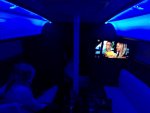
We went for 5050 smds in rgb with a remote. Tucked behind the grab rail on the roof they give a great light. I only have a shot of them in crazy blue mode below but the red is good for night racing and they can be dimmed.
 

Attachments

  • image.jpg
    image.jpg
    72.5 KB · Views: 0
I replaced my old units with lights from http://hmsmarinesupplies.com/ I found some stainless domes for thr main cabin tha were in keeping with the period of the boat. LED strips on an older boat look a bit "Stringfellows" if you ask me.
The light they give is better than the old units which used 2 10 watt festoon lamps. Now I don't worry how many lights are on at the same time due to the low consumption.
Worth a look if nothing else.....
 
I have just replaced my ceilings and have used small mains brass down lights from local electrical wholeseller ,I also used mr16 led lamps ,which I purchased on net 1/4 the price ,and also used mr16 lampholders to convert to low voltage from net.You can get a good choice of mainsdownlights from wholesaller,brass chrome stainless white ,which they sell without the transformers.The light levels are the same as using 50 watt lamps.All my internal lights have mow been converted and I now use the same amperage as one 50watt lamp 16 lights total.
 
I just bought some high power strip lights from ledhut.
I was suprised when i worked out the requirements was 36watts for the 2.5metre, so they can pull a bit of current... Far brighter than four 10watt festoons though....
 
I replaced my old units with lights from http://hmsmarinesupplies.com/ I found some stainless domes for thr main cabin tha were in keeping with the period of the boat. LED strips on an older boat look a bit "Stringfellows" if you ask me.
The light they give is better than the old units which used 2 10 watt festoon lamps. Now I don't worry how many lights are on at the same time due to the low consumption.
Worth a look if nothing else.....

Many thanks - I was looking using the incorrect search words. 'Dome light' seems to be the key. Have ordered a couple your suggestion to see the quality.
 
William_H;4045538 The advantage being that it will stick on the lining and take away no headroom. The down lights be they LED or halogen will take up space behind the lining about 50mm needed and of course a hole in the lining. The strips can be removed if you change your mind with o damage to lining. good luck olewill[/QUOTE said:
My down lights with back pin LEDs take up only around 20mm and 6 of that lies in the plywood thickness and another 2 in the fitting itself.
An incidental benefit is that the rim of the fitting can be used to hide a screw head. The screw attached to the head is a great way of fixing the plywood to the deckhead. Having said that, the screw needs to be in a block epoxied to the deckhead (assuming you cannot screw into the GRP) and that in turn produces headroom above the ply which removes the headroom problem anyway!
 
We went for 5050 smds in rgb with a remote. Tucked behind the grab rail on the roof they give a great light. I only have a shot of them in crazy blue mode below but the red is good for night racing and they can be dimmed.

If I were you I would get rid of that post in the middle. It's spoiling the view of the TV.
That really is a crazy blue mode.
 
Top