Interesting conundrum

Graham_Wright

Well-Known Member
Joined
30 Dec 2002
Messages
8,184
Location
Gloucestershire
www.mastaclimba.com
My Sirling charger has three outputs. Wishing to protect the fuse (in the return lead) I installed an MCB on each outlet.
They seem to interact.
Frequently, I cannot make all three together.
Engaging 1, the second trips the first.
Engaging 2 and 3 is ok. Then I add the third and it trips.
The total current is below the rated output.
How can they interact?
One for Paul?
 
Might be worth adding more detail to help diagnose the problem.

Have you measured the actual current on each circuit or are you just going by specifications of items connected?

What's actually connected? Anything likely to have a high transient startup current.

I'm certain you will have investigated this already but imagine someone will ask.
 
Might be worth adding more detail to help diagnose the problem.

Have you measured the actual current on each circuit or are you just going by specifications of items connected?

What's actually connected? Anything likely to have a high transient startup current.

I'm certain you will have investigated this already but imagine someone will ask.
That's a thought.
I will try switching off all the loads save for the batteries. Each is separately monitored and the total (when exceptionally all MCBs connect) is less than the rated charger output.
 
That's a thought.
I will try switching off all the loads save for the batteries. Each is separately monitored and the total (when exceptionally all MCBs connect) is less than the rated charger output.
Sounds like a plan. You said "frequently" and I assume that means "only sometimes" and that could indicate it only happens when certain items are running or just starting.

Additional data usually helps when tracking an intermittent problem.

I hope you manage to sort it out.
 
There are many different circuit breakers , not the amp size but they measure the inrush current . Need more info .
 
Your post raises so many questions.

Why are you trying to protect a fuse? Surely the fuse is doing what it should and protecting the charger common return from overload.

Are you using common household MCBs?

Are you aware that many are not suitable for DC?

Do you have the trip curve rating for the MCBs?

How many times have you tripped these MCBs? Cyclic ageing reduces trip capacity and time very quickly. A viscous circle in your application.

FYI I always used D rated mcbs for multiple outputs off a 12v DC PSU for industrial control panels.
D rated will supply up to 20 times their rated maximum current for a short period of time and allowed for inrush and the occasional short by a controls engineer!

In most circumstances I fitted individual fuses and fuse holders to protect each output. A cheaper and more reliable means of circuit protection but less convenient for the maintenance engineer for fault finding.
 
Your post raises so many questions.

Why are you trying to protect a fuse? Surely the fuse is doing what it should and protecting the charger common return from overload.

Are you using common household MCBs?

Are you aware that many are not suitable for DC?

Do you have the trip curve rating for the MCBs?

How many times have you tripped these MCBs? Cyclic ageing reduces trip capacity and time very quickly. A viscous circle in your application.

FYI I always used D rated mcbs for multiple outputs off a 12v DC PSU for industrial control panels.
D rated will supply up to 20 times their rated maximum current for a short period of time and allowed for inrush and the occasional short by a controls engineer!

In most circumstances I fitted individual fuses and fuse holders to protect each output. A cheaper and more reliable means of circuit protection but less convenient for the maintenance engineer for fault finding.
Heinemann/Eaton.
Rated 65 volts DC 15A.
JA1S-B2-AS-04-D-A-52
Delay 3 (secs?)
I bought them as a job lot, new, 80 for £50 at Beaulieu (RIP).
I have around 60 in use.
I do have the detailed data but not on board.
A nice feature is that they have isolated contacts indicating the status of the switch for remote monitoring.
 
Your post raises so many questions.

Why are you trying to protect a fuse? Surely the fuse is doing what it should and protecting the charger common return from overload.

Are you using common household MCBs?

Are you aware that many are not suitable for DC?

Do you have the trip curve rating for the MCBs?

How many times have you tripped these MCBs? Cyclic ageing reduces trip capacity and time very quickly. A viscous circle in your application.

FYI I always used D rated mcbs for multiple outputs off a 12v DC PSU for industrial control panels.
D rated will supply up to 20 times their rated maximum current for a short period of time and allowed for inrush and the occasional short by a controls engineer!

In most circumstances I fitted individual fuses and fuse holders to protect each output. A cheaper and more reliable means of circuit protection but less convenient for the maintenance engineer for fault finding.
As said a lack of info in OP. However, having had a look at the breaker details, as a stab in the dark and assuming your wiring is correct? Have you tried swopping the breakers between circuits and see if there is one particular breaker that trips. From the OP it would appear that the "No. 1" breaker is suspect.
 
Classic!

Boat jumble sales don't you just love em!

You might have been sold 15 amp breakers but they are probably not!

B2 in the serial no?

Confirmed here on the rating plate.....
Pardon our interruption...

2 amps more likely!
 
Classic!

Boat jumble sales don't you just love em!

You might have been sold 15 amp breakers but they are probably not!

B2 in the serial no?

Confirmed here on the rating plate.....
Pardon our interruption...

2 amps more likely!
Why do you sat that? The rating plates look genuine and the MCBs came indivdually wrapped in a Heinemann crate.
 
As said a lack of info in OP. However, having had a look at the breaker details, as a stab in the dark and assuming your wiring is correct? Have you tried swopping the breakers between circuits and see if there is one particular breaker that trips. From the OP it would appear that the "No. 1" breaker is suspect.
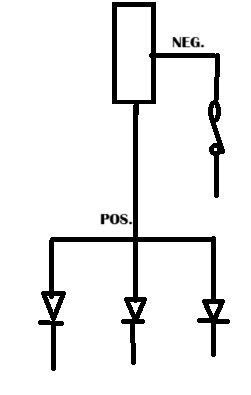
Further to my above, and to answer your question as to how they could interact. I believe, rightly or wrongly :unsure: that what you have is very basically shown below. If you have a breaker(s) made then making another will cause a "Blip" in all the circuits "Made" If you have one dodgy breaker then that could quite possibly be the cause of it tripping. I have not shown the breakers just simple charger.


BCHR..jpg
 
Last edited:
My Sirling charger has three outputs. Wishing to protect the fuse (in the return lead) I installed an MCB on each outlet.
They seem to interact.
Frequently, I cannot make all three together.
Engaging 1, the second trips the first.
Engaging 2 and 3 is ok. Then I add the third and it trips.
The total current is below the rated output.
How can they interact?
One for Paul?
Which model of charger ?
 
Post7
15A DC
65 volts
I will check the model and report back.

Graham
The J series usually has a 4 digit code in the part number to show the current rating.
If my memory serves me right anything with an 0010 was a 10 amp a 0015 was a 15 amp.
Anything with an R in it had a decimal point eg 02R5 was a 2.5 amp
Apologies if I am wrong but it is a few years since I used them in dc control panel builds.


We were often offered alternative cheap (x10 less!) supplies of various manufacturers mcbs. Cloned Chinese copies were rife . Buying new "old stock" could be a nightmare . I preferred to source through a main distributor hence my comment about Jumble sales!
 
Graham
The J series usually has a 4 digit code in the part number to show the current rating.
If my memory serves me right anything with an 0010 was a 10 amp a 0015 was a 15 amp.
Anything with an R in it had a decimal point eg 02R5 was a 2.5 amp
Apologies if I am wrong but it is a few years since I used them in dc control panel builds.


We were often offered alternative cheap (x10 less!) supplies of various manufacturers mcbs. Cloned Chinese copies were rife . Buying new "old stock" could be a nightmare . I preferred to source through a main distributor hence my comment about Jumble sales!
Just to confuse the issue here is one with the same code but rated at 30A.
Pardon Our Interruption...
I think the OP would be better to concentrate on finding the fault with his present setup and ignore the code for now.
 
The charger lurks below the charttableand is difficult to access. The spares I carry bear labels which have suffered due to jostling in the box.
The best guess I have follows;
JA1S-B2-A?-04-D-A-?
NFS 809 15/15
POLE 1
A 15
V 65
HZ DC
KVE 3
3589
The cast-in names are RE-CIRK-IT and
001-10826
HEINEMANN
 
Just to cut to the quick. The first thing I would look at, assuming the charger was working correctly before the CB's were fitted and the wiring is correct!
Also assuming that it always the same CB that trips. Would be that CB.
(1) I suspect that it is faulty, possibly loss of hydraulic fluid in the tripping circuit.
Either swop the circuits around and see if the fault follows with that CB. or change it for a spare
(2) It could of course be that the circuit that trips is carrying a load close to the rating of the CB and switching in other circuits just takes it over the top. That could be ascertained by measuring the current in each circuit, if you have a meter that will take the rating. If the CB's are swopped around and the fault stays on the same circuit, that could also indicate (2).
I would look at (1) swop first.
hope that all makes sense:rolleyes:
I would also double check the label of that particular CB :unsure:
 
Top