Shuggy
Well-Known Member
I thought it might be worth writing up my recent project in case anyone else is interested in how to integrate old and new electronic kit.
The boat was fitted with the following when I bought her:
Raymarine E120 MFD with GPS mushroom
Raymarine 24" 4kW radome
Raymarine ST60 wind/depth/log array and transducers
Autohelm type 100 course computer (driving 1971 Neco drive unit) with ST7000 head unit and secondary control at helm, plus fluxgate compass
Garmin GPS152 to provide position data to Standard Horizon DSC VHF
8 years on from our ownership of the boat (and 12 years on from the fitting of the Raymarine gear) the E120 screen had failed, the radar was power hungry and the ST60 units remained unconnected to the rest of the system as I had never got to the bottom of where the Seatalk 2 cables ran.
I decided to move to an NMEA 2000-based system with a B&G Vulcan 9 MFD, B&G 4G radar, McMurdo AIS transceiver and a VHF splitter.
Other than the mess of cabling to sort out, I spent hours trying to figure out how to integrate Seatalk and NMEA 2000 successfully. I had some very helpful input from a friend and between us we decided that the best way would be to introduce an ST60 Graphic Display into the ST60 and Autohelm side. This has the benefit of a built-in NMEA 0183 interface, which we decided could be fed into an Actisense NGW-1 gateway, which translates NMEA 0183 into NMEA 2000 data. I discovered at this point that the existing Seatalk cabling was completely bodged and when I unplugged the Seatalk -ve cabling the cabin lights went out. At this point I hit a bit of a low and decided to rip apart the main distribution board and identify every wire individually.
Before:

After:

Following that diversion, I wired everything up and plugged in the Actisense unit. Although the ST60 Graphic Display seemed to be seeing all the data on the Seatalk network (depth, log, heading) the B&G Vulcan couldn't see anything other than heading. I tried about 3 different ways of wiring it up including wiring the Actisense directly to the NMEA 0183 connections on the Autohelm type 100 course computer. Frustratingly no matter what I did I could not get the full data set onto the B&G display.

I then spent hours trawling the web and discovered a glimmer of hope. The Raymarine technical archive suggested that if I bought a Seatalk to Seatalk NG converter and chopped off the Seatalk NG plug I could replace it with an NMEA 2000 field-install plug and wire it into the NMEA 2000 backbone I had just installed.
Placing all the old gear on eBay, I bought the Raymarine converter and some field install NMEA 2000 gear. I wired it all up (wow - the connections were tiny & I had to borrow my wife's reading specs!) and set up the network connections in the B&G Vulcan. Excellent news - all working.

A bit more fettling later and I had the wind data up and running too. All that remained now was to rebuild the chart table from this:

to this:

with the VHF, AIS and splitter looking like this:

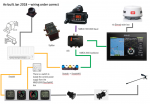
The final diagram looks something like this:

Hope it helps if you're trying to do something similar.
The boat was fitted with the following when I bought her:
Raymarine E120 MFD with GPS mushroom
Raymarine 24" 4kW radome
Raymarine ST60 wind/depth/log array and transducers
Autohelm type 100 course computer (driving 1971 Neco drive unit) with ST7000 head unit and secondary control at helm, plus fluxgate compass
Garmin GPS152 to provide position data to Standard Horizon DSC VHF
8 years on from our ownership of the boat (and 12 years on from the fitting of the Raymarine gear) the E120 screen had failed, the radar was power hungry and the ST60 units remained unconnected to the rest of the system as I had never got to the bottom of where the Seatalk 2 cables ran.
I decided to move to an NMEA 2000-based system with a B&G Vulcan 9 MFD, B&G 4G radar, McMurdo AIS transceiver and a VHF splitter.
Other than the mess of cabling to sort out, I spent hours trying to figure out how to integrate Seatalk and NMEA 2000 successfully. I had some very helpful input from a friend and between us we decided that the best way would be to introduce an ST60 Graphic Display into the ST60 and Autohelm side. This has the benefit of a built-in NMEA 0183 interface, which we decided could be fed into an Actisense NGW-1 gateway, which translates NMEA 0183 into NMEA 2000 data. I discovered at this point that the existing Seatalk cabling was completely bodged and when I unplugged the Seatalk -ve cabling the cabin lights went out. At this point I hit a bit of a low and decided to rip apart the main distribution board and identify every wire individually.
Before:
After:
Following that diversion, I wired everything up and plugged in the Actisense unit. Although the ST60 Graphic Display seemed to be seeing all the data on the Seatalk network (depth, log, heading) the B&G Vulcan couldn't see anything other than heading. I tried about 3 different ways of wiring it up including wiring the Actisense directly to the NMEA 0183 connections on the Autohelm type 100 course computer. Frustratingly no matter what I did I could not get the full data set onto the B&G display.
I then spent hours trawling the web and discovered a glimmer of hope. The Raymarine technical archive suggested that if I bought a Seatalk to Seatalk NG converter and chopped off the Seatalk NG plug I could replace it with an NMEA 2000 field-install plug and wire it into the NMEA 2000 backbone I had just installed.
Placing all the old gear on eBay, I bought the Raymarine converter and some field install NMEA 2000 gear. I wired it all up (wow - the connections were tiny & I had to borrow my wife's reading specs!) and set up the network connections in the B&G Vulcan. Excellent news - all working.
A bit more fettling later and I had the wind data up and running too. All that remained now was to rebuild the chart table from this:
to this:
with the VHF, AIS and splitter looking like this:
The final diagram looks something like this:
Hope it helps if you're trying to do something similar.
Last edited: