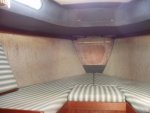
I am undertaking a refit of sorts on my Twister and I want to insulate her so we can get out more in the colder months and keep her cooler in the summer. Does anyone have any thoughts on the type of insulation to use?
The best performing insulation per unit of thickness is polyurethane (kingspan, Celotex)- about twice as good as the same thickness of rockwool, and considerably better than polystyrene.
It's important not to leave any gap between the insulation and the hull, otherwise moist air inside the boat will condense on the cold hull surface causing pockets of condensation behind the insulation.
Low expansion foam would be useful for gap filling and bonding the insulation into place. Of course it's not easy to get anything to stick to the inside of the hull- good prep (rough grit saner, acetone degrease) required.
I did the forecabin of my Vega with carpet on the sides & self adhesive closed cell foam (comes on a roll from Hawke House) on the roof. Crude but helps to reduce condensation...
I'm surprised if this issue hasn't been explored, perfected and demanded by thousands of yacht-owners and new-boat builders & buyers in climates like the UK's.
A bit difficult to believe that retrofitting insulation isn't possible, or that it won't be effective even if done with care and detailed planning.
That's the blog where I got the idea from. I guess you would just have to be really careful when layering the different insulation not to have any gaps. I was thinking about using caulk and then a roller of sorts to make sure the different layers were completely sealed together.
I think it will just take time, patience and lots of measuring!
Well worth doing, I reckon. As long as things like metal through-hull fittings are thoroughly insulated too - and hatches/windows will want double-glazing to prevent them leaking heat like gaping holes.
Such a pity these measures tend not to be included at boats' design/construction stage. A boat which is comfortable in the low season must be much better value than one which no-one wants to spend time aboard when there's an "r" in the month.
I lived through 2 winters FT on the Vega, roof with GRP/balsa sandwich made a difference, the unsinkable Sadlers are reportedly good aren't they? In addition to the carpet & closed cell foam used an oil filled rad for heat. For bunk used an electric blanket under a thin duvet with a thick duvet on top & sleep twixt the two duvets. Drip feed diesel heater/charcoal or wood burner would have been much better than oil rad but getting off topic...