Installing internal halyards on this Proctor mast?

Akestor

Well-Known Member
Joined
12 May 2018
Messages
428
Location
Athens, Greece
www.youtube.com
Hi all!
I have a Westerly 31 Longbow Ketch with a gold 10 m Proctor mast with external halyards. As I am bringing all ropes back to the cockpit, I hope I will be able to install the halyards inside the mast, as I am tired of the external spaghetti...
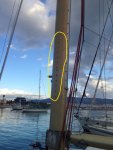
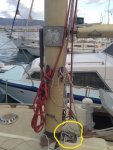
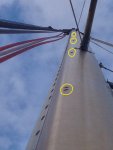
Anyone familiar with this kind of mast and if this is doable? On the starboard side photo, I've marked some rivets that seem to be an internal channel for the wiring? I've also marked a riveted area, where seems to exist an internal sleeve that connects the "two-pieces" mast, with the joint being around 1, 60 m from the mast base. Lastly, I've marked a DIY piece I made, installed it just behind the mast for the blocks to be attached. Where should the mast be cut for the halyard exits? above or below the connecting riveted sleeve?
Thanks
 

Attachments

  • IMG_0438.JPG
    IMG_0438.JPG
    520.9 KB · Views: 32
  • IMG_0430 (1).jpg
    IMG_0430 (1).jpg
    1,008.8 KB · Views: 34
  • IMG_0429.JPG
    IMG_0429.JPG
    489.6 KB · Views: 30
  • IMG_0433.JPG
    IMG_0433.JPG
    491.3 KB · Views: 28
  • IMG_0436.JPG
    IMG_0436.JPG
    454.7 KB · Views: 24
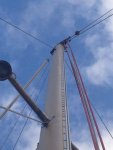
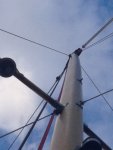
It may be possible to make them internal. I cannot see from the photos whether the halyards at the top of the mast are routed via a block or a sheave. This is critical as it is best to have a sheave that will lead the halyard inside the mast. Then the exit will be via a slot in the side of the mast above the mast joint. If you have 2 halyards you want internal, then the top of one slot must be at least 12" below the slot on the opposite side of the mast. How do I know? We lost a mast in the early 1970's whilst racing and luckily we hauled it back onboard. A manufacturing fault had caused the mast to fold at the halyard exits as the top of one slot was level with the bottom of the other slot. Proctors agreed it should have been a 12" gap and had to replace the mast and all the rigging.

If you have blocks at the top of the mast you could still have internal halyards by having slots at the top of the mast if you still followed the spacing mentioned above. You will need to unstep the mast to be able to cut the slots required.

Personally I do not think all the work required will be worth the time and cost. Your mast is about 45 years old and may have some corrosion you do not know about. If you alter it yourself and the mast then fails, I doubt if your insurance company would pay out for a replacement as the alteration was not carried out by a profesional.
 
At the top, the question might be whether simple sheave boxes inserted in the mast wall get the halyards high enough, or do you need a new masthead assembly to carry the sheaves.
At the bottom, I can't see if it is deck stepped or what.
Masts with slots high above the deck for halyard exits are great, they allow you to pull down on the halyards directly, which is fast and efficient. But they are often double thickness between the deck and a point above the slots. Maybe more so on bigger boats.

One way to de-clutter that mast would be to fit tapered dyneema halyards.
 
It may be possible to make them internal. I cannot see from the photos whether the halyards at the top of the mast are routed via a block or a sheave. This is critical as it is best to have a sheave that will lead the halyard inside the mast. Then the exit will be via a slot in the side of the mast above the mast joint. If you have 2 halyards you want internal, then the top of one slot must be at least 12" below the slot on the opposite side of the mast. How do I know? We lost a mast in the early 1970's whilst racing and luckily we hauled it back onboard. A manufacturing fault had caused the mast to fold at the halyard exits as the top of one slot was level with the bottom of the other slot. Proctors agreed it should have been a 12" gap and had to replace the mast and all the rigging.

If you have blocks at the top of the mast you could still have internal halyards by having slots at the top of the mast if you still followed the spacing mentioned above. You will need to unstep the mast to be able to cut the slots required.

Personally I do not think all the work required will be worth the time and cost. Your mast is about 45 years old and may have some corrosion you do not know about. If you alter it yourself and the mast then fails, I doubt if your insurance company would pay out for a replacement as the alteration was not carried out by a profesional.
Mainsail halyard goes up to a block aft of the masthead and back down, and two jib halyards go from the 2 aft sheaves to the 2 front sheaves and that's all. So 4 sheaves for 2 jib halyards, one of them not used, and the other one hoisting the genoa permanently on the fuller. So there are 4 sheaves at the top BUT they are made for wire halyards, and not sure if an 8 mm halyard will fit in them. The boom topping lift goes via a small block which is attached to the mainsail block.
Thanks for the important info regarding the gaps for the exits! I can visualize why the mast you lost folded at the weak spot.
If all halyards go inside, there should be 3 exits port, and 2 starboard, 5 holes...! I d' love to have them internally, but dropping and lifting cost 300 euros, just for the crane use. Dropping it and unable to do the job would be a double defeat!
 
Last edited:
At the top, the question might be whether simple sheave boxes inserted in the mast wall get the halyards high enough, or do you need a new masthead assembly to carry the sheaves.
At the bottom, I can't see if it is deck stepped or what.
Masts with slots high above the deck for halyard exits are great, they allow you to pull down on the halyards directly, which is fast and efficient. But they are often double thickness between the deck and a point above the slots. Maybe more so on bigger boats.

One way to de-clutter that mast would be to fit tapered dyneema halyards.
Fortunately, there are 4 sheaves on the masthead to carry wire halyards, but not sure if they are good even for an 8mm rope (Dyneema?)
This is a deck step mast.
You are referring to the wall thickness? That makes sense thanks for mentioning was not aware of that. I don't think this Proctor is thicker anywhere, except the length where the internal riveted sleeve is...
What do you mean by de-clutter the mast with tapered dyneema?
 
Mainsail halyard goes up to a block aft of the masthead and back down, and two jib halyards go from the 2 aft sheaves to the 2 front sheaves and that's all. So 4 sheaves for 2 jib halyards, one of them not used, and the other one hoisting the genoa permanently on the fuller. So there are 4 sheaves at the top BUT they are made for wire halyards, and not sure if an 8 mm halyard will fit in them. The boom topping lift goes via a small block which is attached to the mainsail block.
Thanks for the important info regarding the gaps for the exits! I can visualize why the mast you lost folded at the weak spot.
If all halyards go inside, there should be 3 exits port, and 2 starboard, 5 holes...! I d' love to have them internally, but dropping and lifting cost 300 euros, just for the crane use. Dropping it and unable to do the job would be a double defeat!
You now understand why the halyards exits are now built into the mast foot as this does not weaken the mast with so many holes. Personally I think you are now realising this idea in not really worth doing.
 
Top