
Installing a second battery

Jokani

Well-Known Member
Joined
21 May 2014
Messages
840
Visit site
I am going to install a 2nd battery, as per the 2nd picture here:
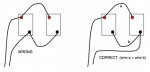
Image.jpg

My existing battery has lots of wires connected to both the positive and negative terminals.

Should I connect them to the terminals of just one battery, or to the positive of one ant the negative of the other?

Thanks in advance.
 
My existing battery has lots of wires connected to both the positive and negative terminals.

Should I connect them to the terminals of just one battery, or to the positive of one ant the negative of the other?

You can leave them connected to one battery, but you should ensure that each wire is fused as close to the battery as possible. You need only do this on one terminal (ie on the positive wires or the negative wires - not on both).
 
Ideally, the +ve wires should be connected to one battery and the -ve ones to the other, but it's unlikely to make a huge difference.

If you only have one battery on your boat at the moment, it's worth considering whether you'd be better off splitting the two and having a dedicated starter battery and a separate domestic battery. You don't get any more power to run lights and things, but if you do run the domestic one down, you've still got a charged one to get the engine going and put some juice back in the domestic.

PM me if you want a circuit diagram.
 
Thank Steve

"Ideally, the +ve wires should be connected to one battery and the -ve ones to the other, but it's unlikely to make a huge difference."

If wire in this way should other connections be all to one battery, or positive to one and negative to the other?
 
Hi. Both of your diagrams are electrically identical as long as the connecting wires are adequately sized. I added a second battery this year, as with
one battery you have to be careful to leave enough charge to start your engine. I tried split charge diodes to separate them but neither battery fully
charged. I next fitted a smart charger (Sterling I think, basic model) and have been very pleased with the results. The smaller engine start battery stays
topped up and even if I run the domestic battery flat I can start the engine and charge it up. With this arrangement you have just the two thick engine
start leads on one battery and all the other smaller leads for your lights instruments etc on the other. If you want to tidy up the wiring, connect all the
small individual wires to two (positive and negative) busbars (commoning blocks) and feed the two busbars from your domestic battery with suitably
thick wires.
 
If the wire are of adequate size to handle the amperage with minimum voltage drop, I can't think of any reason why it should make any difference

Hi. Both of your diagrams are electrically identical as long as the connecting wires are adequately sized.

The internal resistance of lead acid batteries is so low - typically 20 milliohms - that it's comparable with the resistances of the connecting wires and leads. The share of current taken from each battery depends on the total resistance between that battery and the load, so a battery with longer connecting wires will discharge less than a parallel battery with short ones (electric circuit enthusiasts: sketch the Thévenin equivalent circuit and all will be clear).

It's not a huge effect, though, and anyway the system can rebalance itself, so it's more of an "ideally desirable" than a "strictly necessary" or even "pretty good idea".
 
Thanks for all your advice, I'll just wire them up as is easiest to fit if it makes little or no difference.

I have a separate engine battery so no issues there.

Once again, your advice is much appreciated.
 
My existing battery has lots of wires connected to both the positive and negative terminals.

Should I connect them to the terminals of just one battery, or to the positive of one ant the negative of the other?

Thanks in advance.

You should not connect lots of wires to your batteries.

The correct way (whichever of the two configurations you choose) is via buzz bars. Connect all the separte wires to positive and negative buzz bars and then connect the buzz bars to the batteries with heavy duty cable.
 
Top