Installation of battery monitor

About Time

Well-Known Member
Joined
10 Sep 2014
Messages
215
Location
Denmark
Visit site
Hi,

I hope we have an electrician in here able to assist me :-)

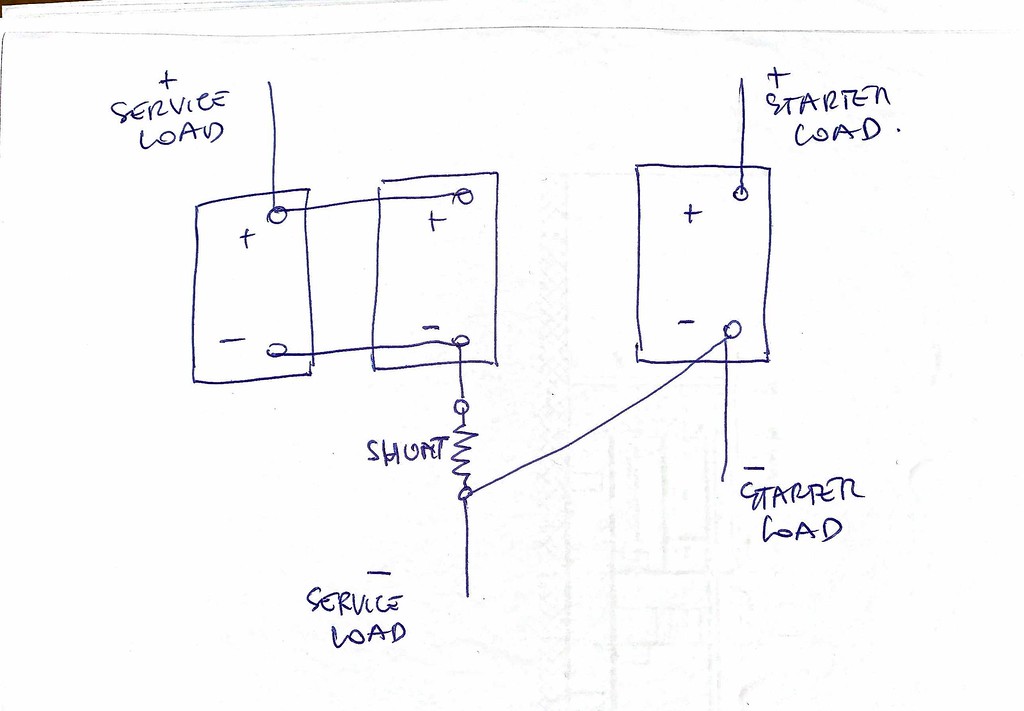
I want to install a battery monitor to my current set up that consists of 2 service batteries (one bank) and 1 starter battery (one bank).

At first glance the Victron 'quick' installation guide looks easy but then I realize that my current set up has all (-) minus connected with one (-) minus wire running to the service circuit and another (-) minus running to the starter circuit.

Can someone help make me a drawing how I should connect the battery monitor to my set up. It will be much appreciated. Thanks.

View attachment Victron monitor.pdf
 
actually this is exactly according your pdf - victron diagram,
pay attention to the correct connection of the shunt,
the big wires; one to battery and the other to neg of the loads,
need to be on the correct side of the shunt.
look at the victron diagram for correct orientation...
 
If you want to know about a shunt, here is an ‘expert’:(
Learn from him, please, don’t copy him:disgust:
 
BartW.... abt. to install.
The (-) minus wire from starter battery goes also in front of the shunt... if the shunt is good for 500 Amps....and I one day will have to use my emergency key to connect both the battery bank and the starter bank (due to a bad starter battery).... will the shunt then die ?.... I guess a large diesel will need more than 500 Amps to crank.... ?
 
.... will the shunt then die ?.... ;

No it won’t, the shunt can handle a high peak current for a few seconds, I have the same on my boat, batt mon with 500 amp shunt on domestic batts, and 1000amp shunt on engine batt’s,
Engines are 1100Hp each,
and I also have a emergency link switch .. .. but hardly ever used that since i have the two batt. Monitors ?
 
The shunt are some solid pieces of metal, with a dedicated internal resistance, not much can go wrong with that, that metal wil just get warm or hot... In normal operation <500 amps it shouldnt get hot.
 
Great. In fact found the spec on the starter.... 3 kW... in 12V system = 250 Amps right ? So this should work fine.

Electrical system
— 12V two-pole electrical system
— 14V/60A marine alternator with Zener-di odes
to protect entire system from peak volt age
— Charging regulator with battery sensor for
max i mum use of alternator
— Automatic fuses with manual reset
— Starter motor power 3.0 kW
– Extension cable harness with plug-in con-
nec tion available in various lengths
 
Great. In fact found the spec on the starter.... 3 kW... in 12V system = 250 Amps right ? So this should work fine.

Electrical system
— 12V two-pole electrical system
— 14V/60A marine alternator with Zener-di odes
to protect entire system from peak volt age
— Charging regulator with battery sensor for
max i mum use of alternator
— Automatic fuses with manual reset
— Starter motor power 3.0 kW
– Extension cable harness with plug-in con-
nec tion available in various lengths

Is that 3kW output, or 3kW load ? a 3kW output starter motor can use more current to operate it, stall current could be 500 amp, all depends on graph.

Brian
 
Thanks for making this note. The starter (original) is mounted to a Volvo Penta KAD 300 diesel. Anyone in the forum able to assist with a current graph for this starter ? I have put things aside waiting for the expert advise ? Thanks.
 
I read a tread that the start current often is 2-3 times the operating current. In my case that means the starter could draw as much as 500-750 Amps the split second it starts to crank (3 kW starter output). Once rotating the current draw will lower to 250 Amps... I guess a shunt valued at 500 A is continous current draw and not a peek measure or ? Anyone knowing this ?
 
I read a tread that the start current often is 2-3 times the operating current. In my case that means the starter could draw as much as 500-750 Amps the split second it starts to crank (3 kW starter output). Once rotating the current draw will lower to 250 Amps... I guess a shunt valued at 500 A is continous current draw and not a peek measure or ? Anyone knowing this ?

Can not find my file with starter loads / engines at the moment, but 500 amp should be safe. The problem is the monitor needs a input voltage, 75 mV or 100 mV say, so the 500 amp / 100mV shunt will have 0.2 mV per amp ( 0.0002 volt ) output, so can be susceptible to induction problems, so as a minimum use a twisted pair to connect shunt to monitor.

Brian
 
Thanks Brian.
I use the supplied Victron Energy shunt that comes along with the battery monitor BMV 712 (as a package). It says 500A 50mV on the shunt. In the manual it says I can use other shunts (up to 9999 Amps 75mV). The shunt has some electronics on the side (that possibly help the issue you indicate ??) ....When you say twisted.... what does that mean ?

Maybe I can have you google victron energy 500 A shunt and you see it.

I am thankfull for all the help guys.
 
Thanks Brian.
I use the supplied Victron Energy shunt that comes along with the battery monitor BMV 712 (as a package). It says 500A 50mV on the shunt. In the manual it says I can use other shunts (up to 9999 Amps 75mV). The shunt has some electronics on the side (that possibly help the issue you indicate ??) ....When you say twisted.... what does that mean ?

Maybe I can have you google victron energy 500 A shunt and you see it.

I am thankfull for all the help guys.

The two wires are twisted together as the name suggests, it helps reduce induction errors.

Brian
 
Thanks Brian.
I use the supplied Victron Energy shunt that comes along with the battery monitor BMV 712 (as a package). It says 500A 50mV on the shunt. In the manual it says I can use other shunts (up to 9999 Amps 75mV). The shunt has some electronics on the side (that possibly help the issue you indicate ??) ....When you say twisted.... what does that mean ?

Maybe I can have you google victron energy 500 A shunt and you see it.

I am thankfull for all the help guys.

The cable that comes with the shunt is a standard ethernet cable = twisted pair, the electronic on the shunt is just a small pcb with a fuse, to bring DC power via that cable to the monitor display
 
Long thread.
To the people who help me with above - Just want to let you all know that mission completed and shunt survives the Amp drawn by the starter.
 
Top