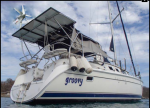
In support of solar

Several smaller panels are definitely preferable for the reasons you state, but it will generally cost and weigh more.
The standard roof top panel is about 300w and 1700*990mm so if you stick with that size you will the sweet spot for cost.

Nobody seems to let the windage or weight of a solar arch put them off. Even an array of three or four big panels is only the same weight as a shall to medium size person, for a large heavy displacement boat it's not really that important.

We fitted a pair of 300w* panels above the cockpit and then did a very rolly Biscay crossing. Can't say I noticed any change in the boat's behaviour.

* I say 300w but actually they are an older generation and are only 265w. Same physical size and weight though.
 
When I read "Don't be tempted to use the solar arch for anything that can create a shadow on your panels. You won't believe how detrimental those little shadows are to solar performance" my immediate thought was that it might be better to install 4 X 50W panels than 1 X 200W panel.

Is there any validity in that argument?

If the panels are likely to be shaded, yes, fit smaller ones, otherwise, no point. In your case, you also have to consider that you will need to have your panels in pairs, so you can't fit a single 200W panel anyway.

My other thought was that solar arches are not really suited to a Blue Water Yachts because of the effect on stability and also on wind-age.

If your boats stability is going to be adversely affected by some solar panels on an arch, it's not a suitable vessel for going to sea, never mind blue water sailing.
 
My other thought was that solar arches are not really suited to a Blue Water Yachts because of the effect on stability and also on wind-age.
Better not tell that to the thousands of blue water boats actually out there sailing the world safely with solar arches.

Some calculations would suggest perhaps that adding a roller furling main, or even adding a permanently hoisted furling inner jib or a radar dome, might have more impact than an arch 2-3m above sea level
 
If the panels are likely to be shaded, yes, fit smaller ones, otherwise, no point. In your case, you also have to consider that you will need to have your panels in pairs, so you can't fit a single 200W panel anyway.


If your boats stability is going to be adversely affected by some solar panels on an arch, it's not a suitable vessel for going to sea, never mind blue water sailing.

Thanks for your thoughts re small solar panels vs a large panel.

As far as yacht stability is concerned I follow the advice of a Blue Water Sailor (on YBW forum?) who says that in the event of very bad weather he gets anything heavy (such as anchors) down below and lashed. And to avoid unnecessary windage he lowers his soft dodger.

This article is along the same lines
Heavy Weather Dynamics: Upwind Sailing, Windage and Resistance

Heavy weather dynamics: the behaviour of yachts sailing upwind in high winds | Nordkyn Design


I suggest this is going a bit far!

Screenshot 2021-09-13 at 18-23-09 Arches, Biminis, Dodgers and Stability - Page 2 - Cruisers S...png
 
Last edited:
Don't be tempted to use the solar arch for anything that can create a shadow on your panels. You won't believe how detrimental those little shadows are to solar performance
This is an important point. Reducing shadows as much as is feasible will make an enormous difference to the harvested solar output. Placing tall structures elsewhere, if possible, rather than on the solar arch will make more difference than would be expected.

The solar arch can still be used for mounting smaller items such as GPS aerials etc. These can be installed such that their top is level with the solar panels. In this way they have a near 360° view of the sky with no shadowing on the panels.
 
I thought of mounting them on top of the stanchions and it appears it is not such a stupid idea. Maybe on top of the gangway?

"In the absence of an arch, many cruisers who don’t want to mount panels atop a bimini choose to install them on the lifelines alongside the cockpit. This is usually accomplished by replacing the upper wire lifelines with stainless tubing, although there are other ways of doing it".
Know how: Installing Solar Panels

Know how: Installing Solar Panels
 
This is an important point. Reducing shadows as much as is feasible will make an enormous difference to the harvested solar output. Placing tall structures elsewhere, if possible, rather than on the solar arch will make more difference than would be expected.

The solar arch can still be used for mounting smaller items such as GPS aerials etc. These can be installed such that their top is level with the solar panels. In this way they have a near 360° view of the sky with no shadowing on the panels.

We binned the Aerogen which was mounted on the gantry, it lost us more output from the panels from it's shadow than it generated.
 
Yes. Solar is brilliant.

I just wish I had bought higher quality panels. I have 3 panels that fit the available deck space. Total of 55W. Unfortunately, they are all suffering from delimitation after 3 years and the lack of power is noticeable.

A typo for delamination
Thanks for the heads up Stemar with regard to airflow underneath the panels. The panels were very cheap too so I will also upgrade for next season. Apologies for typo :)
 
Last edited:
The panels were very cheap too
Cheap is not an indication of quality in this area. While true that "too cheap to be true" is bad, normal cheap panels are generally the same as expensive ones, just with less branding and marketing attached. Look for features like ETFE and bypass diodes as well as half cell and don't assume expensive is better.
 
Cheap is not an indication of quality in this area. While true that "too cheap to be true" is bad, normal cheap panels are generally the same as expensive ones, just with less branding and marketing attached. Look for features like ETFE and bypass diodes as well as half cell and don't assume expensive is better.
Thanks mate (y)

Will do.
 
Thanks for your thoughts re small solar panels vs a large panel.

As far as yacht stability is concerned I follow the advice of a Blue Water Sailor (on YBW forum?) who says that in the event of very bad weather he gets anything heavy (such as anchors) down below and lashed. And to avoid unnecessary windage he lowers his soft dodger.

This article is along the same lines
Heavy Weather Dynamics: Upwind Sailing, Windage and Resistance

Heavy weather dynamics: the behaviour of yachts sailing upwind in high winds | Nordkyn Design


I suggest this is going a bit far!

View attachment 122382
If you go to the Caribbean you will this regularly, especially on USA flagged vessels. I think they must have shares in scaffolding companies. Another iteration we see is French yachts with the tallest structures (monkey bars) and the dinghy slung on the underside but so high up that you can walk on the sugar scoop without ducking. I kid you not. They dont seem to worry about windage or the impact on their stability
 
If you go to the Caribbean you will this regularly, especially on USA flagged vessels. I think they must have shares in scaffolding companies. Another iteration we see is French yachts with the tallest structures (monkey bars) and the dinghy slung on the underside but so high up that you can walk on the sugar scoop without ducking. I kid you not. They dont seem to worry about windage or the impact on their stability

Nice to read a comment from someone who understands the dynamics of yacht stability!:D

Yes, if the panels weigh 15kg each and there is two of them plus the weight of the arch structure the total weight is 50kg. If it is mounted 2.5m above deck and there's another 2m to center of buoyancy it probably negates 200+kg of the ballast. (If you add a dinghy on davits you would probably negate around 500kg of ballast)

Then of course there is the windage.:rolleyes:

MODERN SAILBOAT DESIGN: Quantifying Stability - Wave Train
 
Last edited:
Laminar Flow
Effect upon stability of adding weight at boom height

There seems to be some confusion how designers calculate displacement, righting moments and what particular elements are considered and which are not.

I highly recommend a read of Larsson/Eliasson, Elements of Yacht Design, (1994) for anyone interested in the subject. The methodology of calculations, apart from the use of more up to date materials is, btw, little different from that used in Francis S. Kinney, Elements of Yacht Design, published in 1962. In that sense not much has changed.

Calculations are done typically for half load and empty conditions. They include, in Larsson/Eliasson, navigation instruments, galley equipment, personal gear, bedding etc, etc, half full fuel, water and sewage tanks and crew. For a 12.5m boat of 8.1 t displacement they reckon with 980kg at (half) loading. The combined VCG for this load is, incidentally and for those who believe that loading their boat with below deck gear will compensate for all and any variety of sins when fitting out, 0.46m above CG. For interest's sake: the cumulative VCG for the propulsion system and all other onboard systems and technology, including batteries, tanks etc, is also above CG.

Sails are considered as raised, as one would expect.

None of the calculations include radar or communication antennae, arches, wind generators, solar panels, outboards strapped to the pushpit or rows of jerry cans with water or fuel strapped to the rail nor dinghies in davits.

A radar antenna weighs about 10kg. Mounted some 10m above deck or 12m above CG, this equates to a loss of 120kg/m of righting moment. To compensate for this you would have to add 83kg to the ballast or 2.6% of total, assuming a VCG of -1.45m for the keel (using the above boat as an example). This does not include the weight of the cable or the mounting bracket.
And, so it adds up.
 
I think you’re fundamentally confusing racing and cruising. None of these things are actually issues for a cruising boat.
 
If you go to the Caribbean you will this regularly, especially on USA flagged vessels. I think they must have shares in scaffolding companies. Another iteration we see is French yachts with the tallest structures (monkey bars) and the dinghy slung on the underside but so high up that you can walk on the sugar scoop without ducking. I kid you not. They dont seem to worry about windage or the impact on their stability
Correct, there's a Gallant 13.50 next to me with an French owner. The solar arch is made of 50mm tube its supporting a rib with a 15 hp outboard then it has a bathing platform aprox 2.5sq m. made of very substantial ss it looks to me if it did capsize it would never come back up.
 
Top