In support of solar

I wouldn't say minor I'd say negligable. You're right but I certainly wouldn't bother as the saving would probably be equivalent to 1-2 seconds of sunlight over a day*.

No, I didn't do the maths, feel free to educate me :D
 
As far as I know, and with info from Photonic Universe, very helpful people, panels tend to have bypass diodes built in. I’ve two 100w panels in parallel, with blocking diodes fitted on the junction box below deck, very simple and cheap DIY job.
We have PhotonicUniverse panels also. Our semi flexible ones have now spent 5 years in the spray hood and no issues yet. With technology moving fast I bought these at low cost (but good reputation) prepared to replace when needed - but lasting much better than expected. Even the roving semi flexible panel with no backing, generally tied to the dinghy thwart and seriously bashed about regularly, is doing fine.
Meanwhile the theoretically better fixed panel languishes in the garage as it was too unwieldy.
 
Solar panels are incredible.
They sit there doing their thing silently without moving.
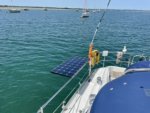
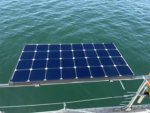
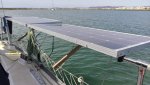
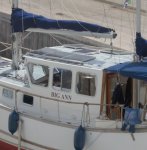
We have four 180w panels mounted on our guardrail. They have a prop that supports the panels that can be quickly adjusted for angle. This allows us to take advantage of early morning or late evening bright sunshine.
We installed a new Victron MPPT controller in November 2019 in the BVIs. This runs all four panels. Since we installed the new reg, we have sailed back to the UK. The panels were deployed horizontal all the way across the Atlantic. In fact we have crossed the pond four times with panels deployed like this with no problems.
Back in the UK for 12 months we did a major refit on the boat. The panels were left in the garage whilst we did this work. We are heading back to the Caribbean and are currently on the Algarve dodging Orcas.
The panels have done 11 months of output once you strip out the refit period but their total accumulated output is currently 462kw. This equates to about 1.4kw per day.
Without the solar we would likely have to run the generator to charge the batteries. Something we never do.
You could argue that you don't need 720w of solar. 1.4kw output could be achieved with far less capacity. We find that even with an overcast day in the UK, with long summer days we could fully charge the batteries with our installation. Panels are cheap compared to other forms of charging.
On sunny days we are fully charged in the morning. In the afternoon we can turn on the immersion heater using spare solar capacity or when the weather is hot we use the ice maker.
When we do this we peak at about 2.2kw of solar per day. The maximum peak output of the panels has been greater than the rated output due to the MPPT regulator.
Solar is amazing

I agree!

I am pleased to hear your guardrail install worked well as I have recently done the same with two 110W panels.

Care to share a picture of the install?

Also is your immersion 12/24v or 230v and inverter powered?
 
ETFE panels are the ones to go for and solve many of the issues of older designs. Unfortunately flexible panels have a bad name because too many people had the old style and had delamination or poor performance. Looking at my Renogy ones I’d be very surprised if they ever delaminate and the output is 104W on each 100W panel!
 
Last edited:
I agree!

I am pleased to hear your guardrail install worked well as I have recently done the same with two 110W panels.

Care to share a picture of the install?

Also is your immersion 12/24v or 230v and inverter powered?

Yes I'd like to see the stern rail solar panels too.

I recently installed two panels (2 X 90W) in series on the aft cabin roof. Just yesterday I wired up the 24V 3000W/6000W inverter and boiled the kettle! It runs the microwave and power tools as well (yet to try the HWS and washing machine)

But as I have a HWS, induction hob, kettle, toaster, bread-maker, small washing machine, microwave oven (in addition to lpg stove) I will certainly need about 6 extra panels. I also plan to install a 2000W water maker but that shouldn't run too long as it produces 80lph.

You don't have to convince me of the value of solar. :D
 
We have PhotonicUniverse panels also. Our semi flexible ones have now spent 5 years in the spray hood and no issues yet. With technology moving fast I bought these at low cost (but good reputation) prepared to replace when needed - but lasting much better than expected. Even the roving semi flexible panel with no backing, generally tied to the dinghy thwart and seriously bashed about regularly, is doing fine.
Meanwhile the theoretically better fixed panel languishes in the garage as it was too unwieldy.
I've always had relatively small panels but have used semi flex permanently fixed so they would harvest sunlight whether sailing or anchored. I'm amazed that so many sailors only get power when at anchor or marina and neglect the most productive part of the day - you never see ocean sailors doing that.
 
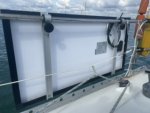
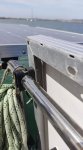
Here are mine. I replaced a wire guardrail with a length of matching SS pipe, fitted to the guardwire loops. Not ideal, but works.

The other fittings are Noa solar panel mounts. Not cheap, but work.

These are connected to a Victron 75/15 MPPT smart regulator. Not cheap but very good functionality (is you can change settings via the bluetooth app).

i also have a wooden T-piece to prop them up. Very heath robinson, but works well.
 

Attachments

  • 897364D5-F805-47B9-8207-04B3CE6BC828.jpeg
    897364D5-F805-47B9-8207-04B3CE6BC828.jpeg
    29.2 KB · Views: 48
  • CA9D10DD-D266-4BDB-8537-C15029320D57.jpeg
    CA9D10DD-D266-4BDB-8537-C15029320D57.jpeg
    35.2 KB · Views: 49
  • E64B1111-5C02-41C8-87C9-0111921660A9.jpeg
    E64B1111-5C02-41C8-87C9-0111921660A9.jpeg
    24.5 KB · Views: 48
I've always had relatively small panels but have used semi flex permanently fixed so they would harvest sunlight whether sailing or anchored. I'm amazed that so many sailors only get power when at anchor or marina and neglect the most productive part of the day - you never see ocean sailors doing that.
I don’t understand your comment related to my post. The spray hood stays up with panels on 24x365, and the panel in the dinghy on the davits is like a zero cost gantry - just with ability to move around for more optimum direction when needed.
But for doing ocean (which I don’t) I would definitely add a Watt&Sea or similar for water driven generation - worked very well on ARC I did
 
How are you getting on with those panels? I'd expect you would get a lot of shade under the mizzen boom, and unless you need 24v for dive reason it would be better to wire in parallel.
I agree!

I am pleased to hear your guardrail install worked well as I have recently done the same with two 110W panels.

Care to share a picture of the install?

Also is your immersion 12/24v or 230v and inverter powered?
Our immersion heater is 1200w @220v. When heating with solar we feed the immersion heater with 110v with an el cheapo inverter. Cost me £35 off eBay. I use a changeover switch to flick between 110v and 220v supplies. Also a 1hr timer. The immersion heater only pulls 300w at 110v.
 
Last edited:
I just have a single 20 watt panel that was cheap as chips on eBay. There was an existing controller and I put in a cheap as chips leisure battery (both under £30) and 16 years later they are both still fine. I don't have much demand obviously with such a simple setup, but I'm amazed they have done this long. I checked it's voltage output (before the regulator) last weekend and it was 18+volts. I have fitted led nav light (NASA) and led interior light.
 
I don’t understand your comment related to my post. The spray hood stays up with panels on 24x365, and the panel in the dinghy on the davits is like a zero cost gantry - just with ability to move around for more optimum direction when needed.
But for doing ocean (which I don’t) I would definitely add a Watt&Sea or similar for water driven generation - worked very well on ARC I did
Sorry, attached it to the wrong post.
 
I agree!

I am pleased to hear your guardrail install worked well as I have recently done the same with two 110W panels.

Care to share a picture of the install?

Also is your immersion 12/24v or 230v and inverter powered?
I agree!

I am pleased to hear your guardrail install worked well as I have recently done the same with two 110W panels.

Care to share a picture of the install?

Also is your immersion 12/24v or 230v and inverter powered?
View attachment 122322received_1175686686241681.jpegreceived_2009440215877163.jpeg
 
One point not mentioned in the flexible versus solid frame debate is back venting. Solar panels, being black and, ideally, exposed to the sun, very quickly reach temperatures that dramatically lower their efficiency. I never felt that flexible panels, mounted to a surface, addressed this problem adequately.
This was one of the main reasons I chose solid panels as these could be mounted with an airgap to promote cooling.

Our 300w array is composed of six 50w panels with two fields each and connected in parallel. This is installed on our wheelhouse roof in two rows on either side of the hatch and boom. For shading purposes this divides the array into 12 individual fields. At anchor or in port I used to fuss and tie off the boom to prevent shading, but charging is so efficient, I no longer bother.

At 35 Euro a pop, I will not have to slit my wrists if I accidentally step on one and being used for navaids in other applications was marine enough for me. I have stepped on them since (I do not make a habit of it) and they did not break and appear pretty tough overall.

small version (2).jpg
 
One point not mentioned in the flexible versus solid frame debate is back venting. Solar panels, being black and, ideally, exposed to the sun, very quickly reach temperatures that dramatically lower their efficiency. I never felt that flexible panels, mounted to a surface, addressed this problem adequately.
This was one of the main reasons I chose solid panels as these could be mounted with an airgap to promote cooling.

Our 300w array is composed of six 50w panels with two fields each and connected in parallel. This is installed on our wheelhouse roof in two rows on either side of the hatch and boom. For shading purposes this divides the array into 12 individual fields. At anchor or in port I used to fuss and tie off the boom to prevent shading, but charging is so efficient, I no longer bother.

At 35 Euro a pop, I will not have to slit my wrists if I accidentally step on one and being used for navaids in other applications was marine enough for me. I have stepped on them since (I do not make a habit of it) and they did not break and appear pretty tough overall.

View attachment 122331
One point not mentioned in the flexible versus solid frame debate is back venting. Solar panels, being black and, ideally, exposed to the sun, very quickly reach temperatures that dramatically lower their efficiency. I never felt that flexible panels, mounted to a surface, addressed this problem adequately.
This was one of the main reasons I chose solid panels as these could be mounted with an airgap to promote cooling.

Our 300w array is composed of six 50w panels with two fields each and connected in parallel. This is installed on our wheelhouse roof in two rows on either side of the hatch and boom. For shading purposes this divides the array into 12 individual fields. At anchor or in port I used to fuss and tie off the boom to prevent shading, but charging is so efficient, I no longer bother.

At 35 Euro a pop, I will not have to slit my wrists if I accidentally step on one and being used for navaids in other applications was marine enough for me. I have stepped on them since (I do not make a habit of it) and they did not break and appear pretty tough overall.

View attachment 122331
Good point about temperature. With guardwire mounted panels temperature is not a problem. They get masses of ventilation. It may be one of the reasons why our panels seem to out perform friends installations with similar solar capacity even though our panels were cheap Chinese electrical shop panels purchased in the Caribbean
 
Our immersion heater is 1200w @220v. When heating with solar we feed the immersion heater with 110v with an el cheapo inverter. Cost me £35 off eBay. I use a changeover switch to flick between 110v and 220v supplies. Also a 1hr timer. The immersion heater only pulls 300w at 110v.

hi

is this a 230v spec one you run at 110v?

will have to lookup how much ours is rated at.
 
Good point about temperature. With guardwire mounted panels temperature is not a problem. They get masses of ventilation. It may be one of the reasons why our panels seem to out perform friends installations with similar solar capacity even though our panels were cheap Chinese electrical shop panels purchased in the Caribbean

Another advantages is (if not already stated) is less shading than many other locations.

We have deck mounted ones, which get shaded. Which is okay as they were intended to be little more than trickle chargers. Ie we accept the compromise.

We also had a sprayhood mounted flexible panel that worked well. We removed it for fear of it being damaged. Ironically that is probably what killed it. It was left on in a F8 gale and was fine. Next time (if there is one) i would leave it on.

The guardrail ones are by far the best at solar harvest compared to other locations.
 
Another advantages is (if not already stated) is less shading than many other locations.

We have deck mounted ones, which get shaded. Which is okay as they were intended to be little more than trickle chargers. Ie we accept the compromise.

We also had a sprayhood mounted flexible panel that worked well. We removed it for fear of it being damaged. Ironically that is probably what killed it. It was left on in a F8 gale and was fine. Next time (if there is one) i would leave it on.

The guardrail ones are by far the best at solar harvest compared to other locations.
We know several boats with solar arches supporting 500w or more of solar. In addition on the frames they have been tempted to add a wind generator, antennas, etc. Solar will generally out perform wind by a factor of at least 10 until you create a shadow over the solar panels. Don't be tempted to use the solar arch for anything that can create a shadow on your panels. You won't believe how detrimental those little shadows are to solar performance
 
We know several boats with solar arches supporting 500w or more of solar. In addition on the frames they have been tempted to add a wind generator, antennas, etc. Solar will generally out perform wind by a factor of at least 10 until you create a shadow over the solar panels. Don't be tempted to use the solar arch for anything that can create a shadow on your panels. You won't believe how detrimental those little shadows are to solar performance

When I read "Don't be tempted to use the solar arch for anything that can create a shadow on your panels. You won't believe how detrimental those little shadows are to solar performance" my immediate thought was that it might be better to install 4 X 50W panels than 1 X 200W panel.

Is there any validity in that argument?

My other thought was that solar arches are not really suited to a Blue Water Yachts because of the effect on stability and also on wind-age.
 
Last edited:
Top