In support of solar

Or get it free like they have both times, they did start with a boat with no engine and had to do a fresh install so makes sense, it’s is a full conversion of boat and no real half way house from what I see on those that have done it.
Noticed that they have not gone electric for outboard, not sure they have explained this yet
I've always assumed that Uma haven't gone electric outboard because they want redundancy - for whatever reason they have insufficient battery reserves they still have 22ltr+ of petrol outboard.
 
Noticed that they have not gone electric for outboard, not sure they have explained this yet
Maybe no one will give them a Torqeedo?

I think logically I should mount two smaller panels on the Starboard side and the same on the Port side so that I will get at least some charge while under sail. Is that the way to go?
I'm not sure if two panels each side will give much advantage, but definitely split them each side of the mast. IIRC, wiring the panels in parallel works best if one is likely to be shaded

Unfortunately, they are all suffering from delimitation after 3 years and the lack of power is noticeable.
Are they flexible or semi-flexible ones? Rigid do seem to last better. The installation is more difficult, but rigid panels have the added advantage that they can be mounted with an air gap under them to give a bit of cooling, which helps efficiency

What's delimitation?
A typo for delamination
 
ETFE panels are the ones to go for and solve many of the issues of older designs. Unfortunately flexible panels have a bad name because too many people had the old style and had delamination or poor performance. Looking at my Renogy ones I’d be very surprised if they ever delaminate and the output is 104W on each 100W panel!
 
How are you getting on with those panels? I'd expect you would get a lot of shade under the mizzen boom, and unless you need 24v for dive reason it would be better to wire in parallel.

Thanks for your thoughts.

The boat is not in the water yet (cue PVB) so I don't know how the mizzen boom will affect the panels (it's a worry). I've thought of mounting a couple on the push-pit as well- at least they wouldn't be shaded. Maybe I will have to install diodes to overcome the problem of shading (apparently it can be DIY)

I always remember the survey they did of cruising yachts and they found that the average yacht spends 90% of its' time at anchor or penned

I thought a lot about 12V vs 24V and decided on 24V as I need an inverter to power the microwave, induction hob, bread-maker, HWS and water-maker. I was also swayed by what Rainbow Power Company had to say about 12V vs 24V.
12 Volt, 24 Volt or 48 Volt | Limitations & Solutions
24 Volt Electrical Systems | West Marine

I think you'll find most production yachts over 40ft are 24V these days
 
I don't think diodes will solve the problem. By wiring in series you are effectively creating one big panel, so any shade on either one will drastically reduce output. Guardwire mounting is a much better idea and not hard to arrange. You can also angle the panels to catch early and late sun.
I have my main panels under the boom but with a 4ft gap between them, so as far away from the boom as possible. Even when not under sail the shadow from the stackpack often falls on one of them, cutting the output in half.
 
My two 90W Renogy solar panels are working fine. I was surprised I was getting a good charge even when the panels were shaded by cloud AND

I got the 3000W/6000W inverter going just 30 minutes ago:D

Everything I tested worked fine - microwave, kettle, angle grinder. I had real problems though as I used a secondhand 9in. long cable from the battery to the inverter and guess what? It had a break in it! (The rest of the 3ft cable was fine when tested with the multi-meter)
 
Yes. Solar is brilliant.

I just wish I had bought higher quality panels. I have 3 panels that fit the available deck space. Total of 55W. Unfortunately, they are all suffering from delimitation after 3 years and the lack of power is noticeable.

Get rigid panels and then they can't delaminate. Much cheaper too.
I saw a video where somebody described how their delaminated flexi panel suffered from corroded wiring, which then led to a short, and then a fire. The sunbrella bimini burst in to flames above him and it was only because he was on the boat, at a pontoon with a hose to hand, that he was able to save the boat.

My first rigid panel had a hard life. Bought the cheapest unbranded one I could off eBay, and in the five years I had it, never missed a beat. It even fell off one night whilst the boat was beached, about seven feet down on to the stones, where it stayed whilst the tide came in and covered it. I was amazed that it had no cracks and still worked. And it was still working when I sold the boat a year later.
 
I've installed two 90W Renogy solar panels in series (24V system) on the aft cabin roof. The next step is to mount further panels on the cabin roof. I think logically I should mount two smaller panels on the Starboard side and the same on the Port side so that I will get at least some charge while under sail. Is that the way to go?View attachment 122241

What do you mean by 24V system ?

Are the batteries wired as 24V ?

Do you have 24V equipment onboard ?
 
I don't think diodes will solve the problem. By wiring in series you are effectively creating one big panel, so any shade on either one will drastically reduce output. Guardwire mounting is a much better idea and not hard to arrange. You can also angle the panels to catch early and late sun.
I have my main panels under the boom but with a 4ft gap between them, so as far away from the boom as possible. Even when not under sail the shadow from the stackpack often falls on one of them, cutting the output in half.

Maybe I will spend a bit more to get solar panels with diodes already installed.

Screenshot 2021-09-11 at 16-35-30 Blocking and By-Pass Diodes Used in Solar Panels.png

Blocking and By-Pass Diodes Used in Solar Panels
 
Maybe I will spend a bit more to get solar panels with diodes already installed.

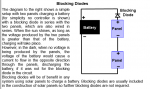
View attachment 122243

Blocking and By-Pass Diodes Used in Solar Panels

But surely bypassing one of your 12v panels just means you are trying to feed a 24v system from a 12v source? Which won't put one milliamp in to the batteries.
(Can MPPT controllers boost the voltage enough to compensate for that?? Even if they can, I'm sure you're better off wiring in parallel and then converting to 24v).
 
Each panel will have two strings with bypass diodes. If one part is shaded you’d end up with 1.5 panels not 1. The panels aren’t 12V more like 18V so would still work
 
As far as I know, and with info from Photonic Universe, very helpful people, panels tend to have bypass diodes built in. I’ve two 100w panels in parallel, with blocking diodes fitted on the junction box below deck, very simple and cheap DIY job.
 
As far as I know, and with info from Photonic Universe, very helpful people, panels tend to have bypass diodes built in. I’ve two 100w panels in parallel, with blocking diodes fitted on the junction box below deck, very simple and cheap DIY job.

Those diodes aren't meant to overcome shades panels.

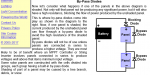
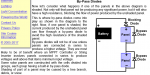
These are the diodes you are referring to;


Screenshot 2021-09-11 at 17-11-38 Blocking and By-Pass Diodes Used in Solar Panels.png
 

Attachments

  • Screenshot 2021-09-11 at 16-35-30 Blocking and By-Pass Diodes Used in Solar Panels.png
    Screenshot 2021-09-11 at 16-35-30 Blocking and By-Pass Diodes Used in Solar Panels.png
    48.9 KB · Views: 3
Well timed thread as our new installation was completed yesterday. Quite why we'd not done this before is beyond me, solar appears to be an absolute game changer.

We opted for 2 x 175W Victron panels, Victron MPPT controller, Victron DC DC charger and upgraded our domestic supply from 220ah of lead acid to 390ah of AGM. I'm sat here in my office looking at our remote monitor and the batteries are lapping up a healthy float charge on the swinging mooring!

Early days but I've a feeling this is going to prove one of the best investments yet.
I wonder how much that little lot cost
 
Virtually all solar panels that you would consider on a boat come as standard with at least two bypass diodes. They are necessary to prevent localised overheating and damage to the panel. If you are connecting the panels in series, it is worth installing additional bypass diodes to conduct past the whole panel in the event of shade, although there will only be a minor improvement in shade tolerance. This is especially true for low voltage panels fitted with a high number of internal bypass diodes.

Panels do not come with blocking diodes as standard. These can be easily added, but except in unusual cases such as when no solar regulator is used, these additional diodes will be counter productive and result in a slightly lower overall output.
 
Those diodes aren't meant to overcome shades panels.

These are the diodes you are referring to;
No the blocking diodes are to stop power loss at night and are not required with MPPT which will prevent that anyway. Bypass diodes allow individual strings to be bypassed without affecting the rest so two panels with a tiny amount of shade will output 27V instead of 36V
 
No the blocking diodes are to stop power loss at night and are not required with MPPT which will prevent that anyway. Bypass diodes allow individual strings to be bypassed without affecting the rest so two panels with a tiny amount of shade will output 27V instead of 36V

I agree with what you say but I am not using a MPPT controller but a cheap Chinese PWM so I don't know what it does.(Just as well the panels have blocking diodes!)
 
Unnecessary as the included bypass diodes already perform this function.
Each of the bypass diodes will have some voltage drop. When a single panel is deeply shaded, the current from all the other panels needs to pass through multiple internal diodes installed within the solar panel. Installing a bypass diode around the whole panel provides a shorter path through just a single diode and so in some circumstances will increase the power out of a solar array connected in series when subject to shade.

The improvement is only minor. The additional diodes are cheap, but they do add another failure point and can be difficult to install in a neat fashion. In most cases owners would be better to connect their panels in parallel or even better with one controller per panel rather than in series, but this is not always the case.
 
Top