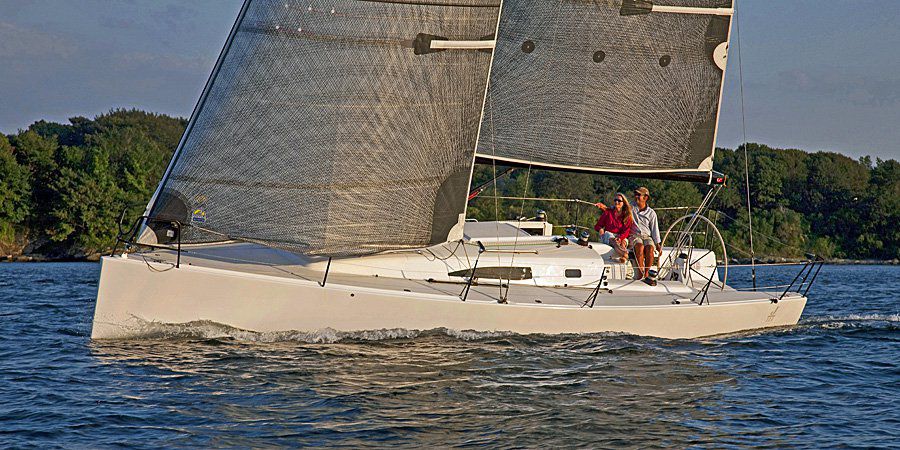
Improving the performance of my 36 foot, GRP, production, sailboat.

We started white sail racing with our club this season. I would highly recommend this as an up-skilling exercise. After a poor first series,we are pleasantly surprised at how we are doing in the second series. Like the OP I had been weighing up new sails, folding prop.Decided to stick with what we have and review at seasons end. Getting the most out of what you have is a great first step. Also reasonably steady crew becoming familiar with your set up and how to handle the boat in different situations.
 
For racing performance around the cans, probably the most critical thing is the shape of the foresail. An old baggy cruising genoa is not going to do you any favours on the windward legs.
 
What performance increase might one expect from having adjustable back-stays?

Ermm, does depend rather crucially on whether you have a fractional rig or not!

If fractional, the backstay controls mast bend which in turn affects the shape of the mainsail.

If masthead, it just leans the mast back slightly and tensions the forestay a little (which ought not to be slack in the first place).

Pete
 
Ermm, does depend rather crucially on whether you have a fractional rig or not!

If fractional, the backstay controls mast bend which in turn affects the shape of the mainsail.

If masthead, it just leans the mast back slightly and tensions the forestay a little (which ought not to be slack in the first place).

Pete

Not entirely true. With adjustable backstay on my masthead rig, I can change the pre-bend from 40mm to 80mm with the back stay on.
 
Buy a book on sail trim.

A few years back I used to work as a skipper for Sunsail in the corporate racing fleet. A new skipper joined the fleet and was consistently found at the back. He got somewhat depressed about this, and approached a few of us to ask what it was we were doing wrong. We all agreed that his main problem was sail trim. He went out and bought the North Sails Trim book, skipped the pub for a few nights and came very close to winning the next event. Suddenly every skipper that worked for Sunsail owned a copy of that book!

Then have a serious weigh audit - do you really need 3 saucepans? Is 8 fenders overkill? Does the wine cellar have to have both old world and new world Merlots? Up to you where the line is, but it does make a big difference.

Then make sure the bottom is clean.

But you can do those things easily and cheaply, and still spend a bit of cash on the boat (if that was the main thrust of the question....)

Don't bother with hull fairing, that's for people looking for the last few percent, and from what you've said that's not you.
New sails will make the biggest and most obvious difference, but in terms of speed increase per £ spent, I'd buy a folding prop first.
Then new sails (Jib first)
Then towable jib cars
Then make sure the outhaul on the main works properly
Then a proper mainsheet traveller
Then a spinnaker (then re-read that sail trim book...)
Then an adjustable backstay.
 
082010BTSN_7014v2-942-913-470-80-c.jpg
Does that wheel look a bit big?
 
Not entirely true. With adjustable backstay on my masthead rig, I can change the pre-bend from 40mm to 80mm with the back stay on.

Fair enough. After several years sailing exclusively gaff rig and square rig, I'm having to relearn (to be honest, learn from scratch in many areas :) ) about tweaking pointy sails. I think I might buy the book Flaming has recommended downthread.

Pete
 
As said this is another vote for a folding prop. Then IMHO if you really want performance to windward remove the furler and go for hank on purpose built jibs for the particular wind strength of the day. Then make sure the bottom is clean. Weed is a real slow down. I would never do a race without an in water scrub before the race.
Re fairing keel to hull. I am not sure what is really meant. My keel is vertically retractable so change from hull to keel is very sudden, a slight gap in fact. However as water flow is along this line I don't see it a problem. In fact I have always attributed good performance to the keel root shape. (ie just like a dinghy) So i doubt OP problem is fairing of keel. Unless there is a sudden step in water flow. I have thought that flat bottomed keels could benefit by fairing to allow water flow over the bottom (end effect) without turbulence. But mostly they are flat to sit on.
Anyway overall performance comes from many factors much being the skipper and crew. You will hopefully with practice improve in ways you won't be able to define. And of course some boat designs simply go faster than others and sometimes a similar boat is simply faster for undefined reasons. good luck olewill
 
Other free options for more boat speed include balancing the helm and looking at crew weight. Have the crew hike hard upwind when powered up - just 1% upwind can potentially win races. Also keep bodies out of the cockpit as much as possible. We often race against boats that have four or more sat aft oblivious to the fact they are dragging their arse which is soooo slow. Also take a look at the tiller (wheel?) upwind and on a reach, is it centered? Another common club racer fault is to sail with loads of weather helm causing a big amount of drag from the rudder.

More £, and I think not mentioned yet, are performance halyards. A lot of boats have over thick and very heavy halyards. Dropping a few mm and using dyneema (asides from stretch) gets a whole lot of weight out of the mast.

Having transformed a couple of boats recently there's a lot you can do that's free but of course prop and sails will be most noticeable.
 
To clarify why a folding prop is the best investment - it's because it will work equally as well on all points of sail, and especially in lighter winds.

Laminate sails are fabulous upwind, and especially in strong winds, but their advantage is reduced on a reach or a run, where that last bit of sail shape isn't as important.
And they're actually sometimes slower in very light winds, where having a lot of draft in the sail suddenly isn't a bad thing.

On the other hand, you'll have to tell everyone about your folding prop, whereas your laminate sails are there for all to see!
 
Other than changing the skipper - what one change would you make to my boat to make her perform better (sail faster and closer to the wind, etc) and what performance increase might be expected from making that change? She is just over 5 years old with the original, production mainsail & genoa, adjustable (but not cockpit-adjustable) cars, non-adjustable backstays, self-polishing antifouling......

It would be nice to know which boat the OP wants to go faster...........first35yacht2.jpg or bavariayact.jpg
 
Each argument has its exponents. Me, I'm a mirror finish believer. Spent too many hours wet&drying to be otherwise. But there are those who argue the slight- roughness-creates-a-boundary-layer proposition. I believe the Olympic dinghies were smooth.

on my last boat we did the osmosis treatment and filled and faired that hull until it was better than when it came out of the mold. all the leading edges were nicely round and the trailing edges sharp and pointy. We then coppercoated and burnished like crazy. the boat went 1/2 knot fast on the engine
 
I lose 0.2 knot with the windvane paddle in the water ( 36ft) in lighter airs.

I use this as an example of just how easy it is to slow a boat down by saildrives, big fat fixed props, rough edges...

(Edit). As the wind increases the windvane arguably comes into its own as it is so responsive to wind shifts....)

Weed is insidious . Bought a hull cleaner thingy ( Brizzo) and it has proved excellent. No point in having racy headsails if the bottom weeds up every two weeks ( which it will in warm summer)
 
Top