Improving sailing speed in light winds

pcatterall

Well-Known Member
Joined
2 Aug 2004
Messages
5,506
Location
Home East Lancashire boat Spain
Visit site
100_5488.JPG100_5507.JPG


We know that our yachtcan make good cruising speeds in moderate winds and upwards but thereare opportunities to make useful cruising speeds in lighter windswithout resorting to engine power.


With Coral Wind therewould seem to be 3 sorts of option or possibly combinations of them.


      1. Spinnaker or cruising chute type of sail
      2. Using the moveable inner stay for an extra jib
      3. Using a mizzen 'stay sail'


I have done somethinking on these options but need input from the experts.
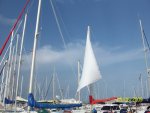
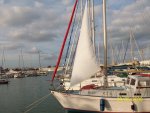
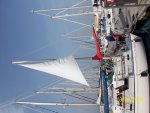
I have taken somephotos of a quick 'lash up' trial of items 2 and 3. The small jibshown is
just 'set up' as aself tacker and the mizzen sail could be much bigger.


Any ideas will bewelcome.
 

Attachments

  • 100_5503-001.JPG
    100_5503-001.JPG
    116.2 KB · Views: 0
I’m a big fan of the mizzen staysail based on 21 years/circa 40000nm with a Biscay 36 ketch (see avatar). The mizzen staysail was of greater area than the mainsail, was tacked down to the windward chainplate (your pic shows the sail tacked on the leeward side), sets across the coachroof passing between the mainsail and the mizzen and then sheets to a block on the end of the mizzen boom with the sheet run forward, through a further block and jam cleat, to the mast. We would fly the mizzen staysail when the wind was 60 degrees or more off the bow and it pulled like the proverbial train. At this angle we’d have the luff set up fairly tight but this would be eased further off the wind. It was built from about 6oz cloth but you might choose lighter if it was to be a very light wind sail only (we’d carry it to about 16kts apparent wind). One advantage of this type of sail is that it’s easy to handle; ease the sheet, lower away on the halyard and the sail falls across the deck and cockpit. The disadvantage is that you can’t tack or gybe it, it needs to be re-set.

Having said all that, I’d probably look at feathering prop and cruising chute or spinnakers in terms of bang for your buck.
 
Last edited:
I agree about the folding prop.
Downwind, I'd probably look for the biggest symmetrical used spinnaker I could get away with.
For reaching, an asy on a bowsprit?

Upwind, adding overlapping sails is likely to be small gains.
If you wanted to throw a lot of money at it, a bowsprit with a bigger genoa and a bigger mizzen to balance?

Start by checking that the sails you have are setting efficiently. Put some woolen tell-tale streamers on the sails and check sheeting positions etc.
It's not a high performance beating machine, but you can still make gains by setting the sails as best you can.
 
Are you short-handed? If so, a cruising chute will be easier to tame than a spinnaker, will give you more power than the staysail, and can be used for reaching, but why not mount the staysail as well.
 
I guess it would need to be a feathering prop due to rudder clearance. What we have seen is £2000 so not so cheap!

My investigation of folding/feathering props suggested that ( contrary to some advice on here) it was better to let our 3 blade prop spin when sailing but I will put that on a dedicated thread rather than here!

Thanks guys for all the other advice!
 
We went for an abysm which is great from reaching to most of the way downwind but remain slow in light beating conditions.

Folding/feathering prop high on our list but concerned about reliability as we find reliable boatyards far more miss than hit.

And weight - we have finally stated to take some kit off the boat when we can but 8 years in we are still adding more spares and tools and everything else and can't ever bring anything heavy or bulky home, or store it ashore.
 
Definitely folding prop and spinnaker for down-wind.

Reduce weight and particularly in the ends of the boat- ie reduce chain in bow locker with some rope, check-out the aft locker for stuff you never use. Don't fill the water tank to max if they are large (do what pilots do and work out how muck you need for the trip).
 
On our Neptunian we were able to fit a Kiwi prop, which certainly improved our speed. It’s not perfect in so much as it still rotates when you get the boat above 5kts and assuming that you have a TMP gearbox you can’t stop that. Like the idea of the mizzen staysail!
 
On my friends ketch he likes to hoist as much canvas as he can. Mizzen staysail is good when close hauled, massive cruising chute can cover quite a few points of sail, spinnaker is best left at home IMHO.
Big sails are not cheap though even when compared with feathering props!
 
General rules for light airs sailing. Even with a ketch.

Ease the halyard tension. In light airs a few horizontal creases down the luff are good. Ease the outhaul a bit too for more belly in the main.

Don't oversheet. You can't point as high in light airs so don't try. First thing to do is get the boat moving in whatever direction it wants to go then slowly alter course and SLOWLY sheet in the sails. If you can't hear the individual clicks of the winch pawls its too fast. Leave the slot open, which means more twist too. Match on the main as it is not just the slot you're keeping open you're also allowing for a bigger difference in wind speed across the height of the mast.

Crew weight for'd and to leeward. OK, you're not racing, but you could always send someone into the forecabin for a snooze. Don't let the crew jump around as it shakes the flow off the keel.

Similar approach downwind. It's all about getting apparent wind and carrying it onto a course that is closer to what you want. Means sailing the angles under spinnaker. And if you lose pressure in the sail come up until you get it again. An oversheeted spinnaker costs a lot more in light airs so if you have enough crew make sure you keep a fair bit of curl.
 
Top