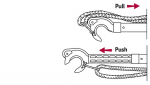
Improving mooring pickup

My boat hook consists of a mop handle (telescopic) with a piece of thin plate 10x25cms folded around the end of the handle for about 10cm and pop riveted to it. The ends are bent together so you have like a flag. Cut out the 2 layers of plate at the bottom of the flag ina semi circle to make a hook shape. Very cheap very effective.
I always moor the tender to the mooring when sailing with a very long painter gives me a big target for pick up. However people around here with large mobo use a pole attached to the buoy to raise the mooring rope up to reachable level. ol'will
 
When we had a mooring I replaced the pick up buoy with one of these. No boat hook was then needed. It was also tall enough to see from the wheel exactly where it was, so even better for the helm :)

anchor-marine-mooring-pick-up-buoy


View attachment 108397

Ours is a 'home made' version. Electrical conduit tube, a polystyrene buoy and roofing lead as the weight. As mentioned - ours is tall enough to be seen from the helm. We have reflective tape wrapped round the pole at the top - its easy to see in the dark (as long as you have a torch. If you have a boat hook you need to worry what to do with the boathook once you have the mooring itself. The pole is all part of the mooring and as long as you catch hold of the mooring itself the pole looks after itself.

Jonathan
 
Mylor were still selling the boat crook last year (but it could have ben old stock I guess). They are excellent and I've used nothing else for years.

No pic as it's on the boat: only 10 miles away but might as well be on Mars for all the chance of a visit. The crook does float as well (it's rather obvious how I found this out!). It's a yellow painted Aluminium shaft with a plastic hand grip at one end and stainless crook at the other. Not an impossible DIY project should the manufacturer have folded, but the thing is very well made and substantial: mine has lasted 15 years of frequent use.
 
Just lasso the buoy!

JOKE EVERYONE! ;)
Don’t worry, I always do as it has 2 advantages - firstly that it’s the only method that can stop a 13m boat going at 4 knots and secondly it helps the mooring’s owner in a Darwinian way to evolve their bouy purchase to something more robust.
 
I use a short rope loop on the pickup buoy's handle. The standard boathook is usually adequate to pick up rope, so that rope loop (perhaps 30cm diameter loop in 10mm rope) is the boathook target. I often singlehand, and mostly manage in one approach singlehanded, but always if 2 handed.
 
I wrote an article for PBO, However, they did not feel it good enough for publication. But it seems relevant to this thread so I hope someone likes it. Enjoy

Boat hooks

Now there’s a subject that can keep the bar pundits at Stone Sailing Club going for ages, In fact any subject draws the crowd in, provided the orator is buying the beers. It is a little-known fact that in the ever-advancing world of electronics, the humble boathook has not been left behind.

My first hook worked perfectly well. A visit to Thomas Foulkes, under the Leytonstone arches, resulted in a massive, galvanised ex army (Boadicea’s Icean army that is) whaling harpoon, “8 ft broom stick handle 3s 7d extra”. Three hours whittling the end of the stick to get the correct taper to fit, resulted in a 4 ft handle; 3 inch nail sticking out of the side & a wobbly 10Lb lump of metal on the end. One of the most dangerous pikes known to the Romans.

Whoa betide anyone on starboard tack who comes between Simon & his buoy. Full main & topsail set, the crew hanging over the pulpit waving the hook, like Boadicea in full fighting trim, 400 yards from the mooring, shouting “left a bit, right a bit” as they thunders past 50 yards away down wind & down tide , the helm screaming obscenities at his crew for missing the ring.

Some idiot in the RYA has tried to banish one of life’s greatest skills, by doing away with the hook altogether. Instead you can see “RYA approved sailing school dot com” along the East coast with poor souls hanging over the bow trying to lasso the buoy like Roy Rogers riding Trigger. Those that do manage to actually lasso the buoy, & not the prop, and then manage to burst the buoy- leaving the owner wondering where his £ 400-00 of best quality Chinese chain has gone.

Seeing a hole in the market on the Blackwater I flog the chain, so no complaints there, as each year owner after owner come with tales of woe & “Do I have any chain?”, “Oh!! & have you got any buoys left?”

It is a little-known fact that the RYA has robbed this from an earlier anchoring technique still practised at Stone.

As we know if you are on starboard tack, running down wind, an old gaffer has right of way over everything in its way, including moored boats. The technique is to let the dinghy out on 200 ft of line (you must have seen old gaffers thus rigged) generally with the wind up the chuff the dinghy will overtake to leeward forming a gigantic bight in the painter. The experienced helm just has to select a plastic fantastic 3 moorings up from his & lasso it with the dinghy, plus the next 2 down the line, thus bringing the heaviest of gaffers to a grinding halt. A leisurely stroll to the bow & our whiskery old salt leans over & gently raises the buoy. “Oh! Have I hooked my dinghy? Sorry old son, Never mind, it will unhook when the tide changes” Just as 3 owners rush for the gel filler & insurance policies

There were 2 designs of hook. One was for swinging mooring owners, which had 2 hooks on the end. You only used one, but two meant more danger with the cat’s cradle getting it out from the bottom of the deepest locker. New crews, eager to please after a day’s cruise, would offer to grab the buoy. More experienced crews would breathe a sigh of relief. Many a novice crew has fallen in to the locker. Sweeny Todd was said to live in a London Street but his counterpart- the owner of an old gaff cutter in Maldon lives on- luring new crew on board, never to be seen again, with the promise of far off lands & hot meat pies at 8 bells.

If you did manage to unwind the tangle of ropes, heaving lines, buckets & lead lines etc & did actually hook the ring, the weight of the old gaffer thundering past the buoy would drag you over the side in a trice. “Don’t you dare drop that hook” was the cry from the helm. Our budding crew had the choice, be dragged over the side & drown or 40 tongue lashings; most went for drowning.

The other type of hook was for dock side dwellers. Fortunately, they rarely went anywhere, preferring to make tarry smells, grow beards & cover the boat in baggy wrinkle, looking to the casual observer like left over tea clipper salts. Anyway, this type of hook has a point & only one hook. This is designed for pushing the boat off just before it crashes into the sea wall. Instead of being pulled over the side the novice crew gets the end of the stick in his stomach & promptly gets pushed over the stern. Pity really, as he does not get the chance to see the bowsprit clear the wall at ankle level & wipe out 3 tourists & a heap of lobster pots the other side of the road.

So, mooring sales apart, there’s a lot to say for the good old hook.

But time moves on & some budding Dyson has decided he can improve on a bit of kit that has lasted generations of old Harry’s. First it was a large detachable gunmetal hook on a stick & attached to a line. Our budding crew just had to lean over, hook the buoy at 6 Knts & disconnect the handle & Bob’s your uncle, just as long as the other end was looped on to the samson post. Old Pete would then do 150 foot pirouettes around the buoy as gaff & topsail did crash gybes decapitating anyone who dared look above the gunwale. Here in St Lawrence Bay it is quite normal for the salts to start the season moored to the east of the club & by October they will be just off Osea pier 3 miles to the west. “Stan – we must do something about the size of these sinkers -I think I’ve dragged a bit”

Nowadays we have super plastic contraptions that threadle the line , bring it back to the boat, tie a bowline , drop the sail & make the tea - all for a meer hundred quid or so.

In the old days if you could not afford a new boat hook you moored just below one of the other cruisers & wait for one to come bobbing down tide like a broad’s fisher’s pike float. They all came from Thomas Foulkes so no one could tell who’s they really were; besides ,to admit you had just thrown it over the side cost more in thank you beers & embarrassment than the actual hook. If you lost yours you just had to move down tide & wait for another.

Nowadays it’s different. You have to buy the dearest hook possible just in case the bloke 100yds downstream catches it & he would see the price tag & nod with envy. The size of boat isn’t an issue any more; it’s the size of your buoy & boat hook. I just wish they would attach the instructions in waterproof paper so I could work out how to use them.
Sam Longley
 
Last edited:
We carry two boathooks, mainly because I forgot to take one to the boat a couple of years ago and had to buy a second en route. The original is 6' long with a nice double bronze hook on the end and a clip for a Star mooring hook (no-nonsense sprung-loaded and slide-offable). The newer one is an absurdly long 8' one with a plastic point-and-hook thing.

I also have a Davey Grabit (thirty quid on eBay!), but that's far too good for use on the boat, so I keep it in my workshop and genuflect when I pass in front of it.
 
We have seen the extended pick up buoy, great and fairly inexpensive idea.

The type of buoy that can be seen in Portsmouth Harbour, just above Burrow Island on the Port side, used by the RNSA is the obvious answer.

It is a round floating base with an attatched vertical tube through which the mooring strop can slide. When at rest the loop is at the top of the raised - 1 metre perhaps - tube. Easy to grab by hand in a low freeboard small boat and equally easy with the boathook from a larger vessel. Once in the hand, the strop pulls through,over the bow roller and on the cleat.

Simples.

Initial cost would soon be outweighed by convenience.

If we go back to a swinging mooring I would choose one immediatly.
 
Or you could put a lanyard on the handle end.
Having hooked a buoy from a biggish boat with an unskilled helm in a bit of a breeze and a Western Solent spring tide, I don't want to be tied to a pole that's hooked on to a buoy. I'll leave the likely outcomes - one with and one without a lanyard round my wrist - to your imagination
 
We float a second small buoy off the main pick-up buoy on a short length of floating line, then just use the boat hook to grab that line.
+1 I was always taught that the handle of the buoy isnt for picking it up and that you should use the floating rope.
 
I got one of these after various disasters trying to hook a buoy solo, very satisfying mechanics, line goes straight on so no ripping off the pick up buoy etc. Can just reverse up and grab the thing from the cockpit.

The Ultimate Boat Hook | Extremely easy to use | Hook & Moor AB

Yes the Hook and Moor pole is brilliant for threading a rope on a visitor buoy with just a (narrowing) shackle on top.

But probably wouldn’t help the OP with a home mooring with pickup buoy, especially the current one with a thick plastic handle. Other suggestions on here address that better.

But we have ended up with 4 different poles to suit different buoys
- conventional cheap telescopic pole - ideal for lifting a pick up buoy
- Hook and Moor - unbeatable for threading a rope if shackle size fits
- another yellow handled threading pole (bought before H&M) - trickier than H&M but copes with thicker shackle sizes
- Baltic stern mooring hook - obviously suits designed use, but also can help secure quickly on other buoy types
 
Having hooked a buoy from a biggish boat with an unskilled helm in a bit of a breeze and a Western Solent spring tide, I don't want to be tied to a pole that's hooked on to a buoy. I'll leave the likely outcomes - one with and one without a lanyard round my wrist - to your imagination
You attach the lanyard to the boat (cleat), it would indeed be foolish to envisage putting it on your wrist or around your neck!
 
I’m another who clips the dinghy painter to the pick up buoy. If I’m sober enough to drive into the dinghy (JOKE) I can pick up the painter/buoy.
 
Top