
Improving electric installation - some questions

slawosz

Well-Known Member
Joined
26 Sep 2018
Messages
625
Location
London
Visit site
I have very simple electric installation on my boat. One battery charged by solar panel. Some receivers:
* nav lights & compass light
* log & sounder
* VHF
* usb & cigarretes socket & voltage display
* anchor light
Those grouped together are switched by one switch ie: the cable from switch goes to terminal block, and on other side 2 cables are connected together in one block.
All cables go to box where terminal blocks are connecting all positive cables.
Questions are:
- should I use terminal blocks (like those): Marine Terminal Strips or there is better way for doing this
- to join several cables into one, does it make sense to solder those into one and use shrink tube (or two) to secure them? - sometimes connecting those cables in terminal blocks is tiring. I know that having several cables in the shrink tube on one side could leave some gap, but maybe 2 would give good seal? I got wirefy tubes that has some glue inside.

Photos below - please dont judge me ;) The junction box is detachable and hidden behind bulkhead as space in Achilles 24 is very limited. Although I might install it below shelfs as it will be much easier to hide cables.
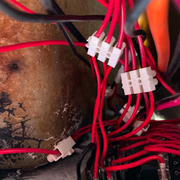

Terminal blocks are joining cables from switch panel. I will replace those by soldered connection secured by shrink tube

All cables are terminating in junction box.
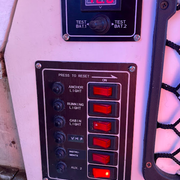
 
I am in the process of fitting one of these.

Blade ATC/ATO fuse blocks, ENDARK car fuse holder, 12 way fuse box with Negative Bus LED indicator for Car, Boat, Van, SUV https://www.amazon.co.uk/dp/B07YDF3...t_i_HKPFP1BEGNVJ2YBQBGJG?_encoding=UTF8&psc=1

It arrived promptly and seems to be of good quality. Certainly feels similar to Blue Sea stuff..

Incidentally I am cutting out choc block connectors that were fitted by the manufacturers 40 years ago.

Most seem to have lasted ok and my main reason for removal is to eliminate miles of wiring which is unnecessary, (provided I can live with a few visible conduits.)
 
2408.jpg


9218.jpg


0.5-1.5mm2-adhesive-lined-heatshrink-ring-terminals-red.jpg


Pre_insulated_crimpers_standard_1.jpg
 
I used exactly the items that buck posted, plus the cable cutters and automatic cable strippers from the same supplier. (12v planet) Those 3 tools, plus a heat gun for the heat shrink have made the complete rewire of my small boat a very enjoyable project, which is now almost done.
 
Looks very interesting! Not expensive, application looks easy. But how about hostile marine environment ;)?

Well clearly they arnt water proof, that said I expect the switch panel your using would be the very first place of failure.

I tend to use them inside a junction box, and with tinned table they are good and reliable like this. Inside a locker you can glue them in place.

The terminal strips are a bit fiddly. If I'm doing something like that I tend to pick up some dinn rail and dinn rail connectors. Dead cheap and easy to stick relays or link connectors with a combining jumper.
 
Blade ATC/ATO fuse blocks, ENDARK car fuse holder, 12 way fuse box with Negative Bus LED indicator for Car, Boat, Van, SUV https://www.amazon.co.uk/dp/B07YDF3...t_i_HKPFP1BEGNVJ2YBQBGJG?_encoding=UTF8&psc=1
I'd second this or something like it. I used a separate -ve bus, but I'm a firm believer in blade fuses, and the LED versions tell you which fuse you blew instantly.

One tip - label your fuses. Yes, I know you know which is which, but after you've blown a few during the wiring work, it should be years before you need to look at them again, and it'll be dark, wet and bouncy, and no, you won't remember!
 
One tip - label your fuses. Yes, I know you know which is which, but after you've blown a few during the wiring work, it should be years before you need to look at them again, and it'll be dark, wet and bouncy, and no, you won't remember!

Absolutely ...I got one of these in Aldi for 18quids... Great job...
Screenshot_20220131-090309.png
 
I am in the process of fitting one of these.

Blade ATC/ATO fuse blocks, ENDARK car fuse holder, 12 way fuse box with Negative Bus LED indicator for Car, Boat, Van, SUV
I like it however not sure how to incorporate switches here - I believe when I will connect the positive cable to my switch box instead of here it will be working properly.

Now I have some more questions :)
- would soldering and using tube shrinks be enough for joining cables?
- do I need to solder eyelets or crimping is enough?
- how to fit more than 2 eyelets to the 'barrier' terminal block which photo is posted above? I think with some fiddling I could put 3 eyelets together (I guess) per side. So if I have one circuit with more than 6 receivers (like lighting) I should 'expand' to the next block pair?
 
- how to fit more than 2 eyelets to the 'barrier' terminal block which photo is posted above? I think with some fiddling I could put 3 eyelets together (I guess) per side. So if I have one circuit with more than 6 receivers (like lighting) I should 'expand' to the next block pair?

In that situation you can either use the Blue Sea ones with the jumpers - so a 6 way will give you 5 out for one in or a wago 5 way which gives you 4 out from one in.
 
For more reliability on board, you can now get gel-filled cases for Wago 221 connectors. Not super cheap but for a few connectors, worth a look. You can open them up to make changes.

Otherwise, heatshrink crimp terminals are pretty bullet-proof.
 
I like it however not sure how to incorporate switches here - I believe when I will connect the positive cable to my switch box instead of here it will be working properly.

Now I have some more questions :)
- would soldering and using tube shrinks be enough for joining cables?
- do I need to solder eyelets or crimping is enough?
- how to fit more than 2 eyelets to the 'barrier' terminal block which photo is posted above? I think with some fiddling I could put 3 eyelets together (I guess) per side. So if I have one circuit with more than 6 receivers (like lighting) I should 'expand' to the next block pair?
Why would you have individual feeds to each individual receiver in a lighting circuit.?

Most boats have the internal lighting on a few circuits (2 or 3).

My mast/ nav lighting will be switched individually but fused centrally (I will use a resettable trip on the main board ) so I am using a separate bank of switches with indicator lights for these.
 
So if I have one circuit with more than 6 receivers (like lighting) I should 'expand' to the next block pair?

I had exactly this situation a while ago, when replacing 40 years old original wire nuts (still working fine) inside a junction box.
Solved by glueing two five way Wago 221s back to back, giving one for incoming and seven for outgoing (and two for the jumper between the two connectors).
Neat when space is limited.
 
I like it however not sure how to incorporate switches here - I believe when I will connect the positive cable to my switch box instead of here it will be working properly.
On Jazzcat, I have a couple of these kind of fuse boxes. T main battery feed which goes to one of the fuses on box 1. That way the supply is fused (20A). I then ran a few things that need to be permanently on (bilge pumps, etc) to the other fuses on that box. From what should be the supply terminal, I then ran a line to a master switch on the panel and back to the box 2 supply. Any circuits, like lighting (each light has its own switch) that needed no other switch were fed directly from the fuses in box 2, while stuff like instruments went from box 2 via switches on the panel.

My reasoning is that a fuse should be as close as practicable to the start of the circuit. the main supply doesn't really meet that requirement, but I figured that to meet it would mean the fuse being lost in the battery compartment, vulnerable to damp and not very accessible. Accessibility won out for that one!
 
Absolutely ...I got one of these in Aldi for 18quids... Great job...
View attachment 129585
I believe the LetraTag labellers operate similar to thermal receipt printers - they write using a LED or low power laser and require a particular type of heat-sensitive label-tape to print on.

I've had a label printer for 15+ years (or at least used to - not sure if I kept it when moving on board) which I believe to be from this Dymo LetraTag range and have found the labels prone to fading after a few years.

I think Rhino make some label printers that operate differently, and even offer rolls of heatshrink tubing you can print on.
 
I believe the LetraTag labellers operate similar to thermal receipt printers - they write using a LED or low power laser and require a particular type of heat-sensitive label-tape to print on.

I've had a label printer for 15+ years (or at least used to - not sure if I kept it when moving on board) which I believe to be from this Dymo LetraTag range and have found the labels prone to fading after a few years.

I think Rhino make some label printers that operate differently, and even offer rolls of heatshrink tubing you can print on.

Interesting....the heat shrink labels would be great.

I hope the plastic labels (rolls of compatable plastic tape on Amazon really cheaply) will last ok in a dark press.

I intended to label my clutches also, so it will soon become clear if they fade.
 
Brother label printers use tape that's very resistant to UV, the Tze range. Also available in printable heat shrink, but not cheap.
 
Brother label printers use tape that's very resistant to UV, the Tze range. Also available in printable heat shrink, but not cheap.
Their "product advisor" page seems very good, just so long as you make sure to click the "show more products" at the bottom.

As far as I can ascertain, their £50 P-Touch printer will print on the same tapes as the much more expensive electrician's model.

EDIT: went down a wee bit of a rabbit hole there, before realising that the heatshrink tape is as expensive as @PaulRainbow suggests - clarity of mind returned after I calculated the cost of tape to be 91p per inch, available in 5' cassettes; no doubt multiple sizes would be needed.
 
Last edited:
Top