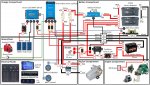
Improved wiring on "Off-1-2- Both switch"

That's almost exactly the setup I have, except that I have a cheap headlamp relay instead of a VSR, because VSRs were expensive when I did it and the relay was a couple of quid. If the relay should die, I'll probably replace it with a VSR, but it works fine as it is.

One thing that's missing from this setup is solar. If the OP has an outboard, power output is probably limited, so as many watts of solar as budget and space allow can only be helpful.
I think he may have an MD2B
 
That's almost exactly the setup I have, except that I have a cheap headlamp relay instead of a VSR, because VSRs were expensive when I did it and the relay was a couple of quid. If the relay should die, I'll probably replace it with a VSR, but it works fine as it is.

One thing that's missing from this setup is solar. If the OP has an outboard, power output is probably limited, so as many watts of solar as budget and space allow can only be helpful.

Passing observation, back 1982 I bought out my first VSR,fitted with a 30 amp relay ( 30 amp alternator were massive then ), which we sold till early 1990. I am still getting spare orders for replacement of original relay modules, so the 30 amp relays are having a life of over 35 years, based on around 4,000 units sold.

Brian
 
When you have a switch labelled OFF, 1, 2, BOTH ... then it is normal to think that both batteries 1 and 2 would be disconnected in the event that the switch was set to OFF. Because the OP has no longer wired both starter and house loads to the Common, the switch doesn't do what might be expected - this is based on the assumption that there is no change to the switch position or external labelling. That is the point I was trying to make. Re-wiring an existing switch to change its function, or wiring a switch in an "innovative" way may confuse anyone who has used it before or has a similar boat with the "normal" wiring.

As the OP hadn't stated where the second switch was, what it looked like, or how it was labelled at the time of my post, I was only trying to highlight the potential issues - which the OP seems to see too.

I'm not claiming it will not work, it will, the OP has stated what he's thinking of doing now and it's OK IMO.

A sensible solution, remembering that the OP wants to use his existing 1,2,both switch , is to fit a matching simple on/off switch for the domestic panel supply adjacent to the 1,2, both switch and to clearly label the two.
 
Last edited:
What's the graphics software you are using for those very neat diagrams please ?

I am embarrassed to say, I use Powerpoint.

Workflow is to search for pics of the components I need on Google, use the snipping tool to copy them and then I dump them onto a Powerpoint slide and draw in the lines. It's quite tedious, but Powerpoint is free for me and I can usually produce OK diagrams ...

Example ....

Charging.JPG
 
When you have a switch labelled OFF, 1, 2, BOTH ... then it is normal to think that both batteries 1 and 2 would be disconnected in the event that the switch was set to OFF. Because the OP has no longer wired both starter and house loads to the Common, the switch doesn't do what might be expected - this is based on the assumption that there is no change to the switch position or external labelling. That is the point I was trying to make. Re-wiring an existing switch to change its function, or wiring a switch in an "innovative" way may confuse anyone who has used it before or has a similar boat with the "normal" wiring.

As the OP hadn't stated where the second switch was, what it looked like, or how it was labelled at the time of my post, I was only trying to highlight the potential issues - which the OP seems to see too.

I'm not claiming it will not work, it will, the OP has stated what he's thinking of doing now and it's OK IMO.

I take your point, some labelling would soon fix that. As Vic said, a matching on/off switch would make sense.

He has exactly what you say he should have. One switch for the domestics and one for the engine. The Combine switch that you refer to is the 1-2-B switch, set to B

He does, The combiner I was referring to was something like a Victron Cyrix that connects both batteries for 30 secs via a push button - what I have on my boat.

After thinking a bit more, and if it were my boat, I'd buy this Add-A-Battery Kit - 120A - Blue Sea Systems because I like having one master switch that shuts everything off .....

[/QUOTE]

The Cyrix Start Assist might work for a slightly discharged engine battery, but wouldn't start the engine if the battery was totally flat. If one battery had failed totally, there is not way to isolate the faulty battery and continue to use the circuits it supplied.

The BlueSea switch also does not allow isolation of a failed battery, whilst being able to use the circuits that it supplied.

IMO, three switches is the most flexible method, with the most features to allow for possible failures etc.
 
Top