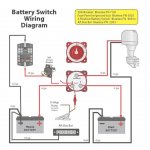
Improved wiring on "Off-1-2- Both switch"

Akestor

Well-Known Member
Joined
12 May 2018
Messages
428
Location
Athens, Greece
www.youtube.com
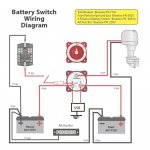
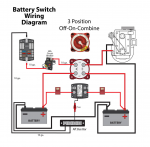
I found this pic on the internet, and most of the info online suggests to connect the dc loads on the COMMON of the switch. This is problematic as when we want to crank, we will have the dc loads drawing from the starting battery only. I changed the diagram a little bit, connected the house loads to (2) terminal instead if the Common, and added an ON-OFF switch for the house loads. So now the loads will only draw from the house battery when the selector is set at starting battery (1). That sounds correct to me, but wonder if I am missing something...
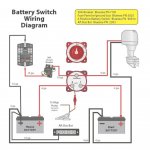
dual battery.jpgdual battery2.jpg
 
Last edited:
It seems to me that often a 1,2,both switch set up was used with 2 identical batteries. Hence you just select one battery or the other for start and for using domestic power but need to go to both for charging. Hence the original diagram. You have gone to asymetric batteries ie a deep cycle and a start battery which is good and you are right to move domestic loads to the deep cycle battery only. So you are moving towards a 2 battery one for engine, one for domestic but using the 1,2,both switch which as said could be replaced by individual switches. All you need now is a VSR to provide charging automatically to the domestic battery. However any arrangement is ok provided you understand what you are doing and why. ol'will
 
I agree with the suggestions to have fitted three switches, would have been more flexible in certain circumstances, but as you have already bought new switches......

I also agree with Wills assessment. If you fit a VSR for automatic split charging you can then just use the new switch for domestic circuits, position one on the 1-2-B for the engine and reserve the Both setting for emergencies only.
 
Had omitted that so far because its only one foot (cable length) from the isolator to the domestic panel. But since I am updating things I ll definitely add one thanks for mentioning.
 
Here is the wiring diagram updated, I might add a VSR in the future as you suggested, and keep the selector permanently on position 1. If the VSR fails, manual selection still an option.
dual battery3.jpg
 
Here is the wiring diagram updated, I might add a VSR in the future as you suggested, and keep the selector permanently on position 1. If the VSR fails, manual selection still an option.
View attachment 90090


Couple of observations.

1. If the wiring starts to smoulder somewhere in the boat, you need to set the Isolator to OFF ... AND throw the switch for the domestic loads to off too in order to isolate the batteries from the loads. This would not be apparent to anyone who doesn't "know" the boat.

2. If you forget the domestic switch, then the house battery is never isolated from its load .... again, not apparent to anyone who doesn't "know" the boat.

I would be a bit uncomfortable having a big red battery switch labelled OFF on my boat that didn't do what it says on the tin ... i.e. disconnect all loads from all batteries.

PS: If really worried about starter driving house loads during cranking then I'd go for two big red isolator switches House/Engine and a combiner to connect both batteries - with the right combiner it should provide a "Both" option via a remote button for emergency starts from combined batteries. On my Victron Cyrix this combines the battery banks for around 30 secs then disconnects them again.
 
Last edited:
Here is the wiring diagram updated, I might add a VSR in the future as you suggested, and keep the selector permanently on position 1. If the VSR fails, manual selection still an option.

Remember the VSR has a current drain when not in use, so a switch in the neg may be an option to remember.

Brian
 
Couple of observations.

1. If the wiring starts to smoulder somewhere in the boat, you need to set the Isolator to OFF ... AND throw the switch for the domestic loads to off too in order to isolate the batteries from the loads. This would not be apparent to anyone who doesn't "know" the boat.

2. If you forget the domestic switch, then the house battery is never isolated from its load .... again, not apparent to anyone who doesn't "know" the boat.

I would be a bit uncomfortable having a big red battery switch labelled OFF on my boat that didn't do what it says on the tin ... i.e. disconnect all loads from all batteries.

PS: If really worried about starter driving house loads during cranking then I'd go for two big red isolator switches House/Engine and a combiner to connect both batteries - with the right combiner it should provide a "Both" option via a remote button for emergency starts from combined batteries. On my Victron Cyrix this combines the battery banks for around 30 secs then disconnects them again.
I agree with the arguments. For domestic loads switch panel, i ll use the existing big switch (off -1-2-both used as a simple on -off switch ), and ll do the splitting with a second identical switch. ( pay for 1 extra switch only) ...Good thing is that in case of emergency there will be 2 big red switches that can shut off everything. Not very relevant with the subject, i saw a video showing short circuit of a 14 gauge wire. There was so much smoke, it would be impossible to see where to shoot with a fire extinguisher. Considering everything is well fused there are still the thick battery cables remaining unfused in most boats if i am not mistaken. Looks like overdoing it but fusing the battery terminals maybe a good idea.
 
Couple of observations.

1. If the wiring starts to smoulder somewhere in the boat, you need to set the Isolator to OFF ... AND throw the switch for the domestic loads to off too in order to isolate the batteries from the loads. This would not be apparent to anyone who doesn't "know" the boat.

2. If you forget the domestic switch, then the house battery is never isolated from its load .... again, not apparent to anyone who doesn't "know" the boat.

I would be a bit uncomfortable having a big red battery switch labelled OFF on my boat that didn't do what it says on the tin ... i.e. disconnect all loads from all batteries.

PS: If really worried about starter driving house loads during cranking then I'd go for two big red isolator switches House/Engine and a combiner to connect both batteries - with the right combiner it should provide a "Both" option via a remote button for emergency starts from combined batteries. On my Victron Cyrix this combines the battery banks for around 30 secs then disconnects them again.

Sorry, but this makes no sense at all.

I would be a bit uncomfortable having a big red battery switch labelled OFF on my boat that didn't do what it says on the tin ... i.e. disconnect all loads from all batteries.

I'd go for two big red isolator switches House/Engine

He has exactly what you say he should have. One switch for the domestics and one for the engine. The Combine switch that you refer to is the 1-2-B switch, set to B
 
Here is the wiring diagram updated, I might add a VSR in the future as you suggested, and keep the selector permanently on position 1. If the VSR fails, manual selection still an option.
View attachment 90090

Three separate switches is the best solution, IMO. On/off for engine, on/off for domestics, on/off for emergencies. But, if you want to use the above, it's a step up from the basic 1-2-B, but it does need the VSR (or another split charge system, to eliminate the need to keep fiddling with the switch to charge both batteries.
 
Sorry, but this makes no sense at all.

When you have a switch labelled OFF, 1, 2, BOTH ... then it is normal to think that both batteries 1 and 2 would be disconnected in the event that the switch was set to OFF. Because the OP has no longer wired both starter and house loads to the Common, the switch doesn't do what might be expected - this is based on the assumption that there is no change to the switch position or external labelling. That is the point I was trying to make. Re-wiring an existing switch to change its function, or wiring a switch in an "innovative" way may confuse anyone who has used it before or has a similar boat with the "normal" wiring.

As the OP hadn't stated where the second switch was, what it looked like, or how it was labelled at the time of my post, I was only trying to highlight the potential issues - which the OP seems to see too.

I'm not claiming it will not work, it will, the OP has stated what he's thinking of doing now and it's OK IMO.

[/QUOTE]
He has exactly what you say he should have. One switch for the domestics and one for the engine. The Combine switch that you refer to is the 1-2-B switch, set to B
[/QUOTE]

He does, The combiner I was referring to was something like a Victron Cyrix that connects both batteries for 30 secs via a push button - what I have on my boat.

After thinking a bit more, and if it were my boat, I'd buy this Add-A-Battery Kit - 120A - Blue Sea Systems because I like having one master switch that shuts everything off .....

1589356912993.png
 
Last edited:
It seems to me that often a 1,2,both switch set up was used with 2 identical batteries. Hence you just select one battery or the other for start and for using domestic power but need to go to both for charging. Hence the original diagram. You have gone to asymetric batteries ie a deep cycle and a start battery which is good and you are right to move domestic loads to the deep cycle battery only. So you are moving towards a 2 battery one for engine, one for domestic but using the 1,2,both switch which as said could be replaced by individual switches. All you need now is a VSR to provide charging automatically to the domestic battery. However any arrangement is ok provided you understand what you are doing and why. ol'will
My Sadler 29 came with two leisure batteries which were very well located in a deep well as low as one could get in the hull and as there was no other convenient place to add a starter battery I kept that arrangement along with the 1B2 switch. Generally I used the B position for engine starting in order to halve the current drawn from each battery and kept to B when motoring. The exception was when anchored overnight when I'd use one battery to provide "house" needs and save the other battery for any engine start the next day. Seemed to work OK, the batteries generally lasted 10 years.
 
Here is the wiring diagram updated, I might add a VSR in the future as you suggested, and keep the selector permanently on position 1. If the VSR fails, manual selection still an option.
View attachment 90090
That's almost exactly the setup I have, except that I have a cheap headlamp relay instead of a VSR, because VSRs were expensive when I did it and the relay was a couple of quid. If the relay should die, I'll probably replace it with a VSR, but it works fine as it is.

One thing that's missing from this setup is solar. If the OP has an outboard, power output is probably limited, so as many watts of solar as budget and space allow can only be helpful.
 
Top