IMOCA 60 question

Windway

Active Member
Joined
25 Aug 2012
Messages
65
Location
Porthmadog
Visit site
Hi
watching the Vendee 2016 and knowing very little about these amazing boats, I am wondering what is the purpose of the two booms that protrude each side of the yacht from the mid section? Are these to hold up the mast, work the dagger boards, or to act as spinnaker poles? Can someone explain, as try as I might I cannot find the answer online! Thanks
 
They are called "deck spreaders". On the wing-masted boats they rotate with the mast. The purpose is to increase the shroud base which reduces the compression on the mast (the wider the shroud base the less tension required in the shroud to hold the mast up).

There is a brief description of Open 60 (forerunner of IMOCA 60) class rig setups here:

http://bhaviknews.blogspot.co.uk/2008/02/open-60-rig-development.html
 
Last edited:
Great info.

Another thing about the 60s that you might not know is that they don't have any weather helm. I first heard this from a skipper, and then confirmed it with a designer. It was said to me like this "if you had weather helm at 8 knots, it would rip your arm off when you hit 25." You have to remember that lift increases with the square of the speed.

Weather helm is actually designed into sailboats. The purpose is to increase the lift. But with their dagger boards the 60's don't need this lift. As you know typical boats don't sail straight in the water, but actually crab sideways a bit. But the dagger boards on a 60 turn the bow into the direction of travel, so they move through the water like a dart. This is why the mustache foils on the new boats have a lift aspect and a dagger board aspect to them.
 
Great info.

Another thing about the 60s that you might not know is that they don't have any weather helm. I first heard this from a skipper, and then confirmed it with a designer. It was said to me like this "if you had weather helm at 8 knots, it would rip your arm off when you hit 25." You have to remember that lift increases with the square of the speed.

That doesn't make complete sense to me. Yes lift increases with the square of speed, but only if you keep the angle of attack constant. At higher speeds you will have less angle of attack.

I guess they use balanced rudders to keep the helm unloaded.

Weather helm is actually designed into sailboats. The purpose is to increase the lift..

This is worthy of some explanation I think. Imagine you have a rudder which is not completely balanced (I.e. It has more area behind the axis of rotation than in front, as per normal). If the sailplan and keel/rudder configuration are such that the boat sails in a straight line with the rudder/tiller centred on a point of sail where leeway needs to be resisted, the you will feel weather helm on the tiller even though it is on the centreline. This is because both the keel and the rudder are providing resistance to leeway (aka lift), so they have higher pressure on their leeward side than their windward side. If you have more pressure on one side of an unbalanced rudder than the other then it will try to turn so you will need to apply force to the helm to resist that.

If you configure the boat so that there is no sideways force on the rudder then the rudder is not providing lift, just drag, so you're not making the most of the surfaces you're dragging around.

A fully or near fully balanced rudder will feel horrible in that there will be no resistance regardless of the amount of helm you apply.
 
Do the deck spreaders allow the shrouds to be adjusted so that the mast inclines to windward giving lift like a windsurfer?
 
MikeBZ, I certainly don't claim to understanding the intricacies of the 60 design process, but when I was interviewing Ryan Breymaier for my book he was the one who brought up the lack of weather helm: "You can steer up or down and there is never any resistance to push against. You can't drive against the weather helm because there isn't any." And I went back over this again with him just to make sure I was hearing correctly. Then I interviewed Merfyn Owen (from Owen Clarke Designs) . He said that "unlike most race boats built for windward/leeward racing, the IMOCA 60 is built for open ocean. So pinching to windward is not a required feature. For this reason, the boats are built with dagger boards that twist the entire boat toward the wind, offering excellent pointing ability. This allows the skipper to ease the jibsheet slightly to increase speed. At the same time , the rudders, the main source of weather helm on most boats and a source of constant drag, are designed rather small."

Keep in mind that the 60s have twin rudders. So the "centre" of the boat when heeling is not the centre of the boat when flat. When heeling, the effective centre is a straight line from the dagger board to the leeward rudder. And if the rudder is built smaller than you would think, then the whole design changes from anything we know. That's about the limit of my knowledge on this. Until the day that I can buy my own IMOCA 60 that is :-)
 
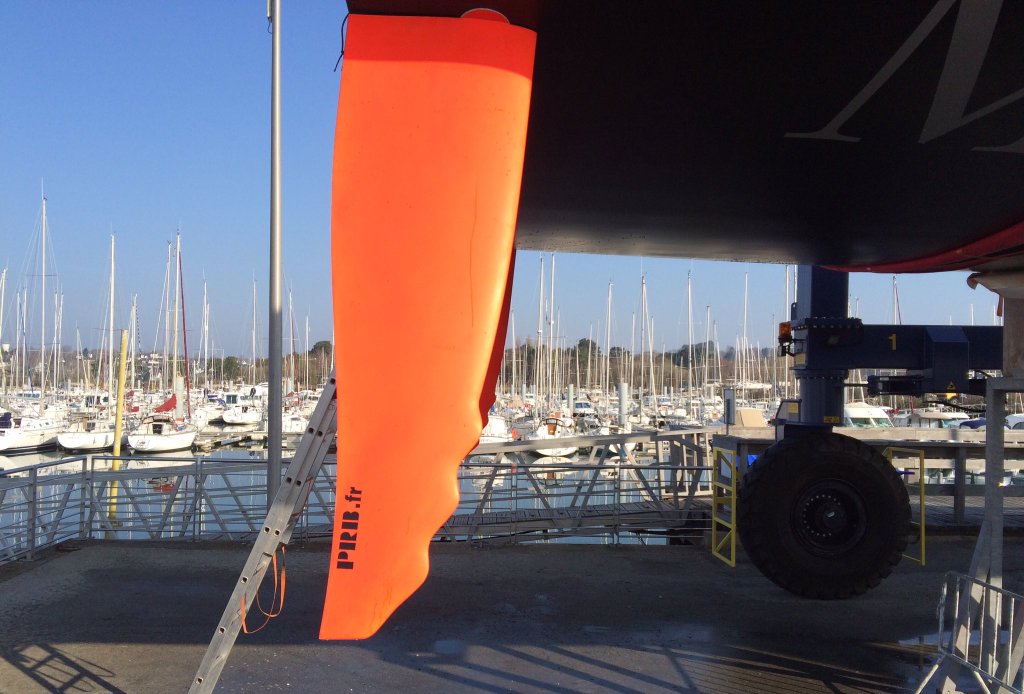
Interesting stuff! As you say the rudders are very small, and almost certainly are semi-balanced - this picture here shows some area in front of the bearing:
CdlLPkuXEAE_TDn.jpg
 
Love that photo of the rudder tubercles. I"ve seen some with the bumps at the top and now this one with the bumps at the bottom. I wonder what the difference is? They reduce the tendency for the rudder to stall at sharp angles.

I"ve been looking into this carefully because I want to build a new rudder for my own boat and was thinking of adding them. I've found lots of discussion, but nothing that says how big they should be or where placed.
 
Top