Immersion heater problem

MJ24

Well-Known Member
Joined
26 Apr 2012
Messages
362
Location
West Wales
www.markjohnsonafloat.org.uk
Last year I replaced my calorifier.

Now when I switch on the immersion, the pontoon fuse trips.

I have had a close look at the wiring, all seems to be ok.

How do I check the actual immersion heater??

I have put a volt meter across the positive and negative on the immersion, and there is a circuit.

With little electrical knowledge I tried the same with the ohms scale. It measured zero.

Presumably the problem is either with the switch, the wire or the immersion heater itself.

How do I eliminate the heater itself (as this is most difficult to replace?

TIA

Mj
 
Not sure.

It's a standard 20 litre calorifier......

Not had a problem until recently, though have to say I have blown the pontoon circuit breaker more than once last year.

What should I expect when using the voltmeter on the heater?

Mj
 
How many kW is the immersion? What's the rating of your shore supply?
Lots of folk go buy one out of Screwfix or the like only to find it is 3kw and their shore power is not able to cope. MAny are fitted with 2kw heaters as standard but they are more expensive - which did you fit? what was the rating of your old one?
If you are looking for a new 2kw one I suggest you contact a company called headrod, http://www.heatrod.com/ - very helpful, next day delivery, will make an element to your specs (power/length) if you need an odd size.
Usual disclaimer.......
 
Most of the immersion heaters fitted to boat calorifiers are smaller diameter than domestic ones. They typicaly are between 800 and 1200 watts, so that shouldn't be tripping the electrics by overloading. Check the joints where the water pipes enter the body of the calorifier. If there is any water leaking on to the heater element, it will ground the current to earth and blow the RCD.
 
With little electrical knowledge I tried the same with the ohms scale. It measured zero.

Assuming the reading really is zero (cheap multimeters aren't always accurate at the low readings) the implication is that you've got a short circuit.
Disconnect the wires and measure the heater again.
Then measure the resistance across the wires (whilst they are still disconnected)
If the heater gives a reading of a few ohms then it is probably OK.
If the wires give a zero reading look further upstream. The switch would be the obvious starting point.

Make sure the power is off when you take the readings!


I don't understand how you got a reading on the volt setting if the supply is tripping out.

PS The thermostat could also be the culprit.
 
Last edited:
Last year I replaced my calorifier.

Now when I switch on the immersion, the pontoon fuse trips.

I have had a close look at the wiring, all seems to be ok.

How do I check the actual immersion heater??

I have put a volt meter across the positive and negative on the immersion, and there is a circuit.

With little electrical knowledge I tried the same with the ohms scale. It measured zero.

Presumably the problem is either with the switch, the wire or the immersion heater itself.

How do I eliminate the heater itself (as this is most difficult to replace?

TIA

Mj

Not sure.

It's a standard 20 litre calorifier......

Not had a problem until recently, though have to say I have blown the pontoon circuit breaker more than once last year.

What should I expect when using the voltmeter on the heater?

Mj

Sorry but it appears from your posts that you know so little about mains electricity and mains installations that you really should get an qualified electrician to look at this.

While the competent amateur could probably find the trouble with a multimeter an electrician will be able to properly test the system with a more specialised instrument to ensure all works correctly with no safety issues.
 
Sorry but it appears from your posts that you know so little about mains electricity and mains installations that you really should get an qualified electrician to look at this.

While the competent amateur could probably find the trouble with a multimeter an electrician will be able to properly test the system with a more specialised instrument to ensure all works correctly with no safety issues.


Yes I am sure you are right.

Just hoped that I could get to the bottom of it easily.

Another little mystery is why the boat circuit breaker does not trip. The pontoon does as said which is irritating as it's a couple days before I can get my PowerPoint switched back on.
 
Are you tripping the MCB or the RCD? Earth leakage on immersion elements is not uncommon and can cause the latter. A 20l marine calorifier is likely to have less than 1500w element, more like 800 or 1000 so should not trip a 16a MCB assuming that is what you have shoreside.Even a 3kw element which is unlikely should not trip a 16a MCB on its own as it only pulls aroun 12a @ 250v AC, also.......... what Vic said.
 
Last edited:
Another little mystery is why the boat circuit breaker does not trip. The pontoon does as said which is irritating as it's a couple days before I can get my PowerPoint switched back on.

Sounds as though you have a fault on your shore power lead or installation. Either causing the trip or maybe a defective CB on the boat which is failing to trip.

You need an electrician.
 
Borrow someone elses shore power lead

Does it trip with other lead?
No - your shore power lead is faulty

Yes - your shore power lead is OK (probably) and fault could be onshore power or boat power distribution.

If Yes above plug the shore power lead into another pontoon mains point

Does it trip?
No - your pontoon shore power point is faulty (probably)

Yes - fault is on boat power distribution.
 
Sounds as though you have a fault on your shore power lead or installation. Either causing the trip or maybe a defective CB on the boat which is failing to trip.

You need an electrician.

Perhaps I should add to that before someone else does that very likely only one CB ( or RCD) will trip. That will be the lowest rated or more sensitive one.
 
Sorry but it appears from your posts that you know so little about mains electricity and mains installations that you really should get an qualified electrician to look at this.

While the competent amateur could probably find the trouble with a multimeter an electrician will be able to properly test the system with a more specialised instrument to ensure all works correctly with no safety issues.

+1, I would agree with Vic, Looks like you have an earth leakage fault in the immersion element, so it will trip the shore supply RCD which is probably 30ma but not trip the onboard MCB.
 
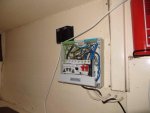
image.jpgimage.jpg

That's what beasts look like.

The circuit breakers should surely trip before the pontoon one??? But it does not.

The calorifier came from a reputable manufacturer. Haven't got the receipt to hand but was from Seatank or some similar name.

They were very helpful when I rang for help in the wiring. The connections are straightforward, the calorifier was a replacement for a leaking one last year. That original one lasted me some nine years with the same wiring installation without a single problem. It was on the boat when I bought it, so could have been much older than that.

Thus my logic(?) tells me it's this new calorifier. It would not be too difficult to replace the immersion.

But am now inclined to get a pro to look at the whole system.

Thanks for opinions and help...

MJ
 
Last edited:
You could try disconnecting the immersion heater. But insulate any wires which will be live when the power is back on. If everything else then works normally with no trips it does point the finger of suspicion at the immersion htr.

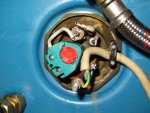
The immersion htr wiring looks OK but whoever did it nicked the insulation on the earth wire. Id move the live wire away from the earth stud but if the insulation is OK it's not going to cause any problem.

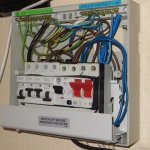
Cannot tell anything useful from the picture of the consumer unit I'm afraid
 
image.jpg

That's a bit bigger and better resolution.

My limited electrical knowledge assumes that despite the heater coil in the immersion, that my multi meter will detect the circuit there. That's why I tried to use the resistance setting on m/m to see if there was not a short circuit.

The set has worked well for several months, but has died slowly over the last few. Have to say that the boat use has been limited last year due to replies illness.

Mj
 
A common mode for failure of heating elements is corrosion through the shell of the heating element accelerated by the heat. his allows water into the heating element which causes earth leakage current and or a short circuit in the element. Either of which shouild trip your earth leakage/MCB breaker. If you unbolt the element you may see the corrosion point ie a lump or discolouration on the skin of the element. Ave a noo one. In any case a new element might be cheaper than a proffessional electrician's visit.
An electrician will check with a "megger" this is an insulation tester like a multimeter but testing at high voltage (500v) so detects breakdown of insulation at high voltage.
As said lower wattage are far better for a boat. (takes longer to heat the water but more suitable for lower current rating marina outlets.) good luck and be careful olewill
 
Top