
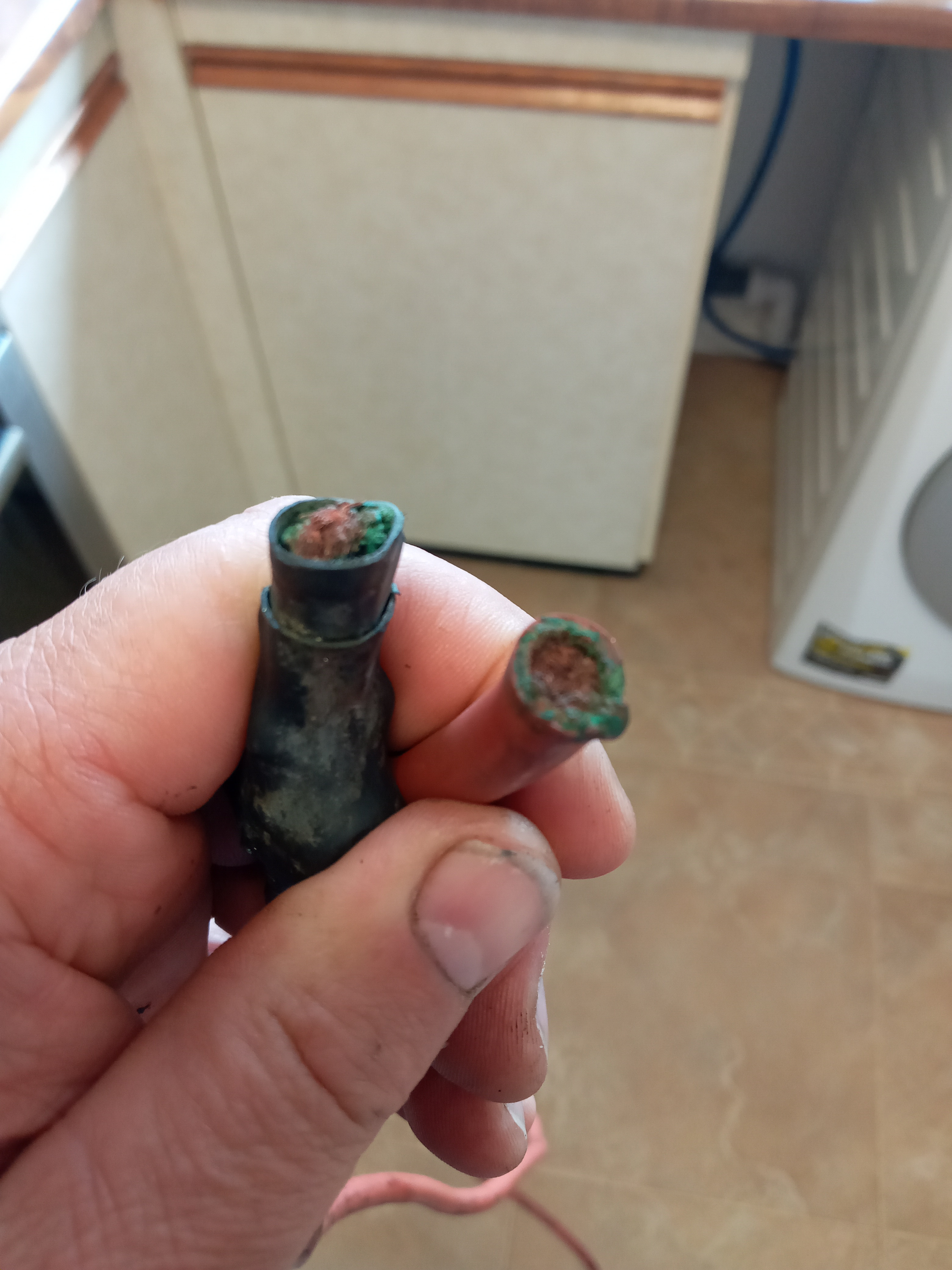
If you don't use tinned wire this is what you'll get.

burgundyben

Well-Known Member
Joined
28 Nov 2002
Messages
7,484
Location
Niton Radio
Visit site
My rib engine failed to start, a little investigation found this.
20210607-163813.jpg


An extra join to make the wire long enough, not tinned, protected with pvc tape out in the weather.

Wasn't a proper job was it!
 
Much of mine had corroded into stiffened black twigs. It was a boat interior, but after only fifteen years seemingly not as dry as the builder had hoped. I replaced it with tinned.

Pete
 
Much of mine had corroded into stiffened black twigs. It was a boat interior, but after only fifteen years seemingly not as dry as the builder had hoped. I replaced it with tinned.

I only had my last boat for 19 years, so when I said "no long-term problems" I was perhaps premature.
 
I only had my last boat for 19 years, so when I said "no long-term problems" I was perhaps premature.
My boat's had non-tinned for 60 trouble-free years...
(but if I plumb in any extra gadgets I always use tinned, especially in damp areas, might as well)
 
If you use tinned cable, unprotected, rolling around outside in the weather, it will die almost as fast as un-tinned.

If you use un-tinned, suitably protected where it needs to be, it'll still be good in several decades. Some of mine is original Westerly wiring from 1980, still good. I've rewired several boats from the 60's, all un-tinned and several with a good amount of domestic cable in them, mostly good.

The trick is to use proper terminals, properly crimped and insulated to whatever degree is required for the location of the wiring.
 
Last edited:
All our wiring is tinned, except for the heavy duty power cables, batteries, windlass (and I suspect) engine. Is this because tinned heavy duty cables are difficult to source, expensive, or simply not available.

We have had no problems - its a dry boat.

Jonathan
 
All our wiring is tinned, except for the heavy duty power cables, batteries, windlass (and I suspect) engine. Is this because tinned heavy duty cables are difficult to source, expensive, or simply not available.

We have had no problems - its a dry boat.

Jonathan
You can get it, I've got some tinned 35 mm sq. tinned welding cable, whish is getting repurposed for my windlass. It is a bit pricey unless you can find some used stuff.
 
it'll still be god in several decades.
We knew you liked wiring Paul, but that's a whole other level of dedication ;)
Is this because tinned heavy duty cables are difficult to source, expensive, or simply not available.
All three of the chandleries near my boat have tinned Oceanflex in stock, one of which carries all of the available sizes. It's not so much more expensive than regular cable since most of the cost is for the raw copper material. It does have better insulation as well as the tinning and thinner strands. It seems expensive because all 50mm cable is expensive, but in the grand scheme of boating I'd say it's good value for money. If you want expensive and hard to get, try buying a helm pod. £500 for a plastic box that nobody stocks and nobody makes in the size you want!

Edit to add not only do 12V planet stock this but it's also available on Amazon for next day delivery
 
We knew you liked wiring Paul, but that's a whole other level of dedication ;)

All three of the chandleries near my boat have tinned Oceanflex in stock, one of which carries all of the available sizes. It's not so much more expensive than regular cable since most of the cost is for the raw copper material. It does have better insulation as well as the tinning and thinner strands. It seems expensive because all 50mm cable is expensive, but in the grand scheme of boating I'd say it's good value for money. If you want expensive and hard to get, try buying a helm pod. £500 for a plastic box that nobody stocks and nobody makes in the size you want!

Edit to add not only do 12V planet stock this but it's also available on Amazon for next day delivery

When our yacht, modern though it might seem, was built - and difficult though it is to imagine a world without - but Amazon was not even a figment of imagination ( or a shadow of its current self) :). Our timing - DSC had just been introduced, AIS would never catch on for leisure yachts, GPS was so inaccurate no-one would dream of using it for an anchor alarm and dyneema was still degraded by UV.

How quickly some things change (except DSC is still largely unused - an application looking for a champion)


I'm actually not sure when Amazon was 'born' and became common place.

Thanks lustyd

Jonathan
 
I think it was around 2000 but yes things have certainly changed a lot in that time. Some for the better, as above. The flip side of availability of things is that everything now comes in a huge pack of assorted sizes. I was trying to buy a simple 1A radio fuse recently and Halfrauds wanted me to buy 100 of them for £8. Don't get me wrong, £8 isn't a massive amount of money, but what on earth would I have done with the other 99 fuses, most of which were not the size I needed? I suspect one could open a very profitable chandlery by doing house clearances for boaters and collecting all that pointless stock of fuses, fasteners, etc. FOC to clear out the garage :)

Sorry, that developed into a bit of a rant ?
 
Once upon a time I was installing AC in a boat, thinking about all of the "bet practices" re. crimping, sealed connections, and tinned wire... and then made to observation that nothing in the AC unit was tinned or sealed. No problems either.

I make my decisions based on moisture. The PDQ is a bone dry boat. There has never been anything but dust in the bilges and a dehumidifier keeps the cabin mildew free. Bare steel does not rust. The conditions are no different than my home.

In lockers, to lights or solar or the engines, the rule are different. Tinned wire, good seals and the like. I replaced a good bit of rotten wire in my first boat, primarily lamp cord run in the (dry) bilges.
 
Thank goodness dodgy wiring isn't a fire risk, eh? :ROFLMAO:

LOL. Even more so unattended at the dock.

That said, I once expereinced an incipient fire off-shore caused by bad PO wiring that he hid under the hull liner. Although it did no damamge, the smell of smoke sure got our blood pumping, since there was no where to go and no one to call ( we did have a dinghy, but the ocean is big).
 
My boat was built with fantastic quality tinned wire throughout. The wire cores were tinned then insulated then sheathed in rubber then sheathed in pvc. After 41 years they are perfect. The only problem is the pvc has gone rock hard so stripping any out is more akin to removing copper pipe!
Even simple two core cable has an outside diameter of about 15mm.
 
My wire comes off a reel, where do you get wire in a tin for marine use? I have never seen any. (-;
 
Top