
Ideas to fill a hole!

sailorbaz

Well-Known Member
Joined
22 Apr 2002
Messages
296
Location
Bald Knob, Queensland, Australia
Visit site
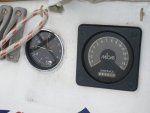
The previous owner of my boat fitted a car type VDO clock in the cockpit next to the log - see pic. The clock hasn't worked since I bought the boat, so armed with instructions how to fix it from google. I took it out and tried to take it apart which resulted in the glass breaking and the inside a corroded mess.
So I now have an 80 mm diameter hole which I either have to fill or find another clock or some other instrument. Since the mast is down at the moment, I thought maybe a wind speed and direction would be more useful.
Any other ideas would be gratefully received.
SailorbazPA310234.jpg
 
Most bulkhead mounted instruments, including wind inst., are designed to be surface -mounted, with just a small hole for wiring.

That doesn't apply to any of the Raymarine ones. The old black type (ST50) need a hole about 40mm (at a guess), the newer grey ones (ST60) fit into a bigger hole which I think may actually be 80mm so would work for the OP if that's what he wants to do.

The three obvious options are:

1. Fit an instrument. Easy at the cockpit end, but potentially much work to fit whatever transducer and its wiring. Costs. You get the benefit of the new instrument.
2. Stick a blanking plate over the hole, either wooden or plastic. Very quick and easy (especially with plastic) but you may not like the look. I currently have an old instrument hole blanked off this way using a piece of white plastic chopping board, until I get round to...
3. Fill the hole properly, with gelcoat, mat and resin. Bit more work, especially if you've not done it before. Costs more than a bit of plastic and sikaflex, but nothing like as much as a new instrument. Looks nicer than the blanking plate.

All have their place, only the OP can decide which he prefers.

Pete
 
The previous owner of my boat fitted a car type VDO clock in the cockpit next to the log - see pic. The clock hasn't worked since I bought the boat, so armed with instructions how to fix it from google. I took it out and tried to take it apart which resulted in the glass breaking and the inside a corroded mess.
So I now have an 80 mm diameter hole which I either have to fill or find another clock or some other instrument. Since the mast is down at the moment, I thought maybe a wind speed and direction would be more useful.
Any other ideas would be gratefully received.
SailorbazView attachment 36041

Blast me that takes me back, Midas. Does it still work, i had then on my new boat in 78.
why not an ext speaker on the 100 x 100 module like the Log
 
Thanks for the replies - I still haven't decided which way to go!

Blast me that takes me back, Midas. Does it still work, i had then on my new boat in 78.
why not an ext speaker on the 100 x 100 module like the Log

Yes the log does work but I've only used it once. All that water coming in through a hole in the hull when I swap the plug for the paddle wheel frightens me!
We just use the speed from the GPS but of course that's speed over ground.
Sailorbaz
 
My opinion is do not buy a paddle wheel log or a wind speed/direction indicator. The log gets fouled up easily so usually doesn't work. GPS is far better. The wind instruments are very susceptible to damage by birds or wind. Just not worth having unless you really need them.
I do like the GPS repeater type instruments like the NASA one. Perhaps a plug cover until you decide what to do good luck olewill
 
If you want to fill the hole then have a look at the East Coast Glass Fibre web site. I have used their technique several times now.

http://www.ecfibreglasssupplies.co.uk/t-RepairingDamagedLaminate.aspx

I recently filled some holes in the cockpit which had been mildly annoying me since I bought my boat: A couple of big speaker holes which had been until then covered over with pieces of painted acrylic attached by self tappers and an old tachometer for an engine which had been replaced. Used a technique similar to the one CET1 links to above. Unless you have a good candidate for covering/filling the hole I think it's worth having a go at gelcoat and fibreglass work if you've not done it before just for the experience and so you have that skill in your armoury for the future. Even if you make a hideous mess, you're no worse off than when you started.

Big downside is cost of materials. You can't just buy the amount you need to fill that hole. The smallest amount you can buy would fill many tens of holes that size and small amounts in the chandler's are pricey. Try buying (or bartering with booze) stuff form your yard boatwrights if you can't blag something from a friend.
Comments on the technique above (from my experience as a complete amateur):
1. The book I used originally advised pva over wax for a release agent. The link above just advises wax and I would say go with that and avoid the pva: it's extra expense, wasn't necessary, and I ended up using it wrongly (I didn't let it dry). Stick (or rather don't) with the wax.
2. painting gelcoat over wax is not as straight forward as it sounds. be prepared to stipple the first coat a bit. I used 3 coats of gelcoat in total (the first on the wax tends to be a bit uneven)
3. Apparently melamine/formica is something people with garages just have in abundance. I found it impossible to acquire a small piece and ended up using a bit of acrylic (which may have been wrong but worked)
4. Don't expect your end result to be invisible. "unobtrusive" is a win
 
Last edited:
cut a round bit of Mahogany , well varnished and glue in pace, better still find a model engineer "Friend" and get one turned with a shoulder who's depth is the thickness of the bulkhead.
 
Top