I’m thinking of getting a generator

Homer J

Well-Known Member
Joined
19 Jun 2017
Messages
545
Visit site
What output would I need it to be to have enough grunt to run the hot water heater? Also to charge the batteries.

what is the etiquette for running one in an anchorage?

can anyone recommend a very quiet one?
 
What output would I need it to be to have enough grunt to run the hot water heater? Also to charge the batteries.

what is the etiquette for running one in an anchorage?

can anyone recommend a very quiet one?

Generators can be pretty quiet for those on board but very noisy and smelly to boats downwind.

Etiquette - doesn’t really matter - you will be despised the moment you start it to the moment you leave the anchorage.

But you have a great point about hot water - solar can’t really handle it unless you have a lot of sun and panels. There are systems, often home made, to heat water directly deck and pipe that to the hot water tank.
 
As a rough approximation, if you want to charge the batteries and use the immersion heater at the same time you will need 2kW but it will be noisy doing both but reasonably quiet doing one or the other.

If you only ever want to do one or the other than 1kW would suffice, but it will be noisy all the time.

Richard
 
I would really advise against the 1 kW option for virtually any purpose. It will run flat out most of the time what will show not only by the noise but on it life span as well. In fact, I would see even 2 kW rather marginal for the proposed purpose. I have my 5th generator now and as result of some learning curve it is 2.6 and it the longest lasting at this stage.
While it is possible to say the more expensive the better, it has its limits. A megabucks Honda will be almost almost inaudible at idle, at the full power will howl like a pack of coyotes anyway. It may last longer under normal operating conditions, but you will find it beyond economical repair after the first wave rolls over it (and it will happen sooner or later) exactly the same way as one of the Chink cheapees. Don't ask me how I know... As per economy, I didn't find a major difference and in general I have been happy with all of those I had.
 
I wanted to use my 1kW Honda to heat water. Quick do a 600W replacement for my 1200W immersion element which I considered to enable water heating. Downside is longer heating time on shore power. In the end I fitted one of these to the immersion heater which buggered the generator so problem solved and cold showers at anchor. I've not bothered to replace the genny
 
I'll be in the market for a portable generator shortly but it will not be a Honda at the ridiculous price they are.

I'd prefer to go for a reasonable size (for the reason stated above): you don't want it working the guts out at 5000rpm all the time.

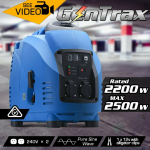
The Chinese Gentrax is very popular in Australia among the people in mobile vans. Surely they are available in the UK?

It is really well worth reading the following eBay sellers bit about manufacturers overstating generator output

GenTrax Inverter Generator 3.5KW Max 3KW
 
Generators can be a real pain! Some of the smaller ones only have a 500 hour lifespan...so i have heard! A small variable speed FP will be a real real bad move imho. If you can get a Northern Lights or Onan or a big one ( low revs) then you are set. If space and/or budget dictates a smaller one then consider spending the money on a diesel Webasto hot water heater. As long as you have clean fuel you will have hot water. Toby Keto is your man on UK south coast for this unless you do it yourself. With the money saved from not getting a genny you may also be able to get a couple 100w solar panels (NOA from Sweden do some nice 100w solar 'bat wing' panel brackets), an MPPT controller from Victron, a few new batteries and a BEP battery monitor. This should provide all your electricity on a mooring or at anchor but it is still advisable (essential for battery life) to connect to shower power once a month (or every other month or every three months!) to force extra juice into the batteries for 24-48 hours. Also running the engine under load once a week is not a bad thing. Good for the engine and good for your batteries. If this is done I believe engine should be run for long enough to come to running temp? So not for 5 minute bursts. On a mooring or at anchor just put the engine into reverse at 1500 revs or so. Btw Webasto hot air (don't know about the hot water but I imagine it would be the same) can drain the batteries so a modern version with eco mode is recommended.

There is a solar system available where you change the heating element in your hot water tank and it becomes 12v solar hot water...takes a bit longer to heat. Search Google for this.
 
Using a generator for battery charging is a poor idea. To properly charge your batteries it will need to run for hours on end. In reality it will top them up to 80-90% charged fairly quickly, then you turn it off and keep cycling the batteries between 50-60% and 90-90%, not doing your batteries any favours.

Solar panels are the best solution for battery charging.

For heating water, my kettle works really well, as does my engine. Stick the engine on for a short while as you approach that anchorage and you arrive with a tank of hot water and don't annoy the neighbours.
 
A petrol generator while it is standing on the boat has a potential risk of carbon monoxide entering the living space so if you must use it in this way please do with care as to its location.
Also be aware the bottom of the generator may be in part exposed metal which gets very hot so be sure it is clear of any wood or GRP.

My 1500W portable generator stalls if I ask it to power the immersion heater.
 
[QUOTE what is the etiquette for running one in an anchorage? [/QUOTE]

Before the days when generators were commonly seen on leisure craft, main engines were used for charging and in many cases of course, they still are. The accepted etiquette then was to run them between the hours of 0800 and noon. As with many things ‘etiquette’, I doubt that’s enshrined in the written word but to quote Eric Hiscock, “if it must be done, choose the fore noon rather than disturb the peace of the evening” (from Cruising Under Sail). The biggest no-no for me, is leaving engine or generator running and b*****ing off ashore!

As for what generator is required for water heating, have you considered fitting a smaller immersion element? A 1KW generator will cope happily with a 750W element and on a yacht sized tank, it doesn’t take much longer at all.
 
Solar panels are the best solution for battery charging.

Agreed. We didn't run our generator once last year for battery charging, solar shower bags good for showers and gas kettle for washing pots. Solar caters for virtually all our needs, generator used very occasionally for a few minutes during the day for microwave needs or power tools. If the OP is planning on using a generator for everything, people will soon let him know he's not welcome in the anchorage.
 
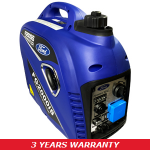
Almost certainly, but apart from being blue, I don't see any similarities between the two above.

I think there is a lot of "badge Engineering " going on

Honda Motor Co. will begin production of eight outboard models private-labeled for Tohatsu Corporation,

n 1987, Mercury Marine and Tohatsu Corporation created a joint venture called Tohatsu Marine Corporation (TMC) to manufacture smaller outboards

The early Mercury FourStroke engines were originally manufactured jointly with Yamaha; Mercury provided the block, crankcase, crank

The new Mercury engine brand was named “Mariner” to invoke a reliable, durable outboard that would appea
 
Last edited:
Apropos nothing much, but maybe of use?

I have a 60A Sterling Pro Charge Ultra charger. My batteries tend to start charging at about 13.5V, increasing to 14.4V, so a draw of between about 800W to 865W.

With my Honda EU10i generator, I have to start it with the switch on full power and, after a couple of stutters, the charging gets going and, after a few seconds, I can alter the switch to auto power.

So I obviously am right on the limit of what the EU10i can handle.

Given that the generator specs state 1000W max and 900W continuous, I'm presuming that the charger has a start up current of about 1000W, maybe a bit more, at 60A.

(As a matter of interest, there is a facility to set the charger at 75%, 50% and 25% power, (45A, 30A, 15A), but at 45A it would increase the charging time significantly, so I prefer the faff with the genny at 60A).
 
Apropos nothing much, but maybe of use?

I have a 60A Sterling Pro Charge Ultra charger. My batteries tend to start charging at about 13.5V, increasing to 14.4V, so a draw of between about 800W to 865W.

With my Honda EU10i generator, I have to start it with the switch on full power and, after a couple of stutters, the charging gets going and, after a few seconds, I can alter the switch to auto power.

So I obviously am right on the limit of what the EU10i can handle.

Given that the generator specs state 1000W max and 900W continuous, I'm presuming that the charger has a start up current of about 1000W, maybe a bit more, at 60A.

(As a matter of interest, there is a facility to set the charger at 75%, 50% and 25% power, (45A, 30A, 15A), but at 45A it would increase the charging time significantly, so I prefer the faff with the genny at 60A).

Your charger at max output is 60a @ about 13.5v, which is indeed about 800w.

Sterling quote input as 6a max for the 60a charger, about 1440w.
 
Top