Hydrofoils -why aren't they popular?

I think hydorfoils will make a comeback for recreational craft where there has been only a small market penetration................ in future fossil fuels will become more expensive and scarcer as electric road vehicles become more viable ................... everybody will be trying to economise on fuel but keep performance. Electric power may become more viable if you need less amps to drive the boat.
 
Last edited:
Jpkes aside I've seen what two potbouys with a rope between does to a 40 foot sports boat on outdrives. As the foils on a small boat will be a lot smaller and flimsier as the video of the bayliner would indicate, it would be a vulnerability that would put me off having them.
 
Jpkes aside I've seen what two potbouys with a rope between does to a 40 foot sports boat on outdrives. As the foils on a small boat will be a lot smaller and flimsier as the video of the bayliner would indicate, it would be a vulnerability that would put me off having them.

In 1992 I did an insurance repair on one of the Red Funnel hydrofoils after it had hit a solid pile whilst reversing at speed (they have to reverse quickly to get the foil rudders to steer at all) - it put a big dint (about the size of a fist) in the foil but in reality it was only the alignment that was out (still cost over £50k back then though). They look flimsy, but they are actually very tough - never known one damaged by wave action or just standard waterborne debris. They managed to drop one in the old Ancaster yard (now Cowes Yacht Haven) when the hoist belts snapped - it still made it back into service iirc.
 
I suspect it doesn't translate well to the average power boat or cruising yacht.

Apart from anything else, it's one thing if you lift your racing machine out of the water whenever it's not actually racing, or your power boat is in daily use at high speeds, but I imagine the fouling accumulated by the average boat sitting around for weeks would make a big difference to the performance and handling of a hydrofoil.

But while lockdown continues I'm working on the design for putting foils on my LM27. ;)
 
my Understanding was that historically the size and weight of anything strong enough to make a decent foil meant that they only worked well on very small or very big boats. With the advance Of carbon fibre technology the game has changed and hence their use in sailing boats, cats, windsurfers, kite surfers etc...... you couldn’t have done any of that with steel !!!
The other snag was the beam and draft disadvantage that massive foils gave a boat when it wasn’t planing...... but again with lighter materials the option to retract or move those foils is far greater.
I think they’re great and can’t wait for them to become common options on RIBS and smaller leisure boats.....

Combine the efficiency of foils with say the advances of the new Sharrow tipless propellor and we may yet make motorboating green (well greener !) .
 
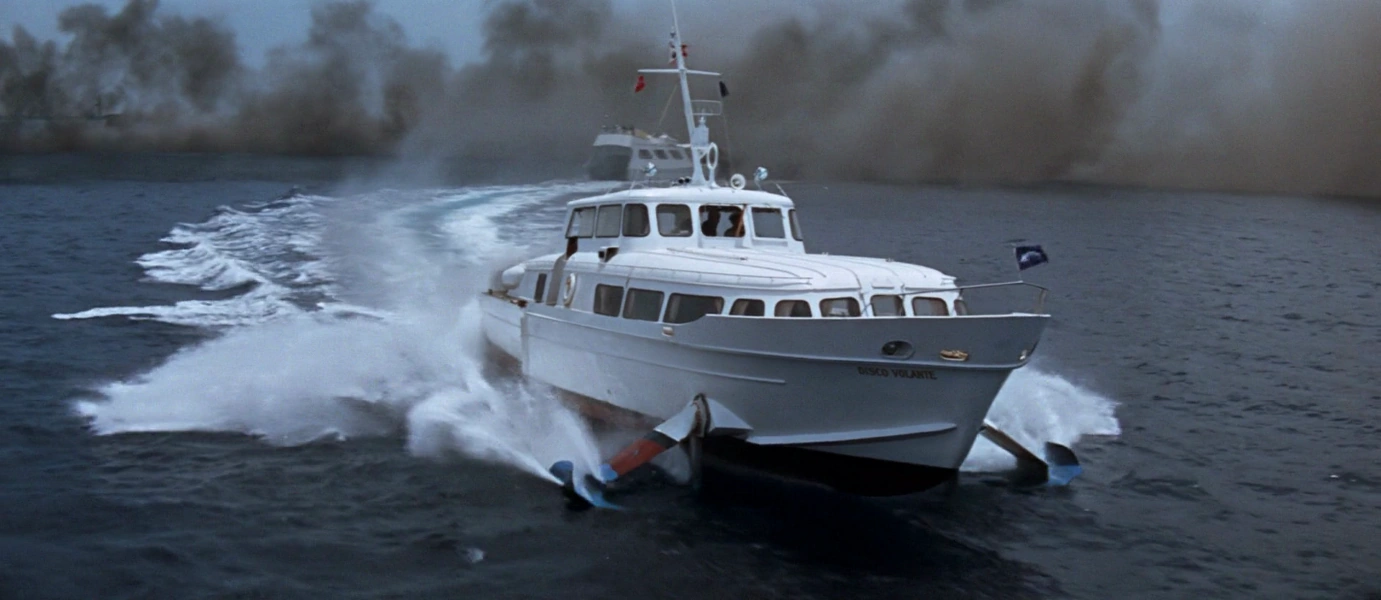
So. Mr Bond. We meet again.

Cocoon_separation_-_Disco_Volante.png
 

We used to have two of these Paritet 'Looker' glass bottom boats here, operating commercially taking passengers on cruises to see what is underneath them.
One of them had a big outboard motor (like the one in the photo below), the other had an inboard diesel with an outdrive leg.

Looker 320 glass bottom boat.jpg

The one with the O/B motor was subsequently sold to St Lucia - her previous owner delivered her over to Rodney Bay by himself, and scared himself terribly when doing so - he was the type who knew everything, and couldn't be told anything, and refused to listen to advice to wait for calmer weather, so he went on a 100 mile passage when the tradewinds were blowing happily.
These boats are not too keen on foiling offshore in rough conditions......

The one with the outdrive leg has been languishing ashore in a boatyard here for a few years - I think the novelty of it has worn off now.
One disadvantage that they have is that it gets very hot in the cabin, especially as the roof is painted black, despite various fans in operation.
This one sustained a very mangled foil at some stage when she ran over a floating mooring rope at speed - the boat stopped almost instantly, the driver was catapulted into orbit (no kill switch in use), and then the foil broke free and the boat started to run amok in circles as fast as it could go with a damaged foil. They managed to subdue it, but it was very fortunate that the driver (or any other people in the sea, or other boats nearby) was not run down.

Edit - Jumblie's post above reminds of the time when one of these Looker boats arrived here in Barbados on a ship, and was discharged ashore - she had a welcoming party of a few very dodgy looking Russians in dark glasses who could have come straight out of a Bond movie, including a tall blonde lady tottering about on stiletto heels taking photos.
 
Last edited:
Condor 4 at No. 9 Berth fb.jpgCondor 5 Little Russel fb.jpg2017-11-16-21-00-001.jpg

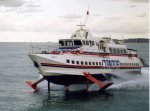
These are the three hydrofoils I was involved in operating for ten years.

They are essentially the much bigger brothers of the Red Funnel hydrofoils from the same yard.

They are all Rodriquez hydrofoils from the yard Rodriquez Cantiere Messina in Messina in Sicily.

Condor 4 RHS 140. 136 passengers at 34 knots 2 x MTU about 1,300 hp
Condor 5 RHS 160. 180 passengers at 35 knots 2 x MTU about 1,550 hp
Condor 7 RHS 160F. 200 Passengers at 36 knots 2 x MTU about 1,950 hp

Early fast ferries were limited by the light high hp engines that were available at the time.

Condor operated hydrofoils from 1964 until 1995.

They operated between St Malo, Jersey, Sark, Guernsey, Alderney initially until 1996 and then until 1989 on the Jersey and Guernsey to Weymouth Route until the introduction of the passenger only wavepiercering catamaran Condor 9 and the car and passenger wavepiercers Condor 10, 11, 12, Express, and Vitesse .

The hydrofoils are fast the fuel burn when on the foils is low in comparison to a normal planning vessel and the ride in the larger ones Condor 5 and Condor 7 was very good in comparison the to the sea state they were operating in . They operated up to about a force 7.

The limitations are: capital cost, maintenance cost, frequency of maintenance, draft when off the foils about 3.2m iirc,

When the senior master of Condor 5 was queried about the poor rearward vision by the MCA in about 1984 with the Question " how can you safely see overtaking vessels " he replied " Its not a problem, nothing has overtaken me since 1964". 1964 was when Condor first used hydrofoils.
 
Perfect for lake use.
I do wonder would happen in an F5 Solent Chop.

In the late 1960/early 1970s, there was a hydrofoil service from So'ton to Cowes and back. It was used by the RORC and Admiral's Cup teams and contenders as the fastest way to get to the boats moored off the Island.

The key problem was the length of the boats and the wavelength of FP's Solent chop. If they matched when the boats were heading into the waves, the hydrofoils had to zig zag to avoid 'kerb jumps' .

On one occasion, returning from the racing, in quite a lot more than F5, our hydrofoil drove over the top of a wave just as it broke, and the foils dramatically lost lift and the boat dived nose first into the foam. Green water washed all over the windows at passenger level, and the props lost grip, stalling the engines and causing huge amounts of black smoke.

After a few seconds when the boat wallowed to the surface in displacement mode, the driver started from zero, and he gradually cleared the turbos and we gained lift and proceeded into Southampton.

What struck me as we crashed almost underwater, was how quickly various people headed for the emergency exits and liferafts. No shouting, no screaming, just hardened racers reacting.

I think the fuel crisis killed off the economics of the hydrofoils. But they were fun while it lasted.


1615406491664.png
 
In the late 1960/early 1970s, there was a hydrofoil service from So'ton to Cowes and back. It was used by the RORC and Admiral's Cup teams and contenders as the fastest way to get to the boats moored off the Island.

The key problem was the length of the boats and the wavelength of FP's Solent chop. If they matched when the boats were heading into the waves, the hydrofoils had to zig zag to avoid 'kerb jumps' .

On one occasion, returning from the racing, in quite a lot more than F5, our hydrofoil drove over the top of a wave just as it broke, and the foils dramatically lost lift and the boat dived nose first into the foam. Green water washed all over the windows at passenger level, and the props lost grip, stalling the engines and causing huge amounts of black smoke.

After a few seconds when the boat wallowed to the surface in displacement mode, the driver started from zero, and he gradually cleared the turbos and we gained lift and proceeded into Southampton.

What struck me as we crashed almost underwater, was how quickly various people headed for the emergency exits and liferafts. No shouting, no screaming, just hardened racers reacting.

I think the fuel crisis killed off the economics of the hydrofoils. But they were fun while it lasted.


View attachment 110941

They were still running 18 hours a day, 7 days per week in the mid 1990's! (y)
 
Many of the issues appear to be the power required to bet them on the foils, with commercial operations they can get the required powerto get them on the foils and reap the benefits of their commercial operations in fuel savings.

In private craft this would be problematic as while they could get the power to get them onto the foils, they took the view that private boats don't do sufficient sustained high speed running to make them financially and economically viable along with the fact that many private vessels do a lot of lower speed stop/start running meaning they would constantly be up and down on the foils.
 
Top