Hydraulic emergency bilge pump or generator

Bi111ion

Well-Known Member
Joined
5 Aug 2012
Messages
352
Visit site
Who has a hydraulic power take off on their main engine gear box? I know it is common to use such a thing for bow thrusters and anchor windlass, but any one tried the following

1) Powering a mains generator

2) Driving an emergency bilge pump?
 
My take on it is that any emergency from water ingress that has knocked out your primary bilge pump electrics , chances are it will also have knocked out your engine electrics too hence Rendering your gearbox useless which is driven by the engine .

An emergency bulge pump alternative can be a manual one like a hand pump lever or a secondary bilge pump maybe connected to another back up battery placed on a higher level .
 
Engine is diesel, so once running it only needs the air intake to be above water which is much higher that the batteries. The scenario is that you start the engine (if not running) as soon as it is clear that pathetic 12v pumps cant keep up, then your hydraulically driven 900l/min mother of all bilge pumps takes over and buys you the time needed to stem the flow. Manual bilge pumps are pretty much irrelevant in an emergency, they can only match a small electric one in flow (unless there are bigger ones I have not seen?) and tie up a crew member who could be helping plug the leak, sending out a distress message or preparing to abandon ship.

The hydraulic PTO idea is just an alternative to mechanical PTO, and intended to be a much higher flow that a standard raw water pump (either the one for engine cooling used as emergency bilge pump or one driven off a pulley and clutch. Manual clutch obviously!)


I considered a small higher battery of last resort for the VHF.
 
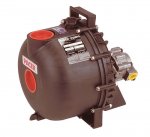
Here is the sort of thing I have in mind, although you could attach a hydraulic motor to any big rotary pump. This is 900l/min self priming 34l/min hydraulic fluid at 100 bar 2" ports. It could shift nearly a tonne of water a minute, so I think it could help with a major holing due to a collision or damage to propshaft or rudder.

water-pump-pacer-s-big.jpg
 
The smallest engine I was thinking of is eg a Beta 60 with a PMR 500 gear box with this hydraulic power take off

http://www.prm-newage.com/p19-live-pto

a bigger engine with a PMR1000 box can have a clutched power take off.

The pump above can be driven by a 6kw motor, while the PTO can deliver up to 22kW/1000rpm so that seems well within its capability.
 
Last edited:
you could run a pump direct off the engine of course - but the potential advantage of hydraulics is you could put the pump wherever you wanted and plumb it in. You could use a hydraulic motor to power a large diaphragm (ditch) pump too. From bitter experience I can tell you they will pump out even a seaweed and shrimp filled boat without blocking. :o
It's a fun idea. You could go really mad and have hydraulic keel lift, or hydraulic beaching legs!
 
Here is the sort of thing I have in mind, although you could attach a hydraulic motor to any big rotary pump. This is 900l/min self priming 34l/min hydraulic fluid at 100 bar 2" ports. It could shift nearly a tonne of water a minute, so I think it could help with a major holing due to a collision or damage to propshaft or rudder.

View attachment 67691

That does look bulky :nonchalance: if you have space in your engine room I guess it will serve you well but it’s one hell of a load to be carrying around .
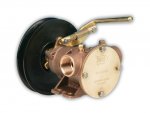
If I have to rely on my engine to pump, I will go for the smaller engine driven pumps that can be engaged with a clutch like this one
E6F03877-355C-4F26-8392-D29710464B8D.jpeg
 
Yes got a huge engine room and the pump is plastic so weight is in hydraulic motor, but that is quite small.

The sort of Jabsco above has an output about 60 l/min which is certainly useful but nothing like the Mother of All Pumps above at 900 l /min. Prices are quite close, but direct drive needs mounting bracket and pulley on engine where as hydraulic PTO needs the PTO and hydraulic pump, as well as pipes, a reservoir and a valve.

I was thinking once you have the hydraulic system it is easy to run engine drive accessories including a generator, maybe a bow thruster, off it. If the hydraulic system only ran the emergency pump then (1) that would be a waste (2) it might not work when you need it as it doesnt get tested.

I am new to hydraulics but its fun to learn about.
 
Last edited:
Last time i looked into this a clutched hydraulic pump fitted to a PRM 500 gearbox was near £1k. Don't know the litres/minute number, but to drive my 1 ton pot hauler. Belt driven bilge pumps, with either manual or electric clutch, are going to fail if water gets to high, belts will slip, lecs will fail. But in that case, how much longer will the engine be running? Water that high is entering the (my) sump through the breather. You could look at an
auxiliary engine to run all sorts, genny/pump/240volt etc, and hydraulics for winches. Gives you charge for starting, lots to be said for it.
Using hydraulics for a genny or bilge pump is not usual, there are power losses in pipework, and every item would need a hydraulic motor, plus flow splitters.
 
Engine is diesel, so once running it only needs the air intake to be above water..
I considered a small higher battery of last resort for the VHF.

You need to start it before the starter motor is submerged. As above, my (Ford) engine sump breather is at the top of the sump. The high battery is a requirement for some, you'll see the box on the superstructure, or roof, near the radio. Mine is in the wheelhouse, with minimum direct connections to the VHF.
 
Last time i looked into this a clutched hydraulic pump fitted to a PRM 500 gearbox was near £1k. Don't know the litres/minute number, but to drive my 1 ton pot hauler. Belt driven bilge pumps, with either manual or electric clutch, are going to fail if water gets to high, belts will slip, lecs will fail. But in that case, how much longer will the engine be running? Water that high is entering the (my) sump through the breather. You could look at an
auxiliary engine to run all sorts, genny/pump/240volt etc, and hydraulics for winches. Gives you charge for starting, lots to be said for it.
Using hydraulics for a genny or bilge pump is not usual, there are power losses in pipework, and every item would need a hydraulic motor, plus flow splitters.

Good point. If that is the cost you could get self contained small diesel for less than that.
 
Good point. If that is the cost you could get self contained small diesel for less than that.

I have been thinking of converting my bow thruster to hydraulic by mounting a pump so it can be driven direct from the front extension of the crank shaft. This needs some fabricated mounting and a dog clutch and would be much cheaper that the power takeoff from the PRM gearbox. I also have a PRM gearbox and the cost of the PRM power takeoff attachment puts that method out of teach for me.

I also have a small single cylinder mains generator and would use a mains submersible pump powered my the mains generator for emergency bilge pumping.
 
I used hydraulics on my previous boat, for the anchor winch/windlass. For that, hydraulic power is unbeatable. You can set the relief valve so that the windlass will pull, say 1 ton, and it will sit there pulling 1 ton for as long as you like. If you try to do that with an electric windlass, it will stall and trip out.

There are inefficiencies in any drive chain, but it is surely more efficient driving a pump directly from an engine, rather than introducing another pump (hydraulic), and another motor (hydraulic), between the power source and the bilge pump.
 
I have been thinking of converting my bow thruster to hydraulic by mounting a pump so it can be driven direct from the front extension of the crank shaft. This needs some fabricated mounting and a dog clutch and would be much cheaper that the power takeoff from the PRM gearbox. I also have a PRM gearbox and the cost of the PRM power takeoff attachment puts that method out of teach for me.

I also have a small single cylinder mains generator and would use a mains submersible pump powered my the mains generator for emergency bilge pumping.

One disadvantage of the PTO front drive is when your alternator belts need changing, and the length, a couple of feet needed in front of the engine. However, it is standard fit for FVs and can be bought off the shelf.
 
One disadvantage of the PTO front drive is when your alternator belts need changing, and the length, a couple of feet needed in front of the engine. However, it is standard fit for FVs and can be bought off the shelf.

Fair comment but if the design of the dog clutch is such that there is a small gap when thr clutch is disengaged you can pass a replacement Vee belt between the 2 sections of the clutch.
 
Fair comment but if the design of the dog clutch is such that there is a small gap when thr clutch is disengaged you can pass a replacement Vee belt between the 2 sections of the clutch.

Not a usual configuration, maybe possible. If you buy from eg Spencer Carter you get a clutched pump unit with a blank shaft for coupling of your choice, mine is a spider coupling. The clutch is enclosed. Most dog clutches would require the dogs to be running on a mutual shaft, so no gap. When the belts went this summer and took out the spare belts which are zip tied to the engine I had to use a makeshift string hoist to lift the pump/clutch out of the way. Link belt to get you home is a good option.

See one here:
https://www.google.co.uk/search?q=s...UIDCgD&biw=1413&bih=760#imgrc=-q8mGLC5TiQjKM:
 
I have been thinking of converting my bow thruster to hydraulic by mounting a pump so it can be driven direct from the front extension of the crank shaft. This needs some fabricated mounting and a dog clutch and would be much cheaper that the power takeoff from the PRM gearbox. I also have a PRM gearbox and the cost of the PRM power takeoff attachment puts that method out of teach for me.
.
The non clutch PTO is around £300 https://www.asap-supplies.com/prm-mt0193-fixed-power-take-off-unit , still a lot for something so simple. The clutched one is a still nearly a grand https://www.asap-supplies.com/brands/prm/prm-clutched-pto-power-take-off-unit-mt0528

Are there other engine gearbox combinations with a cheaper PTO? I am looking at around 60hp?
 
Last edited:
I am a fan of belt drives, much more versatile in mounting options, but depends on side load limits for the PTO of your engine. Multiple or banded V belts can transmit a lot of power, go for Fenner. There will be safety issues with exposed belts. When I first got a computer and had to use an inverter, (FIT2 now, runs off a gnat's treadmill) long periods ticking over, flat batteries, I thought I would simply install a water cooled diesel power pack. 240v, run a microwave and kettle instead of carrying gas, nice fridge/freezer, backup start, what's not to like? I would also have run the hydraulics from it so propulsion engine speed would not be an issue affecting winch speed.
 
The non clutch PTO is around £300 https://www.asap-supplies.com/prm-mt0193-fixed-power-take-off-unit , still a lot for something so simple. The clutched one is a still nearly a grand https://www.asap-supplies.com/brands/prm/prm-clutched-pto-power-take-off-unit-mt0528

Are there other engine gearbox combinations with a cheaper PTO? I am looking at around 60hp?

Interesting.

I happen to have a triple hydraulic pump setup in my garage that I got some years ago when I stripped an old road sweeper for the perkins 4 108 engine that I later sold. It came with a hydraulic starter motor.

I also acquires an hydraulic winch that was from a mine winder for the motor that I was planning to use for a hydraulic propulsion system but did it the normal way with an old PRM box.

On my engine (an old leyland truck engine) I made provision to multiply drives from the front end and was not aware of the PRM power takeoff system you posted, but the shear cost and the fact as my gearbox is not a current model I do not know it would fit. As I do have a full engineering workshop at home I could put something together that would suit me and that I could fiddle with.

The front of my engine. The front crank shaft has 3 vee belt pulleys one each for the 2 alternators and one for the fresh water pump. The shaft is extended so I could fit a direct drive or purther belt drives with an extra supporting bearing on the front,

cVjEtPo.jpg
 
Top