
Hull Laminate Moisture Content

mica

Well-Known Member
Joined
2 Jun 2001
Messages
157
Location
Kent and Solent U.K.
Visit site
Moisture content on a 15 year old hull gives readings between 20 - 25 percent.

Does anyone know if this is something to be concerned about and what the drying time is likely to be to bring it down to below 14% so that an epoxy coating can be successfully applied.

MICA
 
It took 15 years for the moisture to get in. It won't dry out quickly unless you plane off the gelcoat, which is a major undertaking, followed by major reconstruction.

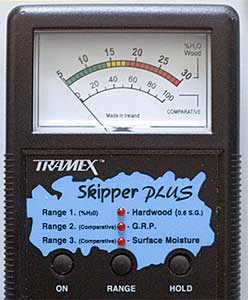
What meter gave 25% readings? Tramex meters read 0-100%, and 25 is not that bad a reading for a 15 year old hull. Bear in mind that even a "100% saturated" piece of GRP only actually holds about 2 to 3% water.
tramex.jpg
 
What reading is the superstructure giving?

I am advised by a surveyor that the important thing is the difference between the hull and the topsides rather than the reading the hull gives in isolation.
 
Depends on what meter is being used. My last boat (Hunter 26) was measure by the Victoria scale and was between 15 - 17. This was regarded as being very wet.
My current boat, very much older was measured, again on the Victoria scale at an average of 3 ? It has not been epoxied and has been lifted out every season of it's life (37 years)
 
I'm not a surveyor and I don't do GRP work personally! I too was under the understanding that moisture readings are a comparative measure.
 
Getting moisture out of hull laminate is like getting oxidisation out of steel...impossible! An ever expensive quest! Why are you so concerned, does it look hideous? Why not leave it and spend the money on something more useful and enjoy the sailing. GRP and moisture (osmosis) is the modern paranoia, even brand new hulls just launched can give alarmingly mmisguiding "wet" readings. Throw the meter over the side and open a bottle of red...moisture problem cured!
 
I've just started working on the hull of my latest project. (Built circa 1973) The topsides where painted with a tar brush by the look of them and the A.F was 4mm thick and flaking badly, No blistering but a very heavy sanding has exposed tiny pin hole voids (air bubbles I'd guess) within the gel coat above and below the water line some of them were damp and showed up as dark areas 3 to 4 mm accross in the sanding dust, Now open they appear to be drying out very rapidly, When dry I'm going to fill the voids with gel coat repair before applying several coats of epoxy over the entire hull, She is showing no evidence of raised blisters and I'm hoping this treatment will prevent it happening in the future, I'm no expert so stand to be corrected, Regards all, Mike.
 
After a heavy shot blast I had to wait a year to get down to acceptable readings. Gel peeling will expose more and speed the drying but adds to the work afterwords. I finished my 30ft boat late last year and the work was OK, the waiting to start was awful!

Yoda
 
G'day Mickshep,

You will have a better results if you wet out the small holes with an epoxy resin then fill with 'closed cell' balloons or spheres.

They will sand easier, cost less and be more water resistant.

Avagoodweekend......
 
Using a Tramex the reading needs to be in the green to epoxy coat. With a Sovereign, 5 and below.

Careful with moisture meter readings - both the above cab detect internal wooden bulkheads which are invariably high. The Tramex will detect condensed moisture on the inside of the laminate and this is common at this time of year. They will also detect steel, other metals etc, so you need to investigate isolated high reading which might be anything but laminate moisture.

Some laminates get wet and then dry out again when the boat is lifted out. As I understand it, these are not a worry. A major indicator of osmosis is a laminate which doesnt dry much when kept ashore. Its like a dish of salt left open in the cabin - it retains moisture.

Dont ignore osmosis but do ignore the "no boat has ever sunk because ....." merchants. The nasty gunge created in osmosis eats away at the resin and does weaken the structure. Sure it may be a slow problem, but it is also continuous. So its rarely a case for panic but its never a case for just forgetting unless the boat is also just for forgetting.

If you want sound advice, talk to one of the paint helplines or log into http://www.passionforpaint.co.uk Very helpful and knowledgeable.
 
Top