Hull epoxy coating

MJWB

Well-Known Member
Joined
24 May 2019
Messages
312
Location
Yorkshire coast
Visit site
Back in 2003 my boat had epoxy hull treatment completed by a company which was closed some years later. So I can't ask them. I assume from looking at the historical invoices that this was to treat osmosis. I did not own her then. Since then the layers of antifoul have built up and I'm thinking about removal. No sign of osmosis now. However I'd like to understand what was done in 2003 and what that means now for removal of the antifoul layers. Wondering whether someone can answer my questions.
The quotation paperwork says "Carry out full Blakes Epoxy Treatment" and describes peeling the gelcoat below the waterline to expose the laminate, grit, pressure washes and dried with heaters to an acceptable moisture level. It then says "once the level is achieved the peeled area is coated with Blakes Epoxy Resin to a thickness recommended by Blakes Paints".
Questions
Does this work not mean replacement of gelcoat first, or, or is it all built up with epoxy? I assume that would be a few mm thick.
Anyone know what colour the epoxy from back then might be?
How can I tell when I'm through the old antifoul layers and exposing the epoxy? I assume there would be primer on top of the epoxy.
Any other guidance appreciated.
Thanks.
 
They won't have replaced the gelcoat, the thickness will be all epoxy. What that thickness is, or what colour I have no idea, but you'll know when you hit it because it blunts sanding discs at a huge rate - you'll feel the drag change significantly. It's hard to go through epoxy by accident.

FWIW, consider having it blasted - sanding years of antifoul is a filthy, hard and unhealthy job (particularly older paints). Blasting costs, but will leave the epoxy (and your health) entirely intact
 
As KevinV notes, you'll feel/know when you've reached the epoxy.
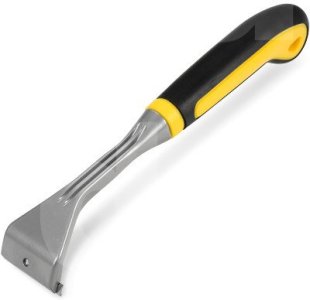
If you are stripping the old antifoul by hand/yourself, then I would recommend that rather than using a sander - unless it's Mediterranean-in Summer dry, the discs clog up every two minutes - use carbide steel paint scrapers like these; just touch the blade corners on a grinding wheel before you start to avoid them digging in and buy 'comfortable' rather than cheap ones as your hands will be getting to know them very well. It'll still be an incredibly time consuming and unpleasant job, but at least you don't end the day entirely covered (inside and out!) in old antifoul paint.
 

Attachments

  • scraper.jpg
    scraper.jpg
    12.8 KB · Views: 6
I stripped off the very thick layers of anti fouling last year. Scraping by hand with a tungsten bladed scraper was extremely hard work, possibly because of the very thick layers I was dealing with, so I ended up paying for the hull to be blasted. This exposed the epoxy layers where my hull had been gel peeled and epoxy coated, probably over 20 years previously. The epoxy was either grey or bright green. The previous osmosis treatment had been very effective, there was no sign of any more osmosis. These were the 2 colours used by international for their epoxy and Blake’s may have been the same. The epoxy was very hard, but, in my case quite rough. I went over the whole hull with a belt sander, then random orbit sander to get a smooth finish, then 2 coats of Hempel High Protect epoxy, one coat of Hempel primer then antifoul. Good luck!
 
We've recently stripped back to the epoxied hull. But there were only a couple of layers of AF to take off so it wasn't too terrible.
We used a formic acid based stripper. It has limited penetration, and I don't think I'd recommend it on a really thick buildup.
I'd have preferred to blast but the boat is in the US where boatyard labour rates start at $100/hr, so we just couldn't afford it.
 
I've worked it out via earlier invoices with the boat. There's 22 years of old anti foul in situ. Getting it blasted sounds attractive I confess. Don't know UK cost yet. Probably scary.
Couple of questions though....
1. Anyone tried wet sanding with an air sander? I doubt sanding is realistically viable on 22 years of AF but considering all options.
2. What is soda blasting as against sand or whatever? The yard manager said soda would probably be better.
Thanks all.
 
The medium for blasting is less important than the skill of the operator. You don't say what the boat is nor where it is located so difficult to estimate cost. The biggest challenge for blasting is an iron keel if your boat has one, not so much the blasting to a sound base but getting a coat of epoxy on immediately to prevent any rust forming. As suggested if you are keeping the boat worth applying Coppercoat rather than short life antifouling.
 
The medium for blasting is less important than the skill of the operator. You don't say what the boat is nor where it is located so difficult to estimate cost. The biggest challenge for blasting is an iron keel if your boat has one, not so much the blasting to a sound base but getting a coat of epoxy on immediately to prevent any rust forming. As suggested if you are keeping the boat worth applying Coppercoat rather than short life antifouling.
Also 100% correct.
 
The medium for blasting is less important than the skill of the operator. You don't say what the boat is nor where it is located so difficult to estimate cost. The biggest challenge for blasting is an iron keel if your boat has one, not so much the blasting to a sound base but getting a coat of epoxy on immediately to prevent any rust forming. As suggested if you are keeping the boat worth applying Coppercoat rather than short life antifouling.
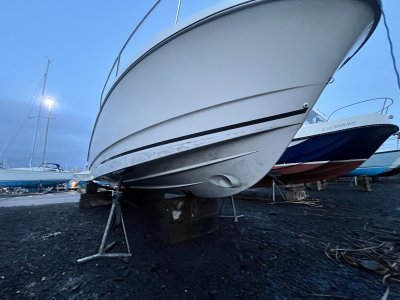
26 ft bilge keeler. GRP hull and keels I assume iron. North of England if you fancy a stab at cost estimate! It appears there's some kind of coating on the keels already. In places at least.
 
I just had my 7m Merry Fisher (sodium?) blasted for £950 which was money well spent.

It was only 10yrs worth on there and it was flaking off in places so was a relatively easy job compared to some I guess.

It was money well spent and took me just a couple of hours giving a couple of very small sections a quick sand and then washing it all down before it was ready to paint. My only regret was trying to paint it in winter in Scotland, if I was ever doing it again I’d do it in the summer. The weather made 5 days painting drag out over about a month.

As for copper coating quotes they were up near £10k 😮 and no chance of DIYing outside in winter.
IMG_6199.jpeg
 
26 ft bilge keeler. GRP hull and keels I assume iron. North of England if you fancy a stab at cost estimate! It appears there's some kind of coating on the keels already. In places at least.
£800-1000 plus £150 for epoxy for the keels. If you do it in warm dry weather DIY Coppercoat is viable on that size boat (provided you are OK crawling between the keels)
 
I just had my 7m Merry Fisher (sodium?) blasted for £950 which was money well spent.

It was only 10yrs worth on there and it was flaking off in places so was a relatively easy job compared to some I guess.

It was money well spent and took me just a couple of hours giving a couple of very small sections a quick sand and then washing it all down before it was ready to paint. My only regret was trying to paint it in winter in Scotland, if I was ever doing it again I’d do it in the summer. The weather made 5 days painting drag out over about a month.

As for copper coating quotes they were up near £10k 😮 and no chance of DIYing outside in winter.

View attachment 205915
Wow 10k for a 7m boat when the hard bit has been done.

If you can wait for the temperature to reach above 12 degrees ish and 4 to 5 days of dry weather then it is quite realistic to do it yourself. Two coats of epoxy, wait a week then the 5 coats of coppercoat in a single day. I did it on my last boat and it has lasted very well.
 
Hi,

In my view, Tranona has the best advice above.

With 22 years of a/f, soda blasting will take a long time and you will pay for the hours - use a blasting contractor with experience of blasting yacht hulls and keels then leave the choice of medium and pressure to him. He will know exactly when he gets down to the epoxy and stop there, leaving a nicely matted finish, ready ro take a/f or Coppercoat - the epoxy will serve as both gel coat (much more durable than the original polyester) and primer.

The iron keels are another thing. If there is any rust, it will be pushing the epoxy off as rust takes up about 8 times the space of the iron that it came from. Best in this case to take it all off.

Also, cast iron is slightly porous, so rust and salt water will have gone into the pores. This cannot be returned to as new, but the best you can do is to give the blasted keels a thorough pressure wash with fresh water which will promote light rusting (gingering) then another quick blast to rake the gingering off. This blast also warmsvthe keels to promote faster drying. In the UK climate, it's best to get the hull into a temperature controlled shop as soon as the gingering has been taken off and get thevfirst coat of an epoxy primer on the keels.You can buy rust and moisture tolerant epoxy primers, first developed for the N Sea oil industry, but they are pricey. We used one in 2011 with Coppercoat on top and found very little rust when we redid the Coppercoat in 2024 (Moody 425)

I don't really know what contractors you have in the Northeast, but a colleague from Hull sailed his Moody 44 to Suffolk for blasting and re Coppercoating in 2024.

A package for a yard to do the whole job can bring savings as they contract for a blaster to do several boats together, so travel and setup costs are shared. The yard will also have trained their preferred contractor on the required clean up and waste disposal procedures to control the toxic material being removed.

Peter.
 
Wow 10k for a 7m boat when the hard bit has been done.

Yes I was quite surprised at the quotes!

Even more so when I realised it’s not that much different to normal paint, just that it needs all the coats in one go.

The price did include blasting, a full drive in drive out service. Similar price from two different places.
 
Yes I was quite surprised at the quotes!

Even more so when I realised it’s not that much different to normal paint, just that it needs all the coats in one go.

The price did include blasting, a full drive in drive out service. Similar price from two different places.
You have to think about cost of materials, labour and inside storage.
Materials would be under 1k.
The bulk of the labour would be the old antifoul removal and making the surface fair. Mine was done by scraper and sander and took a week. Epoxy coating took half a day and coppercoat took a day.
If blasting that would be 1 or 2 days and leave a fair surface.
use of an indoor space for 10 days would likely be 500 ish.
So they are charging 8k for 5-6 days at most labour. Sounds a lot to me.
 
As a price rule of thumb, take the retail price of the Coppercoat and multiply by 3.
1/3 materials, 1/3 blasting, 1/3 prep and application.
Assumes no other repairs needed / horrors found when antifoul removed.
 
Top