markle
Member
Hi everyone, I have recently resurrected my pilgrim 25 project, had her lifted into a yard and have started in earnest!
Some random pics of the project before she stalled - bought a rigid raider and spent some time on that - here (it is now a full rebuild - cabin all done just a few jobs left before a sand and paint)
http://www.ybw.com/forums/album.php?albumid=896
I am a little stuck on the hull deck join. Originally she had wooden strake, bolted top and bottom and then a covering piece over the top screwed to both halves.
I assume this was to assist in keeping hull and deck together!
now there is no strake at all, it is in many pieces in the tip!
The join is like this:
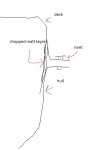
Apologies for the child like drawing - best I could muster on paint!
So it has an outward flange riveted, and reasonable heavily glassed up on the inside - i would guess 3 layers of 600g/m chopped (although when it was layed up metric was a long way away!).
There are sectioned of the flange that have snapped or been worn away.
Is it feasible to just grind the whole flange off ..... and layer up 3 or 4 layers of glass over the top? I can run it up a good inch either side (deck and hull) giving 2-3 inches of contact point!
This will alleviate the issue of planing lots of iroko to fit the profile of the hull/deck as if i get rid of the flange i could bolt a decent rubber fender top and bottom.
Any advice welcome and appreciated
glad to be back on the project finally!
Mark
Some random pics of the project before she stalled - bought a rigid raider and spent some time on that - here (it is now a full rebuild - cabin all done just a few jobs left before a sand and paint)
http://www.ybw.com/forums/album.php?albumid=896
I am a little stuck on the hull deck join. Originally she had wooden strake, bolted top and bottom and then a covering piece over the top screwed to both halves.
I assume this was to assist in keeping hull and deck together!
now there is no strake at all, it is in many pieces in the tip!
The join is like this:
Apologies for the child like drawing - best I could muster on paint!
So it has an outward flange riveted, and reasonable heavily glassed up on the inside - i would guess 3 layers of 600g/m chopped (although when it was layed up metric was a long way away!).
There are sectioned of the flange that have snapped or been worn away.
Is it feasible to just grind the whole flange off ..... and layer up 3 or 4 layers of glass over the top? I can run it up a good inch either side (deck and hull) giving 2-3 inches of contact point!
This will alleviate the issue of planing lots of iroko to fit the profile of the hull/deck as if i get rid of the flange i could bolt a decent rubber fender top and bottom.
Any advice welcome and appreciated
glad to be back on the project finally!
Mark