How to use VMG to optimise downwind angle

BelleSerene

Well-Known Member
Joined
19 Sep 2005
Messages
3,423
Visit site
With an asymmetric it's faster to sail downwind if you head off DDW and then gybe to head off the other way: 'tacking downwind'. So for your given sail configuration, there's an optimal angle to the wind at which you'll reach the objective the soonest.

I believe that if I set a waypoint for my downwind destination, and then keep changing the boat's angle (and keep trimming the sails accordingly) so as to optimise VMG towards that waypoint, that's the optimal angle to sail at. Then, as for an upwind mark, gybe when you're on a layline at the reciprocal angle and you'll hit the mark the fastest.


1 With Raymarine ST60 kit, how do you identify the waypoint towards which it's telling you your VMG?

2 Is it better in practice to do this than to use a polar diagram of the sails?

3 Say there's a tide running, on a several-mile-long leg. Is there a simple way of offsetting for the tide, or do I get into more theoretical vectors than I can have time for in a race?
 
I don't think that will work, what you need to know is the opposite of VMG upwind which is measured as speed component directly into the wind not towards a fixed waypoint. Perhaps your VMG will read negative figures downwind and just aim for the max -ve figure?

Best angle downwind if you start directly upwind of a fixed mark is the component of speed in the same direction as the wind.
 
As usual, we are at risk of confusing two different VMGs. Traditionally, VMG just meant in relation to the wind, and that is what my ST60 normally displays, but my Graphic Display will also display VMG to waypoint, which is what you want.

On my system, the unit will only display data for one waypoint at a time, so distance, time to, VMG and so on are always inrelation to my current waypoint, which is the one I have set a GoTo for or which is the next on my route. Whether it is better to tack on the lay-line for the mark or in a series of shorter tacks is a tactical matter. It may be necessary to do a "test tack" in each direction so that you know your best course in either direction.

I have not used a polar diagram for this purpose, but it is likely only to give a general answer and the meter ought to give the correct answer, pretty well with current kit.

In a tideway, I simply use the COG function to judge my "true" course. No amount of trigonometry will compensate for all the variables you will meet. (For a long leg, it is necessary to set a course allowing for the tide, naturally)
 
1 With Raymarine ST60 kit, how do you identify the waypoint towards which it's telling you your VMG?


2 Is it better in practice to do this than to use a polar diagram of the sails?

3 Say there's a tide running, on a several-mile-long leg. Is there a simple way of offsetting for the tide, or do I get into more theoretical vectors than I can have time for in a race?


1. The VMG is calculated exactly upwind or downwind of your position.
An actual "waypoint" is sometimes used by people who do not have the true wind calculator on their wind instruments, they use a gps with a fictitious waypoint very far away and upwind of where you are, which of course is a gross approximation because one should change the waypoint at every change in wind or with the movement of the boat.
The ST60 VMG calculates the true wind direction, then the component/projection of boat speed along that direction.
Depending on the amount of accuracy you need, the ST60 delays in calculating the various elements might not be sufficient.

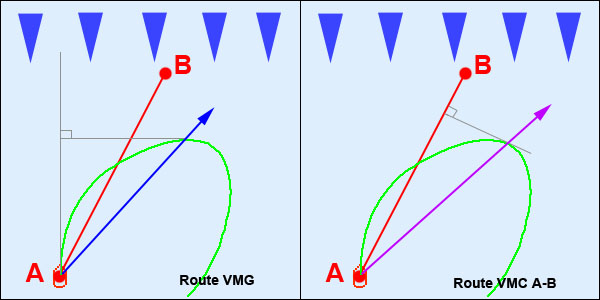
Also, bear in mind the VMG is useful if your buoy, etc is directly downwind of your position. If it is not, there is possibly another combination of speed/angle to the wind (VMC, Velocity Made on Course) which provides the fastest way for the buoy. If you have to go from A to B, VMG is *not* your best choice, the wind angle on the right is.
vmg-vmc.jpg


2. Depends on what "polars" you are considering. If it is a class boat then probably there are *measured* polars which can be considered as a reference; if a one-off, then you may use the theoretical polars given by the designer, orc or whatever VPP measurement system, or *better* make your own polars and use them.
There are various softwares which can be connected to a nmea stream of navigation data, you go out sail sail sail on all angles and all wind speeds and a nice group of apple-shaped polars is provided.

3. Current -especially if significant- has a double influence.

On one side the current affects the speed over ground of the boat, so your polars will be shifted.
pol1_zpsdf5b3c5e.jpg


On the other side it creates an additional "current wind", which concurs in determining your new "true wind". Imagine yourself in a windless day, boat stopped, in a current, you feel this "current wind". Boat stopped, add an external wind: the wind you feel on the boat will be current wind + ground wind. Your polars will be not those of the pure ground wind, but those referenced on ground wind+current wind.
Then, your boat eventually moves, your apparent will be the sum of the three.

Putting the two effects together yields polars like these, not centered and asymmetrical.
pol2_zps86a19c32.jpg

Depending on the type of racing, there are softwares which can compute everything. Should one sail in places with constant currents, then maybe do some by hand, but in places with changing currents imho it's for the electronics.


** edit
I just read the other message, the "waypoint" feature of the ST60 is indeed to get the VMC if I understood correctly**
 
Last edited:
1. The VMG is calculated exactly upwind or downwind of your position. ...

This had me rushing off to Wikipedia to get a more complete explanation.

It has long puzzled me because I thought that "made good" meant towards a specific destination; that being a "Good" place to be. Checking with the manual for my oldest Garmin GPS (dated 1997), which has "VMG" as one of its displays, I can see that is where my understanding came from: "the speed you are travelling towards the destination" is exactly what the reference section says. (And when I wrote a simple navigation program that is what I showed, too!)

So now I understand how instruments can claim to show "VMG" when they have no destination!

Mike.
 
Download Deckman sofware, install it a demo, and download B&G's deckman manual on their site, it give you the full run,
then project it on your system....
 
The ST60 can show VMG which relative to the wind only. If you go downwind it shows a negative speed. Surely the simple thing is to look at the negative number. and then steer so the negative number is as big as you can get it?

TS
 
Top