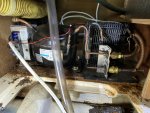
How to tell if fridge compressor needs re-gassing

now that everything solved amicably, can we get an update re OP issue?
is it any better with cupboards open and a big fan blowing through?
[yes, I'm bored waiting for the meltemi to ease so that I can leave with the boat for a couple of weeks :cool: ]
 
So much more useful for forum readers now that everyone has explained their perspectives a little more. Expertise or no expertise, there's always room for more respectful dialogue...

As to my original post - I'm away for the week, so will be trying the ventilation as soon as I'm back at the boat. I also have an IR camera to use to see if I can find any obvious spots of insulation failure, and will check out the performance of the evaporation plate to see if there are any symptoms there... I'll update the thread when I have findings.
 
honestly, pay an expert, I am usually up for doing EVERYTHING myself but found a local guy on the fridge who changed all the o-rings, regassed, changed the fan, and tested it (temps and pressures) and it was about £120 all in, now its like new...
 
honestly, pay an expert, I am usually up for doing EVERYTHING myself but found a local guy on the fridge who changed all the o-rings, regassed, changed the fan, and tested it (temps and pressures) and it was about £120 all in, now its like new...

Im absolutely up for paying for expertise -did you look for specialist marine fridge experts, or just general refrigeration company?
 
Ring around your local area for ac refrigeration engineer, you may not be very lucky during this heat wave though as they are likely to be very busy. You could call at your local climate centre, normally with pipeline centre, they will normally know someone you may ask to come and look for private work. Most refrig engineers charge about £65 per hour so be prepared.
 
Finally made it back to the boat today, armed with a laser thermometer and a cheap(ish) thermal camera for my phone.

I stuck a whole load of ice blocks in this morning, and then went back a few hours later to see if I could find any obvious warm spots inside the cool box.

Firstly, checked the lid. Couldn't see any obvious temperature fluctuations around the lid, either with the thermal camera or the thermometer. So I'm not going to focus on the lid for now.

Inside the cool box, the thermal camera appears to show a couple of 'warm spots' which stood out from the rest of the now chilled interior.

One was the far vertical edge behind the evaporator plate, with a warm spot running top to bottom. I presume this is where the insulation used on the exterior of the box doesn't meet perfectly at the corner, allowing conduction through to the box.

Warm spot - back edge.JPG

The second warm spot is around the drain (which does have a plug in it), and then along that bottom corner. Again, I guess this might be where the insulation has been cut away on the exterior to allow room for the drain pipe to run from the drain.

No idea how much heat could be conducted into the box via these two spots, but I'd imagine it's contributing to it.

I then turned the fridge on and took a look at the evaporator plate. Within a few minutes, the plate appeared to have a light frosting across all of the tubes within the plate (as in I could feel a slight icing with my hands).

The thermal thermometer appears to show a surface temperature of -17C across the entire plate, with no obvious fluctuations of temperature. The thermal camera also seems to show a consistently cold plate with no obvious warmer spots. Does this sound right?

Evaporator plate.JPG

From this, my gut feel is to not worry about the compressor either - and to focus entirely on addressing thermal loss for now. The exterior insulation appears to be Celotex, so I wonder if the issue is that it wasn't secured with glue, and that the gaps between the boards were not filled.
 
Last edited:
Unfortunately temperatures will tell you very little, a cold plate will tell you compressor is running and pumping some gas, only system pressures will tell you how hard it’s working and if the gas charge is correct. a plate temp of -17 could be achieved with a suction temp of -35 but with very little duty / heat transfer going on. Check all you pipe work for any signs of oil, never mind how small as this will normally show the leak as oil comes out with the gas.

you could check the discharge temp, this is the pipe off the compressor to the condenser which if it’s air cooled also has the fan, is the fan working as if not this will stop system working, the small pipe off the compressor is likely to be about 70 degrees or above if working hard. Also in the current heat wave most boat fridges will really struggle as the air they are in will be way above their spec.
 
Unfortunately temperatures will tell you very little, a cold plate will tell you compressor is running and pumping some gas, only system pressures will tell you how hard it’s working and if the gas charge is correct. a plate temp of -17 could be achieved with a suction temp of -35 but with very little duty / heat transfer going on.

Dammit - I knew it couldn't be that simple. I was following some of the previous guidance provided that suggested that if the evaporator plate was showing that it was frosting up, but the tubing to the evaporator plate didn't show signs of frosting, it was a sign that the gas pressure in the system was about right.

you could check the discharge temp, this is the pipe off the compressor to the condenser which if it’s air cooled also has the fan

the small pipe off the compressor is likely to be about 70 degrees or above if working hard.

Not sure if this is what you're referring to, but one of the pipes from the compressor to the condenser is warm, which I assumed meant that it was removing heat from somewhere... one of the pipes around that area is incredibly hot (too hot to touch for very long)

is the fan working as if not this will stop system working

Yes it runs whenever the compressor is active

Also in the current heat wave most boat fridges will really struggle as the air they are in will be way above their spec.

And maybe this is the ultimate problem - I don't really know what's reasonable to expect in terms of differential from ambient air temperature to inside of the cool box. I do think there are some issues with conduction of heat through gaps in the insulation though and I wonder if I can do something about that with some thermal bubble wrap type stuff to line the inside of the cool box.
 
Dammit - I knew it couldn't be that simple. I was following some of the previous guidance provided that suggested that if the evaporator plate was showing that it was frosting up, but the tubing to the evaporator plate didn't show signs of frosting, it was a sign that the gas pressure in the system was about right.


Not sure if this is what you're referring to, but one of the pipes from the compressor to the condenser is warm, which I assumed meant that it was removing heat from somewhere... one of the pipes around that area is incredibly hot (too hot to touch for very long)


Yes it runs whenever the compressor is active


And maybe this is the ultimate problem - I don't really know what's reasonable to expect in terms of differential from ambient air temperature to inside of the cool box. I do think there are some issues with conduction of heat through gaps in the insulation though and I wonder if I can do something about that with some thermal bubble wrap type stuff to line the inside of the cool box.

the small pipe from compressor is the discharge pipe and this should be hot, the other is the suction and should be cold with condensation building on it if it’s not got any lagging.
From what you say the unit seems to have lost a little gas but not enough to stop it doing something. A little loss can really effect stuff as the total charge is low to start with.
Can you see a connection with a cap to allow it to be topped up? Where is the boat based?
 
the small pipe from compressor is the discharge pipe and this should be hot, the other is the suction and should be cold with condensation building on it if it’s not got any lagging.
From what you say the unit seems to have lost a little gas but not enough to stop it doing something. A little loss can really effect stuff as the total charge is low to start with.
Can you see a connection with a cap to allow it to be topped up? Where is the boat based?

For my own learning, what about my description suggests that it might have lost a little gas?

It's based at Chatham on the Medway, Kent. It's a BD35 compressor, so I think there's a top-up valve on top - but not entirely sure!

IMG_7160 2.JPG
 
For my own learning, what about my description suggests that it might have lost a little gas?

It's based at Chatham on the Medway, Kent. It's a BD35 compressor, so I think there's a top-up valve on top - but not entirely sure!

View attachment 140834
I can post this again Recharging marine refrigeration systems taking the chance that this time I will not be shot down for giving environmentally unsound/illegal advice now that I have deleted the passage describing what to do if overcharged.
 
I can post this again Recharging marine refrigeration systems taking the chance that this time I will not be shot down for giving environmentally unsound/illegal advice now that I have deleted the passage describing what to do if overcharged.

Thanks @vyv_cox - it was using your guidance that I had concluded I probably didn't have an undercharge problem, as the evaporator plate seems to show a consistent light frosting across the whole plate with no evidence of sweating etc.

I haven't yet found any evidence of frosting on the return tube back to the compressor, and the compressor does indeed emit a tinny gurgling sound!

I was interested in what might have led @Daverw to suggest an undercharge as I accept I am an amateur trying to interpret this!
 
Maybe once you sort out the insulation so there are no air currents circulating around it and vent away the external heat which is trying its hardest to get back inside from where you removed it then all will be fine ;)
 
Have you addressed the cooling at the condenser? Air flow needs to be as free as possible, preferably assisting convection by drawing cool air from the hull and letting it flow up to the top of a locker or outside. The flow on mine as built was almost non-existent, with a vertical grille blocking most of the airflow. Adding a computer fan can make a considerable improvement at very little electrical cost.
 
For my own learning, what about my description suggests that it might have lost a little gas?

It's based at Chatham on the Medway, Kent. It's a BD35 compressor, so I think there's a top-up valve on top - but not entirely sure!

View attachment 140834
With the evaporator plate showing -17 with a warm suction Wouk’s indicate slightly short of charge. This could be the high ambient not condensing enough to allow the evaporator to boil off enough gas, but you say the air flow and fan are ok. The valve on the compressor suction is for charging and along with the two connections is often the source of a leak
Although I live in Lincoln I’m currently working away in Sittingbourne, I should have a bottle of R134a at home and could have a look one evening next week if you want as I could put stuff in car, I’m not far away and hotel can get quite boring,send me a PM if that would help,
 
I have the computer fan that's attached to the condenser and is powered from the compressor control unit. But I don't have an additional fan for air circulation yet.

I need to work out how to flow the air out of the compartment it's in. The air flow over the condenser is currently out from behind the compressor into the cupboard. This means it's away from the cool box, but there's no obvious air supply from the bilge without me fashioning something.

I then need to work out how to vent the warm air that is collecting in the galley cupboard, ideally something up high so that it can flow up and out. Might need to cut some holes in the cupboard shelf to let the air through, and then put some vents up underneath the worksurface.
 
If you want to see my reaction here refer to the response I can't delete from a responders reply, but the last part will remain as written.

So for me: PLEASE NOBODY EVER ASK MY ADVICE ON FRIDGE SYSTEMS AGAIN ON HERE.
 
Last edited:
So you modify the wording only to provide a direct link to the original text. I assume this means you think I am some sort of dickhead - but no that is you !!!

OK everyone chuck your waste overboard, including the oil from your bilge - apparently that is OK again now !!!

So for me: PLEASE NOBODY EVER ASK MY ADVICE ON FRIDGE SYSTEMS AGAIN ON HERE.
??? Perhaps you might like to read the link before pointlessly ranting.
 
Top