
How to fix a scarf joint which has opened up?

CaptainBob

Well-Known Member
Joined
7 Nov 2007
Messages
1,477
Location
North Yorkshire
www.yacht-forum.co.uk
Here's my scarf joint, which has opened up - I think during the hard frosts in december:
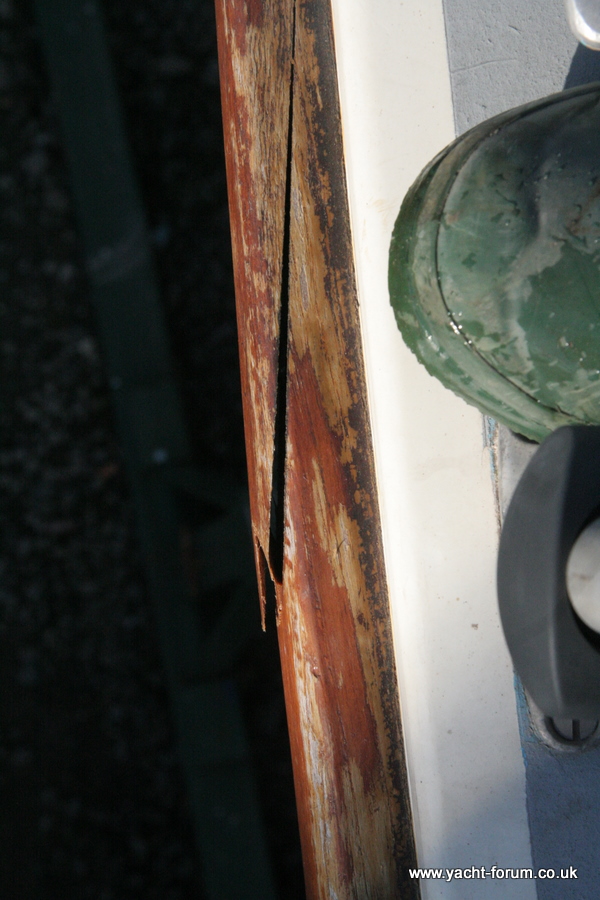
scarfjoint.jpg


Seems like the screw in the middle has pulled out of the boat.

Go easy on me as I'm totally green when it comes to joinery and grp...

I'm thinking of putting in two countersunk, short (no longer than the thickness of the whole strake to avoid them entering the hull at all) SS screws to just nip it up until such time as it's nice and dry and I can do a proper job of glueing it back together.

I'm going to need to use the boat extensively before it's properly dry enough, so this bodge will have to last until autumn probably.

TY!

(please don't mention the horrendous woodwork - that was gorgeous after some hard labour in the summer followed by sikkens novatech/novatop but the december chill made short work of it)
 
Last edited:
As you suggest but use glue and screws (brass would look better than SS). If you need to put a dowel in the original hole to hold the new screw.
 
Biggest problem you will have is cleaning the two surfaces so that you get a good bond. Hacksaw blade is useful.

I have done a couple of these poor Westerly scarfs - on a Centaur which is even worse as it is shorter. Used thickened epoxy and held it together with large size (No 10) pan head self tappers with a penny washer to spread the load. when cured, removed the screws, drilled the hole for 6mm fluted dowels, again set in epoxy and then countersunk for plugs to match the strake.
 
How about this?

Remove one screw on either side of the joint and allow to open up so you can clean it out. Prepare a doubler piece of wood (good and stiff) to go between the two removed screws and get some long temporary srews to hold it. Appy glue of choice and with the backing piece wrapped in cling film to avoid bonding screw in place with the temporary screws. Allow to bond. Remove backing piece, fit original screws and clean up the joint.

Doing this way will allow you to apply constant pressure on the joint while it bonds and doesn't require any new holes to be drilled.

I have recently used the evostick glue in a sealant tube (B&Q) which is excellent and does exactly what it says. Sets quickly and seems to bond very well. I think it's a polyurathane glue.

Yoda
 
As you suggest but use glue and screws (brass would look better than SS). If you need to put a dowel in the original hole to hold the new screw.

Sorry, you should not use brass. It will degrade on any external surface before you know it. I suspect you mean bronze?

Anyway, the route Tranona suggests would be my option..
 
I have the sames problem on a Westely. Do not want to use screws as not a lot of wood thickness to hold.
First tried epoxy, luckily can use sash cramps over genoa track. Left cramps on for a week, removed and it sprung again after a day. Next tried polyurethane glue - likes moisture! Lasted week and sprung again.
This time I will try some coffin cuts with a coping saw on the inside of scarf so wood will bend easier to shape. Plan to use PVA glue and mix in some teak sawdust to fill in any voids.
 
The main problems are cleaning and getting it dry. I have used aluminium oxide paper folded in 2 between the wood, so when I move the paper it cleans both surfaces. If you really can't dry it, suggest something like Stixall (a sort of MS Polymer mastic in building trade), which can handle a limited amount of water and fills gaps and is very strong. Still needs clamping. Perhaps 2 sash clamps with batten in polythene round outside or something like 30boat suggested. Down side to stixall is that if you want to clean it later, it will be very hard to remove.

If you can dry it, use epoxy with filler powders. Good luck.
 
I have heard of people putting in thin wedges of teak (or similar) to fill the gap & then planing down to shape. Apparently, when finished there is no pressure on it to open up & the "repair" is not easy to see unless you are really looking for it.

Caveat; I have not actually done this myself, it just sounded like a nice easy solution if I ever needed it.
 
I have heard of people putting in thin wedges of teak (or similar) to fill the gap & then planing down to shape. Apparently, when finished there is no pressure on it to open up & the "repair" is not easy to see unless you are really looking for it.

If I haven't flogged the Jouster (no reasonable offer refused) by this spring then I shall be doing that job in that way.
 
Best glue I've used is Wudcare Fast Grab 5 minute PU wood glue, available at most builders merchants. Do wear gloves though and tape any adjacent areas you don't want it on........

"Initial grab strength in 5 to 10 minutes. Seawater and chemical proof. Can be used on damp wood , concrete and metal. Expands slightly to increase bite strength. Initial grab strength in just 5-10 min. After 24 hours the glue is fully cured. It will bond all types of wood, MDF, metal, brick, concrete and polystyrene and once cured, is totally resistant to chemicals. When dry the glue offers an incredibly strong bond, is waterproof and even resistant to seawater making it the adhesive of choice for boat builders".....

The strength of this stuff is amazing but, this particular joint is always going to try and spring apart so, as Searush says, inserting and glueing wedges and then reshaping is the way to go. Surfaces must be scraped clean and de-oiled beforehand.
 
I agree about the de-oiling. I have been cutting some teak this afternoon to repaire a rubbing strake on my Konsort strangly enough. I think you could just about squeeze the oil out of the saw dust. Get some acetone into the joint once it has been prepared and just before you slap on the glue. Again Balcotran would be the glue of choice.
 
This thread is quite old now but at risk of being a pest I'm commenting, as today I've discovered a scarf joint on my westerly Griffon has opened. In a midships position on the beam. Has happened in the three days since I was last at the boat (out of the water) So I noted all the above with thanks, but wondered whether anyone has any more recent experiences and advice they could please share with this inexperienced woodworker.
 
Top