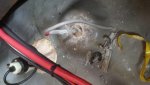
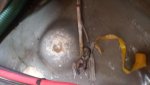
How to fill a hole in the bottom of the boat.

Andrew_Trayfoot

Well-Known Member
Joined
11 Oct 2007
Messages
674
Visit site
My Westerly Griffon has a long redundant Sumlog cable log transducer that I've been ignoring for 20 years. Having had all the AF removed it is now a good time to get rid of it...

Any suggestions as to how I should go about filling the holes?

Happy New Year.

Andrew
 
The "proper job" with bevels inside and out is quite a job, so much so that you might consider "if it aint broke, dont fix it"
In 20 years how much has it leaked vs now you have thought about it can you sleep?
 
Depnds on the size of the hole(s)

Small holes can be filled with a thickened epoxy after bevelling the edges of the hole from each side and then glassing over on the inside with several layers of bi-axial cloth and epoxy resin.

Larger holes must be chamfered ( 1:12 recommended) and then glassed in with layers of bi-axial cloth and epoxy resin The area that the chamfer covers can be quite awesome but makes for a substantial overlap on the existing laminate

read all the guides you can find on the West System websites and view the videos............ masses of instructional material out there ....... Several of these links overlap/ duplicate each other:

https://www.westsystem.com/wp-content/uploads/Fiberglass-Manual-2015.pdf

https://www.westsystem.com/wp-content/uploads/British.pdf

https://www.westsystem.com/wp-content/uploads/User-Manual-2015.pdf

https://www.westsystem.com/instruction-manuals/

https://www.youtube.com/playlist?list=PLKrXmm9fNk0b_btfL4THlghAT6ciaY3hB
 
BTW I found that sanding discs on a small angle grinder were adequate for chamfering.

A grinding disc was much too aggressive in the hands of a novice !
 
The "proper job" with bevels inside and out is quite a job, so much so that you might consider "if it aint broke, dont fix it"
In 20 years how much has it leaked vs now you have thought about it can you sleep?

The pictures below show the old "not broken" trasducer through my hull, when i bought the boat. Look Ok in the left picture, the centre and right pictures were taken after some minor poking around with just my fingers, no tools.

20160909_124223.jpg20160909_124406.jpg20160909_124448.jpg
 
Not a huge hole and yes I would fill it if it was my boat. Indeed I filled a hole somewhat larger for my old log impeller a long time ago. Indeed I am not sure I could find the repair now. Chamfer the edges of the hole inside and out. This makes the filler when hard like a YO Yo so locked in. Flange on the outside and inside. For a small hole use just filler for larger use layers of glass cloth and resin. For a larger hole the trick is to get one layer in and staying in place until it hardens before putting on the next layer from the other side. Use a plastic bag filled with sand to sit on the inside while you lay up glass and resin from the outside. As soon as the resin is hard enough to stand up without sagging put the next layer on from the inside.
The outer layer will chemically bond with the inside layer if you do it ASAP. Than finally sand down the outside and add filler (resin with filler) to get smooth hull. Very simple/reliable really. ol'will
 
Depnds on the size of the hole(s)

Small holes can be filled with a thickened epoxy after bevelling the edges of the hole from each side and then glassing over on the inside with several layers of bi-axial cloth and epoxy resin.

Larger holes must be chamfered ( 1:12 recommended) and then glassed in with layers of bi-axial cloth and epoxy resin The area that the chamfer covers can be quite awesome but makes for a substantial overlap on the existing laminate

From memory, the through hull hole for the cable Sumlog is quite thin, maybe 10mm, and also at 45 degree or so to the surface. There might also be a few mounting screws for the fitting, not necessarily through hull.
When I removed mine many years ago, I just used glass fibre polyester filler to fill the holes, after having bevelled the through hull hole just a bit. This was followed by several layers of glass mat and polyester resin on the inside, maybe 150x150mm. Then top coat to cover the repair inside and outside.
Possibly I would use epoxi today, but I think polyester is also adequate for something like this.
 
Last edited:
I would not advocate removing lots of material to greate a 1:12 bevel, for a small hole like a skin fitting.
I'd bevel it a little, mostly to expose fresh GRP, then fill the hole with glass and resin.
Then abrade the inside, removing any flowcoat, and add some layers of glass and resin, tapering out over say 6 inches in each direction.
The hull was strong enough with the thru hull adding no strength, so the repair need not be as strong as the rest of the boat.
Excessive chamfering risks losing the shape and replacing a large area of sound factory resin with DIY done in a damp boatyard. There are reasons for using this technique in some circumstances, but not for this job.
 
From memory, the through hull hole for the cable Sumlog is quite thin, maybe 10mm, and also at 45 degree or so to the surface. There might also be a few mounting screws for the fitting, not necessarily through hull.
When I removed mine many years ago, I just used glass fibre polyester filler to fill the holes, after having bevelled the through hull hole just a bit. This was followed by several layers of glass mat and polyester resin on the inside, maybe 150x150mm. Then top coat to cover the repair inside and outside.
Possibly I would use epoxi today, but I think polyester is also adequate for something like this.

An epoxy repair putty would probably a good choice to fill the holes ??

I would use epoxy rather than polyester for three reasons ...... I have loads of epoxy resin, filler and bi-axial cloth left over from a similar but larger hole filling job (Ball-Head toilet removal) , epoxy is a better adhesive and sticks to the existing laminate better and it does not require any gel-coating to make it fully water resistant
 
I would not advocate removing lots of material to greate a 1:12 bevel, for a small hole like a skin fitting.
I'd bevel it a little, mostly to expose fresh GRP, then fill the hole with glass and resin.
Then abrade the inside, removing any flowcoat, and add some layers of glass and resin, tapering out over say 6 inches in each direction.
The hull was strong enough with the thru hull adding no strength, so the repair need not be as strong as the rest of the boat.
Excessive chamfering risks losing the shape and replacing a large area of sound factory resin with DIY done in a damp boatyard. There are reasons for using this technique in some circumstances, but not for this job.

I agree with your basic method and the reasons behind it. When i've done 2" through hulls i've tapered slightly to about 6" diameter. It's ridiculous to grind a 24" diameter both sides of the hull to get rid of a through hull.
 
If it's a 10mm hole, taper it to about 30mm diameter, both sides. Fill with chopped strand polyester filler (P40), then fair outside with epoxy filler, paint inside. Job done.
 
My Westerly Griffon has a long redundant Sumlog cable log transducer that I've been ignoring for 20 years. Having had all the AF removed it is now a good time to get rid of it...

Any suggestions as to how I should go about filling the holes?

Andrew

don't use polyester as a fix Andy!
I had to to do mine again (same problem) in epoxy after realising ( the hard way) that polyester does not bond well to old polyester.
Grind the hole both sides so you can fill it with a plug then glass over it both sides with epoxy so the plug cannot be pushed though.
 
Last edited:
I would not advocate removing lots of material to greate a 1:12 bevel, for a small hole like a skin fitting.
I'd bevel it a little, mostly to expose fresh GRP, then fill the hole with glass and resin.
Then abrade the inside, removing any flowcoat, and add some layers of glass and resin, tapering out over say 6 inches in each direction.
The hull was strong enough with the thru hull adding no strength, so the repair need not be as strong as the rest of the boat.
Excessive chamfering risks losing the shape and replacing a large area of sound factory resin with DIY done in a damp boatyard. There are reasons for using this technique in some circumstances, but not for this job.

Good post. Sensible advice.
 
don't use polyester as a fix Andy!
I had to to do mine again (same problem) in epoxy after realising ( the hard way) that polyester does not bond well to old polyester.
Grind the hole both sides so you can fill it with a plug then glass over it both sides with epoxy so the plug cannot be pushed though.

No offence, but if you had to do it again, you didn't do it properly in the first place. Polyester will bond perfectly well to cured polyester if it's properly prepared.
 
Top