
How to Crimp a Battery Cable Lug

Baddox

Well-Known Member
Joined
1 Mar 2010
Messages
1,479
Location
Sunny Northumberland
Visit site
My lump of a diesel engine is suffering poor cranking and turnover at start-up. The batteries are OK but I’ve measure excessive voltage drop across the starter cables which I think is from the cumulative effect of mild corrosion on the connections.

To rectify this, I want to fit crimped lugs to the ends of the wire where none are currently fitted. I’d prefer to take the DIY approach and not relying on tool hire or taking the cables to a garage. So, does anyone have any recommendations of what works and what to avoid when fitting lugs to 60mm2 cable?

Options so far include…..

Solder- place flux into the lug, heat and melt a little solder into it, insert heated wire. Seems to be poorly regarded but no one is clear why.

hammeron_lug.jpg
Hammer-on lug made with a ridge to drive down the sheath onto the wire

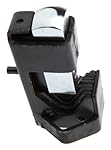
Hammer-on die tool to crimp a lug in place on the cable for example
41EICuzA1FL._SL150_.jpg


Reusable clamp-on lug
re-usb-clugs.gif
These look easily adjustable but next to impossible to cover with any shrink-wrap to protect from moisture.

Bite the bullet and spend a lot on a heavy duty crimping tool that I’m unlikely to need again.
 
Personally I bit the bullet and bought the tool, for £31 (or probably a bit less two years ago). It's proved useful for the odd job since, and I could also use it for crimping talurit-type wire "splices" (though I wouldn't if the wire in question was holding up my mast).

I did find that the dies on that tool seemed a bit oddly sized, I consistently had to use the next size down from what it was actually labelled as to get a good crimp. But the results seemed good, a test piece I sawed in half looked like a solid bar, as it should.

Pete
 
Funnily enough, I've just made six cables up, and just hammered the cr*p out of them. Works well.

Edit. I did do it hot.
 
Last edited:
Personally I bit the bullet and bought the tool, for £31 (or probably a bit less two years ago). It's proved useful for the odd job since, and I could also use it for crimping talurit-type wire "splices" (though I wouldn't if the wire in question was holding up my mast).

I did find that the dies on that tool seemed a bit oddly sized, I consistently had to use the next size down from what it was actually labelled as to get a good crimp. But the results seemed good, a test piece I sawed in half looked like a solid bar, as it should.

Pete

Wow, thanks Pete, I think I owe you a beer for that. The tools that I have came across on the net were into the hundreds of pounds. I'll put an order in for one tonight.
 
ebay

try ebay for a cheap crimping tool or get an electrician to do it for you.
Silver soldering can and probably will crack if the cable moves about
I'd not rely on trying to bang it down hoping to get it to close all around the cable !
Did you check the connections to see if any are warm / hot indicating resistance

cheers
mick
 
I have soldered connections and they were still working after 7 years.
I used a blowlamp, leaded solder and no-clean flux which I got via the trade.
Wet rag to stop the insulation melting too much.
Crimp as best you can first to avoid using tons of solder which runs miles up the cable making it stiff.

I have an Ormiston talurit splice tool which cost about £30 which would probably do it.
Came from a dinghy chandlers!

But a vehicle wiring place will do a better job very cheaply.
(not always helpful when the wire is threaded through a bulkhead of course!)
 
A far as I know, two ways not to do it is (1) hammering the cr** out of them as apparently this does not enclose the strands but squeezes them between two flats, nor is soldering as it opens the option of breakage due to vibration. (I do have to say that mine are soldered and that made it to 20 years when I bought the boat, but still...)

Aparently, if you do not have proper tools, this is the way to go:
http://www.instructables.com/id/Properly-crimping-a-copper-welding-lug/?ALLSTEPS
 
I also bought a tool from eBay and deliberately went for an old one because it was solid and not many bids. "Indent Cable Crimping Tool" brings up ones at £50 - £130 (mine looks exactly like the most expensive ones). Only drawback is that it is very heavy and big so I don't leave it on the boat. It crimps terminal from 10 - ~100 mm².

I've used it for many crimps and imagine I could sell it fairly easily so it was a good buy at around £30. I don't think that they turn up very often so usually get inflated prices 2nd hand, plenty of new ones. I'd probably buy a hydraulic one now (unless mine turned up for £20) but I think that they were twice the price when I was looking for mine.

I also manged to find heavy duy black glue lined heatshrink sleeve on eBay and bought a couple of metres. Another good buy as it seals the cable ends very well.
 
Last edited:
Thanks for all the replies. Sven the site you link to looks useful. I had thought about just hitting the crimp with a cold chisel to form the dent.

A proper crimp should have more than a dent! The metal should have cold-flowed into a completely new shape.

Pete
 
I realised that which is why it didn’t make it to the list I posted. I’ve now ordered a hydraulic crimper and a length of adhesive lined shrinkwrap tubing to seal the join. That should do the job nicely.
 
Personally I bit the bullet and bought the tool, for £31 (or probably a bit less two years ago). It's proved useful for the odd job since, and I could also use it for crimping talurit-type wire "splices" (though I wouldn't if the wire in question was holding up my mast).

I did find that the dies on that tool seemed a bit oddly sized, I consistently had to use the next size down from what it was actually labelled as to get a good crimp. But the results seemed good, a test piece I sawed in half looked like a solid bar, as it should.

Pete

Bought similar about 2 months ago, but up to 300mm2 wire.
Your mention about the die size. I had access to lots of good quality crimps from 10 to 70mm, (have boxes and boxes of them on the ship). Using those crimps, with the rated die turned out perfect crimps. I needed a couple of extra 50mm crimps which I bought from the local lecky shop, and they were much lighter than the ones I had used previously, wall thickness much less.
Had to use the 35mm dies to get a good crimp. So maybe the die's are OK, but some of the lugs being sold are not quite up to par.
 
People will say soldering creates a hard spot in the cable, which is vulnerable to fatigue.
That is true to some extent of a crimped terminal too.
The cable needs to be secured against vibration.

It's instructive to crimp a spare connector as a test and hacksaw through it.
It needs to be free of voids, it should look like solid copper.

You can do an acceptable job with a hammer and punch, if the crimps are good old fashioned thick copper ones. But it takes practice, and it's always going to be a slight doubt.
 
Top