How to care for terylene, nylon and Dyneema ropes?

If rope is liable to herniate during washing, you're quite likely to have trouble with it in normal use.

A lot of rope comes with excessive lubricant in it, it's often necessary to wash brand new rope to remove the worst of it. I've just done this with a slippery new mainsheet.

We had some bargain rope herniate on a boat I raced on. It was a spinnaker halyard. I worked the core back in and milked the cover up and down a few times, then shackled the end to a fixed point, freed the cover from the core by cutting off the heat sealed end and progressively pulled the cover. I ended up knotting the bitter end of the rope and loading it with my weight.
Once the core and cover had settled together the rope was fine, still in use when the new owners broke the mast about ten years later.
 
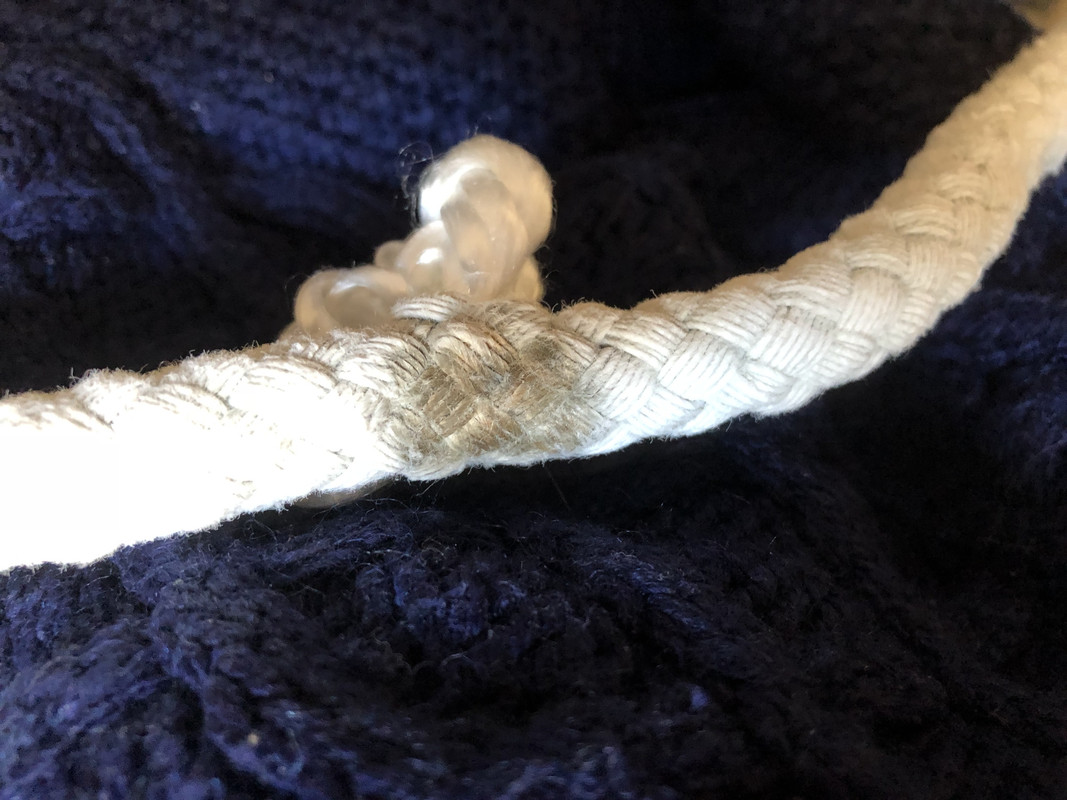
Sample of fairly elderly main sheet after 40 degrees whites cycle in Miele front loader. Luckily it’s ten inches from the end of a rather long rope! It does look as if there was pre- existing damage caused by spending several years in a bowline round a block becket; the dark mark is where the rope was in contact with the becket and the hernia is on what had been the outside of the very sharp bend. I’m going to cut that off and end for end the rope to get a year or two more out of it.

 
Last edited:
If rope is liable to herniate during washing, you're quite likely to have trouble with it in normal use.

A lot of rope comes with excessive lubricant in it, it's often necessary to wash brand new rope to remove the worst of it. I've just done this with a slippery new mainsheet....

This happened many times during testing, always with brand new rope from respected manufacturers.
. The link I posted showed new rope that had never been used (Tuefelberger).

This can also happen with very old rope, as you point out, but it is really a different process, I think, generally involving the failure of some cover strands. But herniation is most common with very new rope, sometimes popping every 18 inches.

Yes, some ropes are a little over lubricated for use. A few rains generally fixes that. Racers have even been known to lightly sand critical sections of sheet and halyard.

yes, with a new rope you can generally milk the hernia back in. But the real answer is not to machine wash ropes for the first 2 years--what are we, society women? Hand wash them, if you must, or better yet, just don't worry about it.
 
Last edited:
If you’re going to put your ropes in the washing machine, just make sure SWMBO isn’t around. Got caught putting my mooring strops in the w/machine a couple of years ago and haven’t heard the last of it since.
 
Last edited:
If you’re going to put your ropes in the washing machine, just make sure SWMBO isn’t around. Got caught putting my mooring strops in the w/machine a couple of years ago and haven’t heard the lat of it since.

As ever it is all to do with logic and education.

I do not physically put the ropes in. My wife does as the washing machine is off limits for me in case i mess it up.

They are just delivered to me clean for untangling and coiling up.
 
Sample of fairly elderly main sheet after 40 degrees whites cycle in Miele front loader. Luckily it’s ten inches from the end of a rather long rope! It does look as if there was pre- existing damage caused by spending several years in a bowline round a block becket; the dark mark is where the rope was in contact with the becket and the hernia is on what had been the outside of the very sharp bend. I’m going to cut that off and end for end the rope to get a year or two more out of it.

When you want that to happen, to splice a rope, it's very hard work. It's stage one of tapering or making continuous line in rope like Marlow Excel Racing.
I guess the bit around the knot changes how the core and cover share the load. If the core is too long relative to the cover, the excess seems to work its way to one end in use.
If the hernia is close to the end, you can probably sort it by cutting the heat sealed end off and just pulling a bit of core out. But as you can afford to chop the bad bit off, that's better still.

To get the oils out of my new mainsheet, I just handwashed it in plenty of fairy liquid and left it to soak for a day. It has made a difference, definitely more grip in the ratchet block. And it doesn't taste so foul.... :-)
 
I was advised not to use normal detergents when washing man made fibre ropes,because of the additional chemicals added to them but to use plain soap flakes. I don’t know if this correct but for the last 10 years I have only used pure soap flakes.
 
I was advised not to use normal detergents when washing man made fibre ropes,because of the additional chemicals added to them but to use plain soap flakes. I don’t know if this correct but for the last 10 years I have only used pure soap flakes.

This has nothing to do with the fibers. They are the same as your clothes. This is obvious. Same with soaks and temperatures. Nylon is nylon, polyester is polyester, and ropes are not delicate with regard to detergent or laundry chemistry.

The reason for the advice against using detergents on newer ropes is that some level of spinning oils or other lubricators are desirable, reducing rope wear and preventing squeaking. There are many approaches, but that is the general idea. With old ropes, the lubricants are gone, so it does not matter. If you want to replace the internal lubrication, Nikwax is a top choice. Fabric softener slows drying, leaving to more mildew. This is why you minimize fabric softener with towels.
 
If you’re going to put your ropes in the washing machine, just make sure SWMBO isn’t around. Got caught putting my mooring strops in the w/machine a couple of years ago and haven’t heard the last of it since.

I got caught with the intercooler off a large ford turbo engine just coming out of the dishwasher. Brought it up lovely

Thinwaters comments on new ropes noted, but surely they can survive a few years on the mast before needing a wash.
 
Please bear with me; I have spent a lifetime sailing wooden gaff cutters with no winches, wooden solid spars and all three strand rope. I now own a GRP winch farm and I'm on a steep learning curve.

Is this for the Nic? that is a lot of very thick rope. Suddenly buying me sheets from the chandlers offcut bins looks like a real bargain.

Pete
 
If you have verdigris on the lines it will kill it

Interestingly, the green mould that had gathered on my halyards has all disappeared now that my boat is used regularly. I guess proof of the old adage 'a rolling stone gathers no moss'.

Thanks for the tip though, I assume one has to soak for the desired period to kill the spores, rather than dunk then wash within the hour.
 
Is this for the Nic? that is a lot of very thick rope. Suddenly buying me sheets from the chandlers offcut bins looks like a real bargain.

Pete

Yes... luckily she came with a lot of very thick rope and had been carefully laid up with mouse lines everywhere and the halyards and sheets (apart from the mainsheet and kicker) put away nicely. I am steadily working through it and most of it is OK, but the spinnaker sheets and guys and the genoa sheets look really expensive and there was nothing in those sizes in the oddments bins at SIBS (I looked!)
 
I'd never heard of spin lube before (and a google search yielded many diverting but not directly relevant results ).

But it does explain why a new rope I bought for jib sheets was so slippery it felt as though it was covered in some sort of mucus.
It was so unpleasant to handle that I took it off almost straight away.

So it's going in a tub with some washing up liquid to give it another go.

Thanks for a very useful piece of info, Thinwater.
 
Top