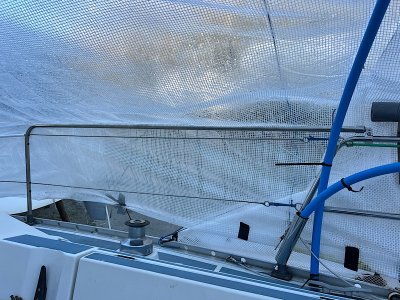
How to attach a horizontal tube to a tapering stanchion?

Simon F

Well-Known Member
Joined
1 Jan 2019
Messages
86
Visit site
Hello Folks,

I want to fit a horizontal 25mm stainless tube between the pushpit and the rearmost stanchion, equidistant between the higher and lower lifelines, so I can mount a pivoting solar panel there, but my stanchions are tapering, so not ideal for a rail clamp or t-piece. I thought about welding on a tab, but I'm concerned it will weaken the stanchion or distort it and also look a bit blue and depassivated. I thought about replacing the stanchion with a non-tapering one, but they're not that easy to find new. I even thought about buying a piece of 316 tube and cutting and drilling it, but maybe someone's got a better idea?

Thanks

Simon.
 
Feels like you should be able to make an insert for a rail clamp/t-piece which conforms to the taper of the Stantion? At the crudest self amalgamating tape and or some bike inner tube? If you wanted something a bit slicker a set of calipers should let you work on the dimensions and then either 3 print something or have someone turn you an insert?
 
Feels like you should be able to make an insert for a rail clamp/t-piece which conforms to the taper of the Stantion? At the crudest self amalgamating tape and or some bike inner tube? If you wanted something a bit slicker a set of calipers should let you work on the dimensions and then either 3 print something or have someone turn you an insert?
I think this nails it. You are sure to need a bushing of some sort, since the stanchion will probably be smaller. Just make it tapered. I'd turn it, but there are probably many possibilities, depending on how the T is fixed. You need to measure the top of the stanchion (what will clear) and the location. The busing will probably need to be split.

As for bluing due to welding (I don't think I would do it that way) it will easily sand/polish/passivate (citric acid) out. Not a big deal.
 
Hello Folks,

I want to fit a horizontal 25mm stainless tube between the pushpit and the rearmost stanchion, equidistant between the higher and lower lifelines, so I can mount a pivoting solar panel there, but my stanchions are tapering, so not ideal for a rail clamp or t-piece. I thought about welding on a tab, but I'm concerned it will weaken the stanchion or distort it and also look a bit blue and depassivated. I thought about replacing the stanchion with a non-tapering one, but they're not that easy to find new. I even thought about buying a piece of 316 tube and cutting and drilling it, but maybe someone's got a better idea?

Thanks

Simon.
That’s just the job for a 3d printer to make a shim.
 
Thanks to everyone who has replied. It's encouraging to see a clear consensus emerging. My concern with these solutions, is that they are all variations on the theme of increasing the friction between the mated components to resist the tendency for the horizontal to travel upwards rather like a melon seed squeezed between finger and thumb where a clamping force produces a force at 90 degrees. I do have some epoxy, but I wonder if stainless steel would bond strongly with that, especially with the small surface area. Maybe if I rough the surface a little with a file?
 
Thanks to everyone who has replied. It's encouraging to see a clear consensus emerging. My concern with these solutions, is that they are all variations on the theme of increasing the friction between the mated components to resist the tendency for the horizontal to travel upwards rather like a melon seed squeezed between finger and thumb where a clamping force produces a force at 90 degrees. I do have some epoxy, but I wonder if stainless steel would bond strongly with that, especially with the small surface area. Maybe if I rough the surface a little with a file?
Yes, a few nicks made with a the corner of a file will do.
 
equidistant between the higher and lower lifelines
If you put it between the guard wires then you may very well end up with no output as you’ll have a hard shadow from the top wire. Usually they are installed where the top wire goes and flap out at the bottom.
 
Top