How tidy is your switch panel wiring?

OK, so i havent got one to show (yet) but wiring was my trade for mebby 15 years, so I know a fair bit of spaghetti training.

Rule 1:
A new wire makes it a new cable form so do not just slap it on top and tie it in, remake the whole loom.
Rule 2:
Pick a style and stick to it, whether its swan neck with a loom passing everything getting smaller as it goes or a fountain of wires from some point.
Rule 3:
Lacing bars, they support the loom and take strain off connections.

Now then bus bars: these should be mounted on the panel with the switches, either beside them on the back or stood off behind.

Good points.
Another good point is to think about how the loom bends and twists etc to enable the panel to move into 'service position'.
Most people are basically trying to fit too much into too small a space using wire that's fatter than it needs to be.

Unplanned looms always end up with wires which are too short to allow the loom to articulate when the panel comes off.

It seems an unbreakable tradition that all wiring must go to the navigator's panel. I think that needs challenging.
 
Good points.

It seems an unbreakable tradition that all wiring must go to the navigator's panel. I think that needs challenging.

That's a good point.

A good example is a fridge installation, normally sat on the other side of the boat to the switch panel, a lot of the time the power has to go from the battery all the way to the panel, then back around to the fridge by the batteries again (as its hard to run wires across the boat).
I've seen installations that turn what should be a 1-2m run into 10 metres!

My plan is to have an push to make switch on my panel with a small gauge wire which will run to a latching a relay that powers the fridge. This way the fridge power can come directly (fused of course) from the battery, saving tons of extra wire and mess.
Push the button and the relay 'latches' on, but after the initial button press doesn't need any more power.
 
A good example is a fridge installation, normally sat on the other side of the boat to the switch panel, a lot of the time the power has to go from the battery all the way to the panel, then back around to the fridge by the batteries again (as its hard to run wires across the boat).
I've seen installations that turn what should be a 1-2m run into 10 metres!

My plan is to have an push to make switch on my panel with a small gauge wire which will run to a latching a relay that powers the fridge. This way the fridge power can come directly (fused of course) from the battery, saving tons of extra wire and mess.
Push the button and the relay 'latches' on, but after the initial button press doesn't need any more power.

Definitely an important consideration. My solution was simpler, because our fridge has its own little control panel with the temperature dial and a mode switch that includes an "off" position. So I simply placed a small fusebox in the battery bay that supplies the fridge direct from the isolator. I couldn't see any purpose or benefit in putting another switch for it at the chart table. The bilge pump is arranged similarly - it's located just below the companionway, has an auto/on switch next to the steps, and a short direct wiring run from the battery bay (same fusebox as the fridge).

There's a placard on the main fusebox stating that the fridge and bilge pump are fused in the battery bay, and the Seatalk instruments inside the autopilot brain under the aft bunk.

Pete
 
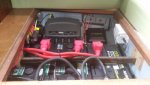
My batteries are beneath the aft end of the port side sofa, along with the black box VHF/AIS, vYacht multiplexor/wifi router, dual sensing VSR, TV amp, backup VHF antenna connector and some additional fusing. The isolator switches, one for each bank and an emergency switch, are located in the end of the sofa base, right next to the batteries.

20161221_105639.jpg

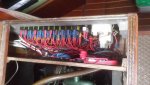
Two metres of 10mm cable run from the isolator switch/battery -ve to the positive and negative busbars behind the switch/breaker panel in the side of the companionway steps.

20161221_105829.jpg

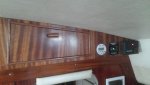
A small overhead locker houses the Eberspacher controls. The solar controller and bluetooth dongle are housed inside this locker, minimal cable runs from the panels to the controller and controller to batteries.

20161221_110508.jpg
 
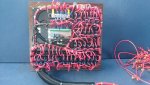
Here is the wiring panel on my new boat, looks very confusing, but fortunately all (most!!) of the wires have numbered tags attached and there is a diagram in the owner's manual which appears to decode the meaning.

wiring-panel_zpswt2fukji.jpg


As one might expect over the years odd bits of kit have been added and some of the switches - on the other side of this hinge out panel - have slightly odd combinations of function. For example one is labelled "instruments", and in addition to switching on the depth sounder and log, also controls some of the cabin lights!! Another labelled "Cabin Lights" also switches on the Fridge!! I expect some of these oddities can be sorted out but they are rather confusing.
 
You lot make me envious with your ultra-clean "hidden bits".

You will note that I have carefully avoided showing any pictures of mine :)

I'm pretty happy with the electrical design and the assembly details - all the connections are secure and well-made and so on - but the physical layout of the wires themselves leaves something to be desired. I was quite pleased with it a few years ago when I did it, but since starting a new job where the guys downstairs produce beautifully dressed wiring (Dougal's trade in post #15), by comparison I'm now embarrassed at my snakes' wedding behind the panel.

Like I said in the circumnavigation thread recently, I've learned enough to do the third boat properly :D

Pete
 
OK, so i havent got one to show (yet) but wiring was my trade for mebby 15 years, so I know a fair bit of spaghetti training.

Rule 1:
A new wire makes it a new cable form so do not just slap it on top and tie it in, remake the whole loom.
Rule 2:
Pick a style and stick to it, whether its swan neck with a loom passing everything getting smaller as it goes or a fountain of wires from some point.
Rule 3:
Lacing bars, they support the loom and take strain off connections.

Now then bus bars: these should be mounted on the panel with the switches, either beside them on the back or stood off behind.

Here is the wiring panel on my new boat, looks very confusing, but fortunately all (most!!) of the wires have numbered tags attached and there is a diagram in the owner's manual which appears to decode the meaning.


Thanks for the reminder Leighb, I forgot a Rule, an important one at that. ....
Rule 0:
Numbers, every, and I do mean every cable, even a short interconnect shall be numbered. also these numbers shall be written in the Cable Schedule which shall be kept with all other boat documentation. With The Cable Schedule there shall be a Systems Diagram depicting the wiring and equipment.
A curious feature of The Cable Schedule is that the numbers really shouldnt be sequential since, at some future date, a wiring addition or change will ruin the sequence.
 
Modesty forbids

Oh too hell with it! ...

QOnutDLIOwX6uEJcwipdS6qocvKYP-ytvSnCLElUap7oQ49GhLY8lSs5Fi-qFiifGqcZXOs10mR_NDWinyf4Llsl1iLkjjCRb0BsW-Q2grFCwpKYdDtLdS3VZs3mHBUwsdJIWGuaIFJPOTxnP0xVEVWOrrc0sSR-UBKpDR7ONIxpIq-9M4-2oa8ZkGeZSfG55TJeZPUmQVloYzwvQgGVQm_L4M-78lGUuHSF2a0YiAdN0YKPumnDWHOF6Q1FVDuvOU0IXyRDTLGN9lK-UN_D3scdM7-w7zDFI8dj4psQXZ5Pm1dO_V24I191SXH4ocSpUzL9LggCE2NWCrcIodMrPIY2HKql3syTIQkspn_Byk3ZUWJ0tJjr6y-iA5HZAgd2axGBGSbLUEtiBixRG1N9Zsb-fyI4vh-76j0m56V87bpg-g86u8xiVo5zT6hmaVwILTD9iVnRbWjGNUVZapX-9_2cgjHGZ4rubsifS4AuX_D-x6OcdNr8M5yXywWjaJ5AdalhaCX5S9XYSlzmWQi2FJIt8fufDO6BFnFR83_536YYaENun8Dnx-_aEeCQ5bbscD3eSdF--LyLfAPhU5pjGa1HX320EH7cvT5QcwRBWMKK2I5i6W1n=w1199-h674-no


Not our boat though, that's still a mess (cobbler's shoes and all that!)

Thats really n not so bad...
Good bits are:
The looms are combed very nicely, no zig zagging in and out of the bundle.
Cable ties look to be cut flush (that ought to be Rule -1).
Length of wire from loom to equipment seems to be very even.

if the builder had used lacing bars then that could have been a top marks job.
 
As one former wireman to another, I have to say you've forgotten another rule Dougal ...

Thou shall't never cross one wire under another within a loom :)
 
Thats really n not so bad...
Good bits are:
The looms are combed very nicely, no zig zagging in and out of the bundle.
Cable ties look to be cut flush (that ought to be Rule -1).
Length of wire from loom to equipment seems to be very even.

if the builder had used lacing bars then that could have been a top marks job.

I should hope it's not too bad, given that I'm a time served panel wireman :)

Couldn't squeeze lacing bars into the available space which was, it has to be said, rather tight. One row fewer switches and breakers would have made all the differ but wouldn't have met the customers requirements
 
I should hope it's not too bad, given that I'm a time served panel wireman :)

Couldn't squeeze lacing bars into the available space which was, it has to be said, rather tight. One row fewer switches and breakers would have made all the differ but wouldn't have met the customers requirements

I forgot to add that whilst lacing bars are absent and would have been ideal, what isn't clearin the pic is that the loom is secured to the panel with a series of p clips and cable tie bases

And talking of lacing bars, takes me back to the days when we did the job with proper lacing using waxed cord! Boy, that was a job on a big loom
 
That's odd! Dougal I assume could see it 'cos he commented on it

[...]

I've cut and pasted the image into this post, see if that works (apologies to anyone who's seen it already)

I can't see it either. There's a valid image tag and URL (pointing to "googleusercontent.com") but all that URL serves up for me is a grey no-entry sign. Possibly it only shows the actual picture to people who are logged into some Google service or other, which Dougal happens to be but Paul and I aren't?

Pete
 
I can't see it either. There's a valid image tag and URL (pointing to "googleusercontent.com") but all that URL serves up for me is a grey no-entry sign. Possibly it only shows the actual picture to people who are logged into some Google service or other, which Dougal happens to be but Paul and I aren't?

Ah! It is on Google Photos (which is pants compared to the old Picassa) let.s try again ...

DSC_1457.jpg

OK, so you'll have to click on it to see it in all it's (ahem) glory
 
Considering how many connections there are that's very neat but if I come along and pull half a dozen connectors off how do you know where to put them back? Not trying to be a smartypants, I'm sure there's an easy answer.
 
Slight thread drift but, anyone recommend an idiot's guide to electricity, wiring and batteries on boats...I do mean idiots too.....needs to start assuming I know absolutely nothing! Most times I read an article or post I am lost within a few sentences because of the terminology.

I haven't dared to look behind any of my 3 switch panels, but if the battery cupboard is anything to go by, it's going to be hell behind there!

On the plus side, I do have the original wiring diagrams....(but I don't the symbols!!!!)
 
This is the bask of my distribution paned with the main switch/MCB on the other side.

IMGP2647_zpsdmblnsde.jpg


I mush prefer to use slotted trunking so cables can be added easier and neater then when cables are made into a cable loom.
 
Top