How tidy is your switch panel wiring?

Ceirwan

Well-Known Member
Joined
26 Jul 2007
Messages
1,159
Visit site
One of my jobs for this winter is to replace and rewire the switch panel on my new (to me) boat.
I took it off to fix a non working light and it took me 20 minutes to cram it all back in again!

I've rewired a few before, but I'm curious too see how other people organise it all, so if you've got a nicely wired panel or just an abomination, chuck a photo on here for us to appreciate!

I'll start it off with the current state of mine:
DSC_0002.jpg

And that's after I put in a negative bus just to try and neaten matters up!
 
No pics I'm afraid, but when the leckie rewired Khamsin two years ago he was adamant that the switch box should not be touched. He said it's the best wiring he's ever seen.
Nothing to do with me, it came with the boat.

My dilemma now is that should I go ahead with a total interior upgrade - do I keep the old fashioned switch box?
Of course I will :encouragement:
 
One of my jobs for this winter is to replace and rewire the switch panel on my new (to me) boat.
I took it off to fix a non working light and it took me 20 minutes to cram it all back in again!

I've rewired a few before, but I'm curious too see how other people organise it all, so if you've got a nicely wired panel or just an abomination, chuck a photo on here for us to appreciate!

I'll start it off with the current state of mine:
DSC_0002.jpg

And that's after I put in a negative bus just to try and neaten matters up!

How about starting with a hose clip :encouragement:
 
Most panels start off reasonably tidy but later additions mean it becomes a rat's nest - i know mine has - to such an extent that it is difficult to cram it all in and get the fixing screws back on. I'm not going to publish any photos they wouldn't be helpful. I'm looking forward to seeing some good ones. My problem is access is from the front only and only 6" x 4".
 
Rewiring is up there on my list of serious jobs to do. Question I'd ask is what's the best way to secure new bus bars etc to the slightly-curved hull?

The original wiring (big choc blocks for the +ves and a spade bus bar for the -ves), capacity now truly exceeded (and those spade connectors are well dodgy) was secured to what appears to be a small piece of ply glassed over to secure it to the hull.

I've previously sikaflexed (with 291 but if doing it for anything more than a bodge I'd use 292) a pice of ply to attach stuff to but that doesn't seem so neat.

My default option is obtaining another piece of ply and glassing it in along side (though unsure how the inevitable gap in the middle works). What would others do?
 
My default option is obtaining another piece of ply and glassing it in along side (though unsure how the inevitable gap in the middle works). What would others do?

Most bus bars are only screwed at each end, you could epoxy a suitable block of wood in place at each end and just let the bus bar bridge the gap, or use a solid piece of wood under the bus bar and sit it on thickened epoxy to bridge the gap.
 
Most bus bars are only screwed at each end, you could epoxy a suitable block of wood in place at each end and just let the bus bar bridge the gap, or use a solid piece of wood under the bus bar and sit it on thickened epoxy to bridge the gap.

That's one bus bar. I have *a lot* of wiring which needs a neat, permanent home.....
 
Rewiring is up there on my list of serious jobs to do. Question I'd ask is what's the best way to secure new bus bars etc to the slightly-curved hull?

I cut a square of ply the size of the back of my panel, painted it white, then put a good thick fillet of gun adhesive along top and bottom and squodged it into place on the hull side (having first cut away the vinyl lining and cleaned and slightly roughened the fibreglass). I can't remember what I used, but it may well have been Sikaflex 291. Certainly I'd have no doubts about the strength of the stuff in that quantity, even though it's nominally a sealant rather than an adhesive.

I could then easily mount the various bus-bars, terminal strips, control boxes, and even the 240v consumer unit to that square of ply using screws.

Pete
 
My original fuse/switch panel is as tidy as it was when new in 1982.

The problem is all the add-ons have been supplied direct from the domestic battery so lots of stuff stays live when the battery is isolated. There are inline fuses and choc-block connectors in all sorts of odd places. There are several crimped on terminals on the battery terminal clamp bolt.

One of my priority jobs is to fit a new additional fuse panel and then rewire each item which is currently fed directly, via inline fuse.
 
electrical setup.jpgNMEA box.jpg

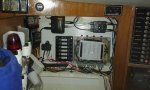
There was about 4 days of work (for my son) to get this lot sorted out. The biggest issue is that this type of switch panel lacks space and therefore is very difficult to make it look tidy when dealing with historical wiring. Behind the switch panels was greatly improved by the fitting of the negative bus bar.

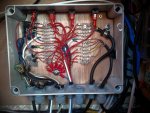
The clear box contains just NMEA wiring with switches to provide input and output options, This made a huge difference in tidying things up.

Yoda
 
Last edited:
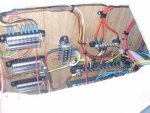
When I purchased mine, some 2 years ago. I removed all house wiring and started again. The boat was built in 1984, and over time lots of 'extra' bits had been attached, mostly using bell wire. It had 10 switches and 10 fuses. Now it has 17 switches, on the dash alone, 30 fuses and 3 bus bars. The smaller one in the picture is for the 'ever' 12 volt feed. For bilge pumps, Fridge and the remote cockpit lighting.P1070077 (640x480).jpgP1070485 (640x480).jpg
 
Rewiring is up there on my list of serious jobs to do. Question I'd ask is what's the best way to secure new bus bars etc to the slightly-curved hull?

The original wiring (big choc blocks for the +ves and a spade bus bar for the -ves), capacity now truly exceeded (and those spade connectors are well dodgy) was secured to what appears to be a small piece of ply glassed over to secure it to the hull.

I've previously sikaflexed (with 291 but if doing it for anything more than a bodge I'd use 292) a pice of ply to attach stuff to but that doesn't seem so neat.

My default option is obtaining another piece of ply and glassing it in along side (though unsure how the inevitable gap in the middle works). What would others do?

OK, so i havent got one to show (yet) but wiring was my trade for mebby 15 years, so I know a fair bit of spaghetti training.

Rule 1:
A new wire makes it a new cable form so do not just slap it on top and tie it in, remake the whole loom.
Rule 2:
Pick a style and stick to it, whether its swan neck with a loom passing everything getting smaller as it goes or a fountain of wires from some point.
Rule 3:
Lacing bars, they support the loom and take strain off connections.

Now then bus bars: these should be mounted on the panel with the switches, either beside them on the back or stood off behind.
 
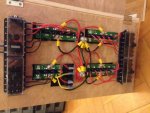
I've just re-done mine... Went from a single 6 way fused panel to 2 x 6 ways with circuit breakers mounted side by side with each other. I used 2 busbars which are mounted below the switch panels on the inside of the wooden panel that it's all mounted to. Each switch is cabled individually via its' circuit breaker from the +ve busbar. I had to extend any of the existing wiring that I was re-using, so it would reach the new panel and allow the whole lot to be swung down on to the chart table for any repair work or additions in the future. I also labelled each wire with a description of what it was feeding. It's not super tidy in behind the panel, but it's all easily identifiable now at least, and looks a whole lot better from the front.
 
Top