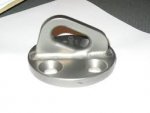
How strong?

zoidberg

Well-Known Member
Joined
12 Nov 2016
Messages
6,994
Visit site
I have a couple of these devices, in titanium alloy, and invite thoughts on the UTS of the upstanding loop, in a direction parallel to the baseplate.


40773532463_1b24f77072_b.jpg


No, Harken don't know.
 
Probably more than that of the screws that hold it down and maybe the substrate it’s attached to? If loaded parallel to the deck only two screws are holding it down
 
Sarabande's memory is in rather better fettle than mine, alas, and Major Clanger et all had good input to make.

The 'bits' are to be mounted, each, on the quarters of a 6-7000lb AUW keelboat - not onto the transom. So think 'shear'. Something akin to a Jordan Series Drogue will be attached, probably using 2 professionally-sewn lifting strops, with known capacities, as the stern bridle. These will be rated to 'fail safe' before the setup can pull chunks off the stern of the boat, although it is unlikely that the string of 100 or so cones will develop enough resistance to pull the back end off the boat.

As for 'Ask Harken'..... I did, of course. They have nothing in their archives relating to those, or other, 'Special Projects'.

As I recall, Don Jordan's ideas for 'capacity' and 'peak loading' are based on 70% of max AUW - which was ( too often ) taken to be a boat's displacement. Most didn't work on LOADED displacement, so some JSDs were manufactured, sold and used which proved significantly under-spec'ed for the task.

Several competent types, over on Cruisers Forum, are working on improvements. That's not unreasonable, given the advances we've seen in materials technology in the near-30 years since Jordan did his work. He didn't have much of a budget, using the materials he had to hand and which most cruising yotties to expect to source, but already peeps now make their cones from much tougher fabric than the original Dacron sailcloth, and the use of 3-ply laid nylon rode is 'not thought optimum' when single-braid HMWPE is now readily available. The best way to join bridles to rodes is being explored, as is the use of unnecessary knots.

But, there's no budget for testing to destruction. Certainly, established ideas are being challenged, improvements sought, but the numbers involved are tiny. The opinions of every experienced long-distance cruiser who has used a JSD are analysed, pored over, debated. Some views, of course, carry more weight than others...... just like here. Such as that of 'Ming-Ming's Roger Taylor - 'I wouldn't go to sea without one'.
 
Man maths, I imagine you need to question what and how it's bolted to more than the pad eye.

Man maths tells me to have the shackle closer to the base then further away so the load to the right of the pic but it also tells me to have a substantial backing (and probably top plate with only a 95mm diameter) as well as transom reinforcement to stop the quarters pinching inwards under load dependent on design.

As much as I would love to computer model my boat I go on the if it looks right philosophy.

Oh I've found those Jester decals out, just need to find a scanner big enough.
 
Why not use a much larger padeye, which can take unambiguously beefy bolts? One which looks capable of handling drogue sized loads without any nagging doubts or frenzied computer calculations?
The thing in the picture is more suitable for a bathplug chain or a gerbil dungeon.
It will also have weird mixed metal corrosion issues.
 
Why not use a much larger padeye, which can take unambiguously beefy bolts? One which looks capable of handling drogue sized loads without any nagging doubts or frenzied computer calculations?
The thing in the picture is more suitable for a bathplug chain or a gerbil dungeon.
It will also have weird mixed metal corrosion issues.

I would imagine that 4 12mm bolts will outperform the structure it’s being bolted to and the strop being attached to the item, but I don’t know the boat or the application.

Calculating a safe working load for that item is an engineers nightmare, there are far too many unknowns.
 
More relevant I suspect is deck strength. Don’t forget a hefty backing plate to spread the load. Good quality bolts too.
 
According to Jordan ( http://www.jordanseriesdrogue.com/D_5.htm ) the overall Design Load should be around 6500lbs. and that for a single leg therefore a single 'chainplate' around 4550lbs.

The 'standard' way of attaching a drogue-bridle is like this...


49038147801_4a119eeec9_m.jpg


I'm looking to achieve much the same facility using the Harken 'deckeyes', with very substantial backing plates inside. The hull skin there is solid GRP about 3/4" thick.
I reckon that I should be able to achieve an SWL in the titanium deckeyes/bolts/backing plate/hull combo much in excess of the Single Leg Design Load of around 4550lbs.

Sewn lifting strops rated at 10,000lbs, with antichafe, will likely be used for the bridle legs. These I expect to attach to the Harken goodies using Soft Shackles, again with antichafe sleeves, rated to 'about' 8000lbs. Should inspection make it necessary in use, I could doubleup with additional - but slightly longer - Soft Shackles to take over should the primary ones chafe through.

As to 'why use the Harken thingies?' I've got 'em. What else could I use them for?

But I'm still wondering about the UTS of the Harken jobs. Specifically, the web-loop which is about 9mm x 10mm section.
 
The best answer. Take courses (or read books in engineering statics and deformable bodies. This is just like asking for free legal advise.

a. The strength of the screws is often a reasonable starting point. It was designed by an engineer and there is a good chance he matched them to the pad eye. This is nearly always the case.

b. Saying the "screws with break first" of the "hull will fail first" is a cop-out, since properly designed, they can all be strong enough. It is also incorrect to say only two bolt are holding it. Two are resisting primarily in shear and two primarily in tension, but even that loading is mixed and requires evaluation of bolt stretch and how the surface and backing plate will deform under load (everything deforms, although often not enough to be seen).

c. The primary reason DJ suggested chain plates was almost certainly to spread the load. That is why it is done that way on chain plates. You could analyze the structure, but if you would not use pad eyes for chain plates, you have your answer.

Without knowing the boat, I'm going to guess that this is not just about backing plates. Even with a thick backing plate, the bolts will have considerable shear load and could shear through a cored deck sideways. I would be laying up more glass on the inside and then adding a backing plate. You probably need 7-8 mm solid glass (not counting the core) to resist the shear load safely, and that load needs to be transferred to a larger area.

BTW, it is difficult or impossible to engineer the straps to be a safe break away. The problem is that the fabric part has a different ratio of SWL to BS and chafe. If you make the straps robust enough to last (remember the boat lost in the Golden Globe when the JSD failed?) they will not be weaker than the attachment point. Also, a JSD that is undersized to reduce stretch (just in case someone suggests this is NOT stable. A JSD becomes unstable if the tail weight is not heavy enough or if it is towed at normal drogue speeds. Jordan knew this and reflected it in his specs. I have tested shortened JSDs.
 
Last edited:
Top