How on earth do I fit a spinnaker halyard on a Pandora 700 masthead?

john_morris_uk

Well-Known Member
Joined
3 Jul 2002
Messages
28,796
Location
At sea somewhere.
yachtserendipity.wordpress.com
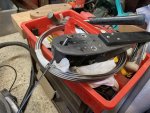
As some of you may already be aware, I’m in the middle of helping our daughter restore/rebuild a Pandora 700. As part of re-rigging the boat and fitting a new tri-colour and VHF and Hawk etc I removed the masthead casting. The sheaves were split and broken so a friend turned up some new ones from some acetal stock I bought. New stainless pins fitted with Duralac and the sheaves with a dab of poly-sulphide grease and all is well.
C8762E64-1CE8-4861-9CC0-DA514FBE29C1.jpeg
1CDD1738-7E07-4C52-B485-54FA9EE655D4.jpeg
My problem is, “how do I make provision for a spinnaker halyard”?
The sheaves fitted so far are for the main halyard and the Genoa halyard and a two little ones for the topping lift.

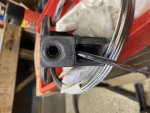
Any spinnaker halyard needs to come above the forestay and there’s a sort of hole in the casting but I don’t know how one would fit a swivel block to it?

I’m used to much bigger boats so I’m in unfamiliar territory here. Has anyone got any suggestions?

Here’s the hole.
2A1C3F0A-44AA-4BB7-91D6-41417873A072.jpeg
I suppose I could fabricate a f’wd mast crane and fit it under the Tri-White? A ‘U bolt’ in the crane would hold a swivel block...

PS Please excuse the messy workshop. I am having a clean up - honest.
 
Your idea will be the best way forward as the spinaker halyard needs to be ahead of the forestay. Make it from a substantial piece of stainless plate as the downward pull of the halyard will try to bend it. Dont make it any longer than it needs tp be get clear, as the bending moment increases with length.
 
Two thoughts.

Tap the hole for an eye bolt and hang a small block from it. (Small with ballbearings will work fine on thin dyneema, and should clear the fstay.

Or. I like this, but there may not be room... Get two ss straps with 3 holes in each (1 at each end, 1 quite close to an end) Get a nice small sheave that fits the forestay clevis pin. Its plain bearing to act as a spacer between the straps hanging from the pin from the 1 hole ends. Now put a clevis pin and spacer between the straps in the hole near the end, and the shortened forestay between the holes at the end. It's now an internal halyard.
 
Your idea will be the best way forward as the spinaker halyard needs to be ahead of the forestay. Make it from a substantial piece of stainless plate as the downward pull of the halyard will try to bend it. Dont make it any longer than it needs tp be get clear, as the bending moment increases with length.
Fair enough. I could drill and tap the alloy casting to boot the crane on and screw the Tri-White back in through the new plate.
 
Two thoughts.

Tap the hole for an eye bolt and hang a small block from it. (Small with ballbearings will work fine on thin dyneema, and should clear the fstay.

Or. I like this, but there may not be room... Get two ss straps with 3 holes in each (1 at each end, 1 quite close to an end) Get a nice small sheave that fits the forestay clevis pin. Its plain bearing to act as a spacer between the straps hanging from the pin from the 1 hole ends. Now put a clevis pin and spacer between the straps in the hole near the end, and the shortened forestay between the holes at the end. It's now an internal halyard.
Clever idea with the clevis pin, except there is no clevis pin. The forestay has a mushroom fitting on the end and is threaded through the mast head casting. (Same for the backstay.). You then put a swageless fitting on the bottom end of each wire.
 
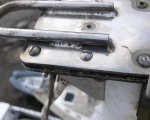
Our Pegasus 700 has a separate spinnaker bail plate bolted on to the masthead, this is the only photo I can find of it on my phone, it’s the shiny plate and loop, not much bigger than what you can see...


4113E665-421A-4FCF-B545-C10F93E6ADE7.jpeg
 
I like Chris's in #6 with a block on a shackle, as the spin halyard needs to swing sideways, not be constrained by an in line sheave.

Edit: Though just a plate extended forward, bent down with a hole in it for the shackle.
 
Our Pegasus 700 has a separate spinnaker bail plate bolted on to the masthead, this is the only photo I can find of it on my phone, it’s the shiny plate and loop, not much bigger than what you can see...


View attachment 108486
Perfect and I understand entirely. I’ll look at getting a plate cut out, although I think I’ll go for a small swivel block rather than the bail in your picture.
Do you run the halyard down through a slot and inside the mast? Or is it external all the way to the deck?
I think she’s got spare sheaves at the bottom for another line to exit but I’ll have to add the slot.
 
As some of you may already be aware, I’m in the middle of helping our daughter restore/rebuild a Pandora 700. As part of re-rigging the boat and fitting a new tri-colour and VHF and Hawk etc I removed the masthead casting. The sheaves were split and broken so a friend turned up some new ones from some acetal stock I bought. New stainless pins fitted with Duralac and the sheaves with a dab of poly-sulphide grease and all is well.
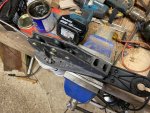
View attachment 108457
View attachment 108458
My problem is, “how do I make provision for a spinnaker halyard”?
The sheaves fitted so far are for the main halyard and the Genoa halyard and a two little ones for the topping lift.

Any spinnaker halyard needs to come above the forestay and there’s a sort of hole in the casting but I don’t know how one would fit a swivel block to it?

I’m used to much bigger boats so I’m in unfamiliar territory here. Has anyone got any suggestions?

Here’s the hole.
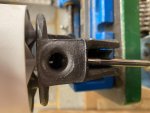
View attachment 108459
I suppose I could fabricate a f’wd mast crane and fit it under the Tri-White? A ‘U bolt’ in the crane would hold a swivel block...

PS Please excuse the messy workshop. I am having a clean up - honest.
John
It looks to me like there is space for another sheave in the casting at the top and if there is a spare exit at the bottom it would suggest there is capacity for a 4th halyard. To me the hole at the front of the casting looks very much the lead for a spinnaker halyard. Just a matter of adding a 4th sheave using what looks like a spare drilling aft of the small sheave. Would love to pop up and help but......
Yoda
 
One wants minimum friction on a spinnaker halyard so I would keep the line on the outside of the mast, Sometimes handy if dropping a cruising chute when on the deck & want to control the drop yourself, because you can get hold of the halyard. Just remember to clip it clear of the mast when you leave the boat to stop the flapping.
 
Perfect and I understand entirely. I’ll look at getting a plate cut out, although I think I’ll go for a small swivel block rather than the bail in your picture.
Do you run the halyard down through a slot and inside the mast? Or is it external all the way to the deck?
I think she’s got spare sheaves at the bottom for another line to exit but I’ll have to add the slot.

This year, yes we have run a line down inside the mast. There was an existing thru mast fitting near the top. It wasn’t until I saw a post on here about spinnaker bails that we realised what it was for, previously we just ran the spin halyard on a spare mast top sheave not even off the bail which probably accounted for some of the hoisting issues we experienced.
 
I have an external halyard with a turning block at the base of the mast. Minimum friction and I can easily launch and recover the spinnaker from the safety of the cockpit. I don't want to be at the mast taking down a spinnaker when rolling wildly downwind on a small boat.
 
Typical arrangement for spin halyard is to have it exit the mast up very high like 2 metres so that in hoisting a forward hand can stand at the mast and pull the halyard down getting max power min friction. he pulls through a closed clutch. Once set the halyard is pulled through so that it leads back to the cockpit to a cleat and the clutch is opened. This allows the spin halyard to be released from the cockpit. Plus of course the spin halyard can be pulled up from the cockpit. But far quicker /easier pulling down a the mast.
Now if OP uses this system then much of the halyard (bottom 2 metres) is external. If he then has halyard partially external a the top to enter through a slot he might as well leave it all external. This particularly so if experience for daughter proves she doesn't want a spin anyway. I would say of our racing fleet at our club less than half habitually use spin in a race so perhaps OP should consider need for spin at all. ol'will
 
My memory may be totally incorrect but:

I vaguely recall the RHKYC raced a fleet of Pandoras. Kukri might be able to confirm this and more importantly might be able to provide a, or some, contacts. You are having a series of queries all of which are interesting, so don't get me wrong - they demand posting - but you might get applicable answers from someone who is sailing the yachts.

There is nothing wrong with the state of your workshop - its does look as though you use it!

Jonathan
 
Our Pegasus 700 has a separate spinnaker bail plate bolted on to the masthead, this is the only photo I can find of it on my phone, it’s the shiny plate and loop, not much bigger than what you can see...


View attachment 108486
That sort of thing seems pretty standard for small masthed rig yachts.
The OP could alternatively mount a nice Harken sheave box in the front of that great big windjamming white plastic thing that's on the top.....

More seriously, you could just drill a couple of holes and tie a block on with a bit of dyneema. Do it right and the block articulates nicely and can give a better line to the halyard than a bail and a block with a swivel. It's probably got to be an external halyard and it needs to keep away from the furler swivel and/or jib halyard shackle etc.
 
My memory may be totally incorrect but:

I vaguely recall the RHKYC raced a fleet of Pandoras. Kukri might be able to confirm this and more importantly might be able to provide a, or some, contacts. You are having a series of queries all of which are interesting, so don't get me wrong - they demand posting - but you might get applicable answers from someone who is sailing the yachts.

There is nothing wrong with the state of your workshop - its does look as though you use it!

Jonathan
Yes there is a small fleet (5 or 6 I think) of Pandora’s racing at RHKYC. There should be a class secretary contact in the club website www.rhkyc.org.hk or you can email the class sec at pandora@rhkyc.org.hk

looks like there is also a link from RHKYC to a Pandora International Website that may also have some info.

good luck!
 
That sort of thing seems pretty standard for small masthed rig yachts.
The OP could alternatively mount a nice Harken sheave box in the front of that great big windjamming white plastic thing that's on the top.....

More seriously, you could just drill a couple of holes and tie a block on with a bit of dyneema. Do it right and the block articulates nicely and can give a better line to the halyard than a bail and a block with a swivel. It's probably got to be an external halyard and it needs to keep away from the furler swivel and/or jib halyard shackle etc.
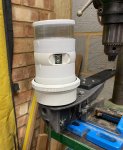
Great big white thing indeed! That’ll be a 14cm high latest thing in Aquasignal LED Tri-White nav lights. (I definitely can’t justify the several hundred £ for the Lopo light slightly smaller one. ). I agree that perspective has made it look big in the pictures though.

Thanks for those suggesting asking the Pandora association etc. Daughter is also asking some of these questions via the Pandora Association Facebook page. I’m a Facebook non-user so I leave that to her. I’m grateful for the differing suggestions/opinions.
366E4F65-8355-4B85-8A47-BA0BFC672597.jpeg
Here’s the casting without the light. (I’ve taken it off to clean the cutting compound off the threads before reassembling with Duralac.
The thing that puzzles me is, ‘why the nicely smoothed hole in the front. It does look ideal for a dyneema toggle holding a spinnaker halyard block now that’s been suggested. Cheaper and easier than a plate on the top.
 
Last edited:
Whilst you have it on the bench a s/s plate would be a great option. To prevent the plate bending down a couple of small fillets welded beneath it to bear against the front of the casting would be helpful.
 
3170D178-FC63-42FB-BD44-CC424F132B4E.jpeg
A bit of lateral thinking and another look and I’ve realised that the hole on the front goes through to the inside. I’m wondering if I could fit a nut inside to go on an eyebolt? Either that or take advantage of the smoothed exit and use a dyneema toggle as already mentioned.suggested.
 
Top