
How much power do you actually get from a 100W panel!

JumbleDuck, are you suggesting that shadows such as from mast and boom are unlikely to render a coachroof panel a bit pointless?

That has been my experience, yes. Such shadows as there are tend to be soft penumbral ones ...
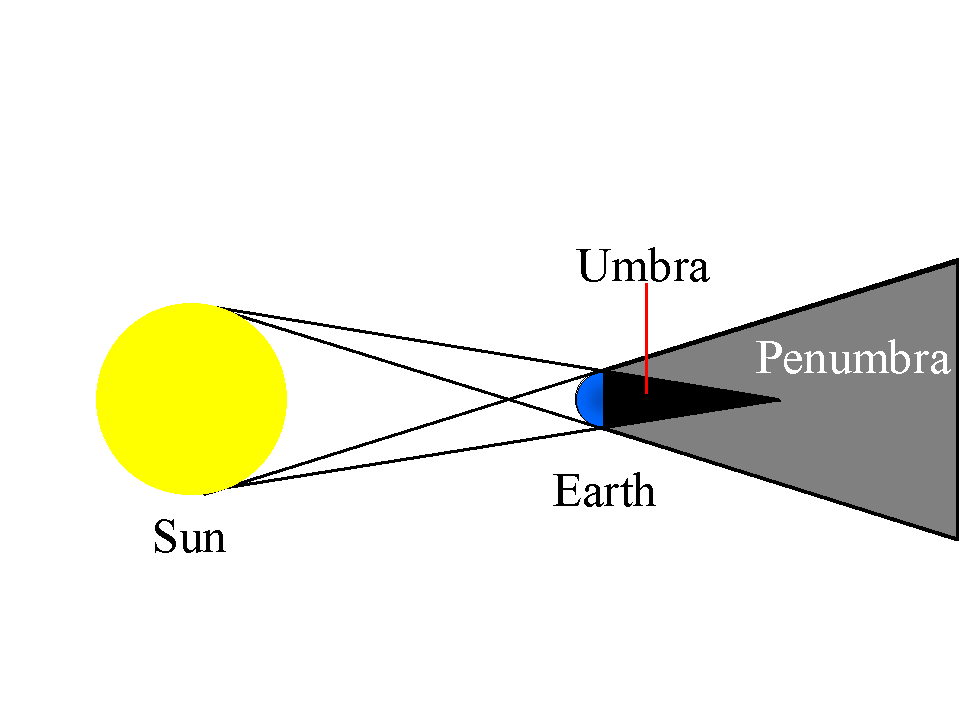
umbra.gif


... which cut down output a little but don't have anything like the catastrophic effects often predicted. Even a hard umbra has to shade a significant amount of panel to have an effect, and at anchor or on a mooring one moves around so much that any effect from either doesn't last long.
 
Panels installed Mid August 2017, 2X300W serial connection so 80+V going down to the controller, Victron MPPT100/30, 24V system
panels is as per the website, only 300 and not the 310 they show now as the smallest: http://www.axitecsolar.com/data/solarpanels_documents/DB_72zlg_poly_power_MiA_EN.pdf

first week of Sept (shot service batteries-don't think they make any difference though). Only case I've seen max power close to nominal power, but it was a v.hot and sunny day on 1st-2nd Sept and I was in Skiathos on anchor iirc:
solarfirstweeksept2017.png


first week of Jan (removed shot service batteries, all load going to the engine bank 2X180 LA batteries). Again sunny but note hours charging vs Sept:
solarfirstweekjan2018.png


both weeks v.sunny, but obviously sun much lower and for fewer hours on the sky in Jan. Struggling to see how some of the numbers you are reporting fit with my data (unless mine is setup wrong...)
Re shadows hard vs soft, I think it has to do with intensity of sun rays that exaggerates the differences down here.

cheers

V.
 
Last edited:
Struggling to see how some of the numbers you are reporting fit with my data (unless mine is setup wrong...)
Re shadows hard vs soft, I think it has to do with intensity of sun rays that exaggerates the differences down here.

cheers

V.

Your figure for the Summer look similar to mine, taking into account that you have nearly three times the wattage as me. Your Winter figures are better than mine, but that's to be expected, as i'm East Coast UK.

A couple of things that will skew recorded data, firstly, if you have another charging input (wind or shore power charger) that can result in a lower yield, or even virtually no yield at all as the other source either leaves little for the solar panels to do or the solar controller senses the output from the other source and shuts down, assuming the batteries are fully charged. Secondly, if you are not using much power the yield will be lower because the batteries get charged up quickly and their is nothing much for the panels to do. When you were connected to shot batteries the panels would be delivering everything they could.
 
One way to eke out the power is to turn off the fridge overnight. Provided it's well insulated and not opened, it will not warm up that much during the hours of darkness. Fortunately, peak cooling requirement coincides with peak solar generation.
 
One of the things to be aware of with the Victron readings is the variability between the 24 hour yield total output from the panels compared to the peak output which might be very short-lived due to the boat moving around and causing changing shadow effects.

As an example, my readings are from 4 x 100W panels in mid-September in the Med. The panels are flat and not movable and at any one time two of them tend to be in shadow from the boom.

This is from the 19th September 2017:

24hr Yield 710 Whr / Max PV Power 347W

and this from 21st September 2017:

24hr Yield 1300 Whr / Max PV Power 249W

The maximum power generated on the 19th Sept of 347W is excellent for 400W of panels bearing in mind the time of year, the horizontal mounting and the potential boom shadow ..... but it was clearly an instantaneous moment close to midday when the sun was highest and the boat had moved round on it's anchor and eliminated the shadows.

Two days later I achieved a much higher total output for the 24 hours but only ever got 249W maximum out of the 400W of panels due to less fortuitous instantaneous positioning but a longer period of sunshine.

If I can ever attain the maximum ouput for the longest period I'll crack open a bottle of bubbly! ;)

Richard
 
Last edited:
A rough calculation from that gives about 44Wh per day, or roughly 5.5W over a nominal 8 hour day.

Are you sure about the decimal point or units you've quoted?

44 watt hours per day equates to just short of 4Ah per day into a 12V battery - so looks like about the same as Mistroma is getting from a single 100W panel (but we don't know where Gladys is located).
 
You get 100W from a 100W panel as long as the insolation (the sunlight falling on it) is 1kw/m^2 - this is the standard test that all manufacturers put their panels through (and at a fixed atmosphere and temperature). 1kW/m^2 is not that rare so one day at solar noon you might be surprised. How much is converted to electrical energy that you can use depends on losses: shading is the biggy but then there are cable losses, temperature (output gets worse when the panel is hot) and the age of the panel. MPPT controllers make sure the maximum power is extracted because the max power is never at 12V (or 24V either) so are well worth the investment now they are cheapish. I did a series of articles on solar panels for PBO which is available in summary here and includes how to assess your needs and how much insolation you are likely to get in any month anywhere in Europe (whoever mentioned JRC I'm with you on that one). http://www.pbo.co.uk/expert-advice/solar-panels-everything-you-need-to-know-24455
 
You get 100W from a 100W panel as long as the insolation (the sunlight falling on it) is 1kw/m^2 - this is the standard test that all manufacturers put their panels through (and at a fixed atmosphere and temperature). 1kW/m^2 is not that rare so one day at solar noon you might be surprised. How much is converted to electrical energy that you can use depends on losses: shading is the biggy but then there are cable losses, temperature (output gets worse when the panel is hot) and the age of the panel. MPPT controllers make sure the maximum power is extracted because the max power is never at 12V (or 24V either) so are well worth the investment now they are cheapish. I did a series of articles on solar panels for PBO which is available in summary here and includes how to assess your needs and how much insolation you are likely to get in any month anywhere in Europe (whoever mentioned JRC I'm with you on that one). http://www.pbo.co.uk/expert-advice/solar-panels-everything-you-need-to-know-24455

I mentioned the JRC model on #8 (that's where the link went). I've used it for years and predictions have proven accurate between 2012-2017 in UK, France, Spain and Italy.

I have mentioned it several times in various threads over past 4-5 years and think this is the first time anyone has agreed that it is useful. Normal response is for lots of comments giving examples of peak output but few giving much more detail. It's easy to get daily average Wh or Ah for a given month from the JRC utility.

e.g. 100W panel in a particular orientation on a boat in Corsica will generate nn Ah/day in an average August.

I found that was the main thing I wanted to know when setting up to cruise in the med.

PS I hadn't seen your article before and have only just scanned through it , looks comprehensive and useful.
 
Last edited:
I find this site quite interesting, as it's on a similar latitude:
http://www.newquayweather.com/wxsolarpv.php

You have to take into account how badly angled your panels are, as well as the typical 'hours of sunshine' for a given location.
Also a lot of mooring locations have significant shading morning and evening.
 
That has been my experience, yes. Such shadows as there are tend to be soft penumbral ones ...... which cut down output a little but don't have anything like the catastrophic effects often predicted. Even a hard umbra has to shade a significant amount of panel to have an effect, and at anchor or on a mooring one moves around so much that any effect from either doesn't last long.
+1 That's been my experience as well. 50W panel beside the mast generates power as long as there's some light around, even if shaded by boom/mast/sail/stratus. My home solar panels are currently generating electricity (albeit not much) and they're covered in several inches of snow.
 
Hi Mistroma, the other database I've used for outside Europe is the NASA one here: https://eosweb.larc.nasa.gov/cgi-bin/sse/sse.cgi and I agree with you what you need to know is not peak power (i.e. Watts) but energy (Amp-hrs or Watt-hrs) integrated over each 24 hours. Both databases give us these numbers by month and location.

And like you hint I find some people are able to ignore the physics when it comes to claiming output from their panels, some of the numbers I've been quoted are beyond belief and are probably either incorrectly measured or respond to the amount of money some salesman has levered out of the owner. Please guys, read the article and apply the maths: physics works :)
 
Top