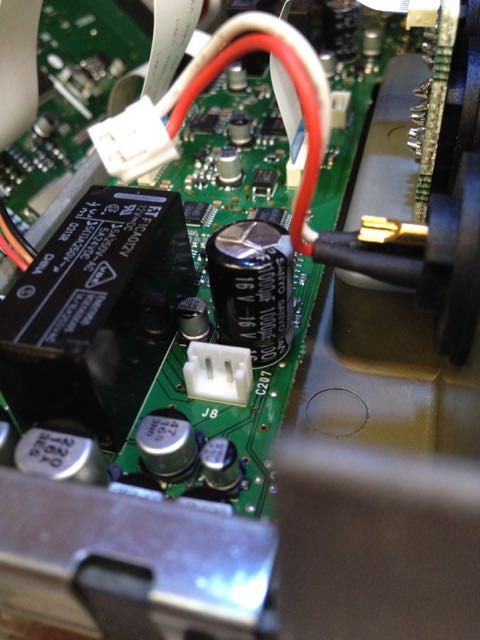
How much damage have I done to my VHF?

:eek:
What a ridiculously wasteful point of view.

Manufacturer, Icom, have previously repaired damage caused by the previous owner. Certainly not a "Ah well, just replace it" attitude from them.

I think I'll get hold of a replacement capacitor and replace it if things go down hill, or if I get the urge.

I think an apology to Angus is required.
 
Oh dear. Just replace the capacitor (and check for any others that are bursting out of their vests)
Then use the radio as much as possible - even take it home and put it in the shed powered on 24/7.it will be chattering away to itself if you stick a bit of wire in the AE socket. To test the transmit after a week or two of being powered on, take it back to the boat ( I assume you don't have a proper aerial in the shed, some of us have many....) and check that it draws about 5 amps from your 12volt supply when keyed at 25 watts (full power).
If it works after that, it will probably work just as well as any that we are using - they will all fail some day. Dare I admit to having an old Husun as a spare on board...?
 
As said main concern is the stuff that has spewed from the burst electrolytic capcitor. Almost certainly a power input line filtering capcitor. hence its failure may not have immediate consequences if it fails open circuit. replace and clean up would be my advice. good luck olewill
 
I think you are being a little hard on Mr McDoon to describe the points he made as "A ridiculously wasteful point of view" :D

Some people might be concerned that the set may let them down at an inopportune moment because of the over voltage and that the best option is to fix with new. It is not necessarily wasteful to replace an item of safety equipment which many people regard a radio as being that may be compromised.
Ok, my comments came across a lot harsher than intended. For that, I apologise to Mr McDoon. I do read a lot of the stuff he posts around here and do respect his opinions. I was just rather shocked that he would suggest replacing a £500 bit of kit when all that may need replacing is a 50p capacitor. Do people replace the VHF on a second hand boat? You never know what the previous owner may have been up to!

Err so how can such conclusions be reached that its "ok" if so little detail has been given. It would take some time to fry a 16v (as presumably that is what it is) cap on 24v... So I'm not sure I believe that it was just a couple of seconds, unless something else is going on. Most voltage regulators can tolerate around 25-30v before you kill them so the 3.3/5v logic stuff should all be ok. Have you tested to see if it still has output? RF output stages are sensitive to stuff like this. Do you have a pic of the damage?
Not a couple of seconds, I'd imagine it was around 15 to 20 seconds. I've spoken with various people around the marina via the VHF and used a SWR tester, output is still what it should be.
Picture attached...
capacitor.jpg

Pretty hard to see, but the top of the capacitor is slightly bulgy. There was a bit of liquid around it, I've already mopped that up.

Oh dear. Just replace the capacitor (and check for any others that are bursting out of their vests)
Then use the radio as much as possible - even take it home and put it in the shed powered on 24/7.it will be chattering away to itself if you stick a bit of wire in the AE socket. To test the transmit after a week or two of being powered on, take it back to the boat ( I assume you don't have a proper aerial in the shed, some of us have many....) and check that it draws about 5 amps from your 12volt supply when keyed at 25 watts (full power).
If it works after that, it will probably work just as well as any that we are using - they will all fail some day. Dare I admit to having an old Husun as a spare on board...?
VHF stays on throughout the day. Living aboard in a marina, so it's on just in case someone wants to get hold of us. Working fine so far, though I will replace the capacitor, once I get hold of a replacement.

Thanks all for your thoughts and opinions.
 
Personally, I'd regard a 16V cap as under specified if it's straight across a marine '12V', which is really up to 14.5V plus noise.
It may or may not be a diode drop lower of course.
At least it's a decent make, Sanyo or Panasonic are good choices for caps IME.
 
The capacitor in question has definitely taken a hit, as it's slightly swollen and there's a tiny bit of fluid around that's clearly come out of it. Bit like a LA battery overcharging.

I'm wondering whether the capacitor in question is there to protect the rest of the VHF from numpties like me?
Do not allow the electrolyte to leak onto the circuit board as it will cause short circuits.
 
Do people replace the VHF on a second hand boat?

I did, but more because it was a nasty cheap unit with awkward DSC controls and no facility for an external mic, rather than because I was worried the previous owner might have zapped it.

And I actually zapped the new one myself a couple of months ago - a 6mm2 cable fused at 30amps which I thought was switched off, and I managed to short it against the radio's case behind the panel. Some impressive sparks before the fuse blew, and I was worried for the radio, but it seems to have survived.

Pete
 
Personally, I'd regard a 16V cap as under specified if it's straight across a marine '12V', which is really up to 14.5V plus noise.
It may or may not be a diode drop lower of course.
At least it's a decent make, Sanyo or Panasonic are good choices for caps IME.

Totally agree. Id have like to have seen 25v rated caps on the main supply, other than that however. It will most likely be fine.
 
I could post you a couple of caps to Gouvia Marina. I have a few laying around from my old monitor.
If the capacitor has started to leak, it will continue. As already mentioned, the fluid is corrosive and will do more harm than good.
Are you able to see if there are any more caps on the same +12 line, which are also potential candidates. Normaly there are two or three caps of different sizes to filter the different harmonics.
I would replace it if it were me, about 2 hours work.
 
I could post you a couple of caps to Gouvia Marina. I have a few laying around from my old monitor.
If the capacitor has started to leak, it will continue. As already mentioned, the fluid is corrosive and will do more harm than good.
Are you able to see if there are any more caps on the same +12 line, which are also potential candidates. Normaly there are two or three caps of different sizes to filter the different harmonics.
I would replace it if it were me, about 2 hours work.

Thanks for the advice and the offer of capacitors. We're not in Gouvia this winter, but I'm heading back to the UK soon so I'll easily be able to pick some up from Maplins or so.
 
I'll easily be able to pick some up from Maplins or so.

That's what you think :)

(My local Maplins has more or less given up stocking electronic components, in favour of low-grade computer accessories and trashy car "pimping" stuff.)

Pete
 
Curious?
The Maplin website tells me there's dozens in stock in all the stores around our UK base?

I was being slightly facetious, but the Portswood branch really does seem to have very little in the way of basic components. Apparently they still have at least one electrolytic cap in the cupboard (literally, a large cupboard behind the till) though.

(The Above Bar branch is a bit better, with an actual components counter still)

Pete
 
... Maplins has more or less given up stocking electronic components, in favour of low-grade computer accessories and trashy car "pimping" stuff...
Maplin is the last place I would look to buy electronic components, especially now CPC offer free delivery so long as you spend £5. If your order doesn't come to £5, just buy something that you use a lot of.

I have a saved basket containing epoxy glue, IPA solvent spray, contact cleaner spray, LE lamps, windscreen washer fluid... I just add whatever I'm low on to my basket.
 
Because at 24 volts the amps in the circuit are lower?

I think Steve means why didn't the circuit fail safe. I would expect a modern radio to have both over voltage and voltage inversion protection. The overvoltage protection is usually just a zener diode which blows the fuse when the input voltage is above a rated value. I suspect the cap is before the protection.
 
Top