How many METRES of high tide would I need to navigate a 2.5 feet draft Yacht

im just flying a plane 1 mile away from a local field, What height i should fly at? im not going above the clouds or anything it will be fine.

forgive us but the opening question is very naive as with 76cm draught and the tides for June anything but LW would be fine so its a bit of a silly question for anyone with any knowledge considering charted depth aswell

Rather harsh, he never claimed to have any knowledge, just asked a simple question. And it's not a silly question if he hasn't done it before, and very sensibly wan't to keep his new purchase floating!
 
It's possible to learn how to do many things by trial and error, but not in a field where a mistake could very well kill you, and possibly others too.
Please, please get some proper training, or at least start off by getting a good sailing manual.

Oh please, come on guys, it's hardly a life or death scenario shifting a wee boat 1 mile in caernarfon bay. I think we can presume he is going to do it on a nice day., not in a force 9. We pootle about in boats, it's neither dangerous nor death defying stuff.

To the op, best advice I ever got was; a) keep the water out of your boat, b)keep yourself in your boat, c) keep the boat off the land, everything else is just detail. Go on a nice day, with the flood tide and you'll be fine.
 
The safety Harbor and the mooring are 1 mile from each other, and at no point will be going out to sea. Im a commercial pilot and have been in situations that are 1000 times more dangerous then this going at high speed. I value your input, but please...

Maybe I should have stated in the beginning that it was not a sea crossing, just a 1 mile estuary trip

maybe but you do not provide enough information to answer the question

If you told us the minimum charted depth or highest drying height that you will encounter on the voyage from the "safety harbour" to the mooring it would be possible to tell you what minimum height of tide above chart datum you require .

For example the entrance channel to the boat yard where I normally lay lay-up dries approx 2.5m above chart datum My boat draws 0.7 m. Therefore I need a height of tide above chart datum of 3.2 m, plus a safety margin, say another 0.5m making a total height of 3.7 m to access the yard

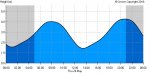
If I look at the Admiralty Easy Tide website I will find this curve for today

Today tide.jpg

You will see that access was possible for a brief period , about 2½ hours, around 0800 this morning and again for around 3½ hours this evening

In a few days time we will have reached " spring tides" and on Monday evening the height of high water will be 4.7 m giving me an extra 0.4 m to play with at high water and the access period will have extended to about 4 hours but around midnight.

At times, at neap tides when the height of high water may be as little as 3.5m, it is not high enough for me to access the yard at with a reasonable safety margin at all.

Remember barometric pressure and other meteorological conditions all affect the actual tide heights. At times there will be more water than predicted or there may be less.
 
aside from chart, tide timetable - Ask locals, observe transit of others.

asking locals is good, observing others is not always a great idea, they may not know what they are doing, or may have a very different configuration, as when someone followed me once, they didn't realise I had a lifting keel and had it up, drawing only 40cm. They grounded.
 
asking locals is good, observing others is not always a great idea, they may not know what they are doing, or may have a very different configuration, as when someone followed me once, they didn't realise I had a lifting keel and had it up, drawing only 40cm. They grounded.

Yes, a degree of averaging out is required. ;) Asking locals is always good, not just for the specific advice, but something else interesting and useful always seems to come out of asking. Most people are more than happy to help. Do not feel afraid to ask the harbour master or coastguard wherever you may be either, you can phone them for advice.
 
Make sure you carry the correct safety equipment, an epirb is essential.
Some pyrotechnics are advisable should your epirb fail to function.
Wear a life jacket and life line at all times.
Log your passage plan with the coastguard. It will be comforting to make several radio checks as you proceed. Failure to do so will lead you to doubt the
functionality of your VHF.
Your chart plotter will assist you in passage planning. You do have the updated current charts don't you?
Stay hydrated.
Tiredness can lead to self doubt, anxiety and poor navigational decisions. A death spiral. Stay calm and keep on top of the situation.
A dry suit will keep you comfortable in extreme conditions.
Sign off with the coastguard when you reach your mooring.
Don't forget to have some fun too :)
 
Make sure you carry the correct safety equipment, an epirb is essential.
Some pyrotechnics are advisable should your epirb fail to function.
Wear a life jacket and life line at all times.
Log your passage plan with the coastguard. It will be comforting to make several radio checks as you proceed. Failure to do so will lead you to doubt the
functionality of your VHF.
Your chart plotter will assist you in passage planning. You do have the updated current charts don't you?
Stay hydrated.
Tiredness can lead to self doubt, anxiety and poor navigational decisions. A death spiral. Stay calm and keep on top of the situation.
A dry suit will keep you comfortable in extreme conditions.
Sign off with the coastguard when you reach your mooring.
Don't forget to have some fun too :)

All this, including logging a passage plan with the CG, for a 1 mile trip in an estuary ?


Just switch the echo sounder on and keep an eye on the depth!

For more fun get the crew taking soundings with the lead ....... but you seem to have left a lead-line off your list!
 
Last edited:
All this, including logging a passage plan with the CG, for a 1 mile trip in an estuary ?


Just switch the echo sounder on and keep an eye on the depth!

For more fun get the crew taking soundings with the lead ....... but you seem to have left a lead-line off your list!

Is this a "Whoosh" moment??!! :encouragement:
 
Where are you sailing it from and to? The tide table says Aberystwyth but I'm not sure there's much of an estuary. Aberdovey has though, I know there's moorings up river but pretty much the whole place dries and some areas +4m, you would want to use the tide to move you in either direction rather then punching it. You're in a bilge so worst comes to it you'll be stuck dired out for a while. If it's only a mile could you not ask someone at the moorings if they will give you a hand moving it?
 
Sorry Vic, I overlooked the lead line. It'll be of comfort should the depth sounder fail.
:)

Its a useful bit of kit to have if the sounder fails and to "explore" the bottom before drying out at an unfamiliar location. Will find ledges, deep gullies, a steeply shelving bottom , old cars, supermarket trolleys and other large items
 
Top