
How long do shear legs need to be?

viva

Well-Known Member
Joined
2 Nov 2009
Messages
132
Visit site
I want to lower and raise the 7.5m wooden mast on my 25ft gaff cutter. The wooden mast is held in a tabernacle on the coach roof. I am thinking of getting made an A frame made up from two scaffold poles(or similar) flattened and bolted together at the top which would also include a block. The base would be a round 2m wooden post of about 20cm diameter. The 2 scaffold poles would fit into round holes at the ends of the wooden base pole which would be placed and secured on the fore deck in front of the coach roof, such that the base pole can rotate as the mast is lowered.
My questions are
1 Ideally how long would the scaffold poles need to be.
2. What is the minimum length of the poles?
2. Would it work OK?
Many thanks to all responders
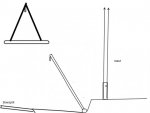
a frame.jpg
 
longer than the distance between the base of the poles and the stem, as you need to fix the forestay while the mast is still under control, and that means it has to pass in between the legs. A guess - 2.4m

The wooden base post at 20 cm is much too big. A fence post of 3 to 4 inches is enough.

I'd lash out on used alloy scaffolding poles rather than steel which will be too heavy.
 
Your sketch shows the A-frame at 45deg. with the mast vertical. Much better if the A-frame was flat on the foredeck at right angles to the mast.
Length of poles not too critical, suggest approx. to the stemhead or a bit longer.
When the shrouds slacken, the mast will lose sideways support and could do the tabernacle a mischief. Helpers to steady the mast would be useful.
 
longer than the distance between the base of the poles and the stem, as you need to fix the forestay while the mast is still under control, and that means it has to pass in between the legs. A guess - 2.4m

The wooden base post at 20 cm is much too big. A fence post of 3 to 4 inches is enough.

I'd lash out on used alloy scaffolding poles rather than steel which will be too heavy.

Thanks for this. The tabernacle does have a bolt through the bottom of the mast. With this and a couple of hallyards led forward I think I can remove the 2 forestays . My mistake I meant to put 10cm pole
 
You're using this more as a gin pole than a set of sheer legs - just modifying the direction of pull of the forestay (or rope used in place of it) rather than lifting like a crane. The higher you can put the tip of the A frame the better, but the dimensions aren't really critical.

I used to raise and lower the mast on Kindred Spirit (24'6", gaff rig, tabernacle) using the bowsprit as the gin pole. The heel of the bowsprit pivoted on the front of the samson post, which was set about 2'6" back from the stem. I'd shackle the jib halyard block to the top of the cranse iron on the tip of the bowsprit, and the bobstay was in its normal position on the bottom. I'd then haul in the jib halyard (while the mast remained horizontal) to lift the bowsprit until it was approaching vertical - the bobstay passed down about six inches ahead of the stem, which was plumb, so the tip of the sprit must have been just a little bit further forward than that. I would then belay the bobstay, and that was the bowsprit / gin pole set up ready for use. The jib halyard (a two-part purchase) would now be flying across above my head, I guess maybe seven feet up.

To actually raise the mast, I would stand in the middle of the foredeck and haul on the jib halyard. One other person was needed to start the mast moving - right at the beginning the pull was too close to horizontal, but by the time they'd raised it to arm's length my halyard had taken over the weight. Ideally a third person was useful to make sure that the rigging ran free instead of getting snagged on things as it went up. Once the mast was vertical it was happy enough to stay that way (getting it started on its way down at the end of the season required a hefty shove) but of course I was always nervous until the forestay was properly done up! As well as my temporary forestay I used to get someone to lean against from behind.

Top tip for tabernacles, assuming your mast stands on its foot once up, as it should, rather than hanging from the bolt: put a healthy dose of tallow on the mast heel to let it slide into place. The first year we had Kindred Spirit's mast raked too far aft because we hadn't greased the foot and trying to pull the masthead all the way forward was at risk of levering the tabernacle off the deck.

Here's a timelapse video of us doing the job:

ScreenShot2013-09-29at193340_zpsde741e3f.png

http://i1168.photobucket.com/albums/r494/ybw_prv/MastUp_zps53bb121a.mp4

(Sorry, crappy IPC policy broke the video linking - click the URL)

Pete
 
+ 1 for using a gin pole.
Especially as you have a tabernacle.

Ours is an old windsurfer mast cut down.

lets us raise a 30 foot mast just using the mainsheet blocks and jammer.
 
For what its worth I use a ( wooden) A frame. The mast step is on a raised beam across the cabin top and that provides a good location for the carpeted feet of the A frame.

It has eyebolts , one to attach the forestay and one to use the main sheet tackle down to the stem head.

The A frame almost reaches from the mast beam to the stem head fitting. No more than an inch or so short. Its base is almost the full width of the cabin top

Been using it to raise and lower the mast for quite sometime. I usually lower it single handed but I prefer to have someone handy when raising it, although I have done it alone on a number of occasions
 
I have the feeling you may be going OTT with the sheerlegs structure. Your mast isn't all that heavy.

Some time ago I lowered a 10m. alu mast - with Sarabande's invaluable help - in Dover Marina, and this is what was constructed......

A pair of aluminium poles just over half the height of the mast, lashed together as sheerlegs. The lashing was half a dozen figure-of eight turns, two frapping turns, and a clove hitch. When the legs were V-separated, this was tight and rock solid. A pair of 16' borrowed scaffolding poles would do just fine.

The bottom ends of the poles were inserted into short lengths of gash exhaust tube, used as 'shoes', each with a 2" hole cut out which took the pole ends and prevented damage to the GRP decks.

Those pole ends were lashed with cords immovably to stanchion bases on the sidedecks abeam the mast tabernacle, and the V-end of the sheerlegs rested on the pulpit.

A reliable masthead halyard was tied to the V-top of the sheerlegs, and the other end secured to a cleat on the mast.

A lowering line was tied to the top of the sheerlegs and led via a snatch block on the stemhead around a suitably-positioned cleat from where someone could manage the lowering.

Two more masthead halyards were taken out port and starboard to helpers who prevented any lean of the mast to either side.

A simple 4' high 'X' of timber, simply lashed to the pushpit, received the weight of the mast when it was lowered.

The standing rigging was cast off and the mast lowered under control without incident or damage.


Everyone was surprised, including the dockies who'd been betting on a cockup......
 
I have the feeling you may be going OTT with the sheerlegs structure. Your mast isn't all that heavy.

Some time ago I lowered a 10m. alu mast - with Sarabande's invaluable help - in Dover Marina, and this is what was constructed......

A pair of aluminium poles just over half the height of the mast, lashed together as sheerlegs. The lashing was half a dozen figure-of eight turns, two frapping turns, and a clove hitch. When the legs were V-separated, this was tight and rock solid. A pair of 16' borrowed scaffolding poles would do just fine.

The bottom ends of the poles were inserted into short lengths of gash exhaust tube, used as 'shoes', each with a 2" hole cut out which took the pole ends and prevented damage to the GRP decks.

Those pole ends were lashed with cords immovably to stanchion bases on the sidedecks abeam the mast tabernacle, and the V-end of the sheerlegs rested on the pulpit.

A reliable masthead halyard was tied to the V-top of the sheerlegs, and the other end secured to a cleat on the mast.

A lowering line was tied to the top of the sheerlegs and led via a snatch block on the stemhead around a suitably-positioned cleat from where someone could manage the lowering.

Two more masthead halyards were taken out port and starboard to helpers who prevented any lean of the mast to either side.

A simple 4' high 'X' of timber, simply lashed to the pushpit, received the weight of the mast when it was lowered.

The standing rigging was cast off and the mast lowered under control without incident or damage.


Everyone was surprised, including the dockies who'd been betting on a cockup......

...and that is a word perfect description of the way I do it too.... the only addition would be to say that I use my main sheet as the block/tackle for lowering the mast as it gives me 6 to 1 purchase....
 
We have A frame permanently fitted to deck as part of the boat design ( Pegasus 700 ) , mast is around 8.5m and I wouldn't want to try manhandling it any more than a few degrees from vertical without it, it is amazing the turning force involved ( see PBO issue where they managed to snap the hintu mast in two when they dropped it ! ) Important to have the A frame low to the deck when starting so it finishes roughly vertical once the mast is down. Make sure to work out the geometry of the joints to the deck as these can twist during the process so slack joints or rod end bearing to a deck bracket will work well. The mast will want to swing sideways once it get low enough even if the process is on the level, so some kind of steadying wire/ropes abeam and level with the fulcrum point and attached near the spreaders so they stay taught during the lowering will help limit this. We use a 6:1 pulley system back to a deck winch which gives very good control. Length of the legs is from athwartships to the stem fitting, which is probably around 1/3 mast height. When lowering we fit a X shaped wooden support at the transom for the mast to rest into once down.
 
Last edited:
Top